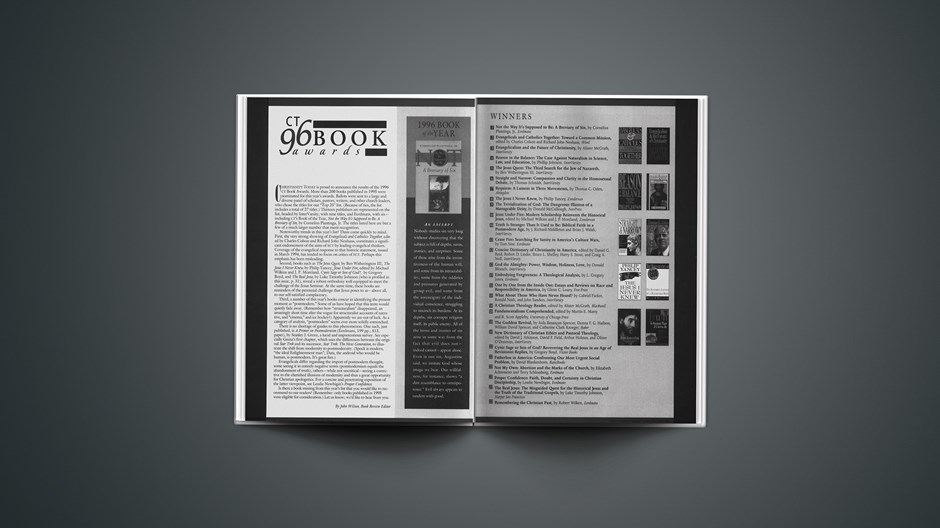
CHRISTIANITY TODAY is proud to announce the results of the 1996 CT Book Awards. More than 200 books published in 1995 were nominated for this year's awards. Ballots were sent to a large and diverse panel of scholars, pastors, writers, and other church leaders, who chose the titles for our "Top 25" list. (Because of ties, the list includes a total of 27 titles.) Thirteen publishers are represented on the list, headed by InterVarsity, with nine titles, and Eerdmans, with six--including CT's Book of the Year, "Not the Way It's Supposed to Be: A Breviary of Sin," by Cornelius Plantinga, Jr. The titles listed here are but a few of a much larger number that merit recognition.
Noteworthy trends in this year's list? Three come quickly to mind. First, the very strong showing of "Evangelicals and Catholics Together," edited by Charles Colson and Richard John Neuhaus, constitutes a significant endorsement of the aims of ECT by leading evangelical thinkers. Coverage of the evangelical response to that historic statement, issued in March 1994, has tended to focus on critics of ECT. Perhaps this emphasis has been misleading.
Second, books such as "The Jesus Quest," by Ben Witherington III, "The Jesus I Never Knew," by Philip Yancey, "Jesus Under Fire," edited by Michael Wilkins and J. P. Moreland, "Cynic Sage or Son of God?," by Gregory Boyd, and "The Real Jesus," by Luke Timothy Johnson (who is profiled in this issue), reveal a robust orthodoxy well equipped to meet the challenge of the Jesus Seminar. At the same time, these books are reminders of the perennial challenge that Jesus poses to us--above all, to our self-satisfied complacency.
Third, a number of this year's books concur in identifying the present moment as "postmodern." Some of us have hoped that this term would quietly fade away. (Remember how "structuralism" disappeared, an amazingly short time after the vogue for structuralist accounts of narrative, and "cinema," and ice hockey?) Apparently we are out of luck. As a category of analysis, "postmodern" seems ever more solidly entrenched.
There is no shortage of guides to this phenomenon. One such, just published, is "A Primer on Postmodernism" (Eerdmans, 199 pp.; $13, paper), by Stanley J. Grenz, a lucid and unpretentious survey. See especially Grenz's first chapter, which uses the differences between the original "Star Trek" and its successor, "Star Trek: The Next Generation," to illustrate the shift from modernity to postmodernity. (Spock is modern, "the ideal Enlightenment man"; Data, the android who would be human, is postmodern. It's great fun.)
Evangelicals differ regarding the import of postmodern thought, some seeing it in entirely negative terms (postmodernism equals the abandonment of truth), others--while not uncritical--seeing a corrective to the cherished illusions of modernity and thus a great opportunity for Christian apologetics. For a concise and penetrating exposition of the latter viewpoint, see Lesslie Newbigin's "Proper Confidence."
Is there a book missing from this year's list that you would like to recommend to our readers? (Remember: only books published in 1995 were eligible for consideration.) Let us know; we'd like to hear from you.
1996 BOOK OF THE YEAR
"Not the Way It's Supposed to Be: A Breviary of Sin"
by Cornelius Plantinga, Jr.
An excerpt
Nobody studies sin very long without discovering that the subject is full of depths, turns, ironies, and surprises. Some of these arise from the inventiveness of the human will, and some from its intractability; some from the oddities and pressures generated by group evil, and some from the sovereignty of the individual conscience, struggling to uncinch its burdens. At its depths, sin corrupts religion itself, its public enemy. All of the turns and ironies of sin arise in some way from the fact that evil does not--indeed cannot--appear alone. Even in our sin, Augustine said, we imitate God whose image we bear. Our willfulness, for instance, shows "a dim resemblance to omnipotence." Evil always appears in tandem with good.
WINNERS
1. "Not the Way It's Supposed to Be: A Breviary of Sin," by Cornelius Plantinga, Jr., Eerdmans
2. "Evangelicals and Catholics Together: Toward a Common Mission," edited by Charles Colson and Richard John Neuhaus, Word
3. "Evangelicalism and the Future of Christianity," by Alister McGrath, InterVarsity
4. "Reason in the Balance: The Case Against Naturalism in Science, Law, and Education," by Phillip Johnson, InterVarsity
5. "The Jesus Quest: The Third Search for the Jew of Nazareth," by Ben Witherington III, InterVarsity
6. "Straight and Narrow: Compassion and Clarity in the Homosexual Debate," by Thomas Schmidt, InterVarsity
7. "Requiem: A Lament in Three Movements," by Thomas C. Oden, Abingdon
8. "The Jesus I Never Knew," by Philip Yancey, Zondervan
9. "The Trivialization of God: The Dangerous Illusion of a Manageable Deity," by Donald McCullough, NavPress
10. "Jesus Under Fire: Modern Scholarship Reinvents the Historical Jesus," edited by Michael Wilkins and J. P. Moreland, Zondervan
Article continues below
10. "Truth Is Stranger Than It Used to Be: Biblical Faith in a Postmodern Age," by J. Richard Middleton and Brian J. Walsh, InterVarsity
12. "Cease Fire: Searching for Sanity in America's Culture Wars," by Tom Sine, Eerdmans
12. "Concise Dictionary of Christianity in America," edited by Daniel G. Reid, Robert D. Linder, Bruce L. Shelley, Harry S. Stout, and Craig A. Noll, InterVarsity
12. "God the Almighty: Power, Wisdom, Holiness, Love," by Donald Bloesch, InterVarsity
15. "Embodying Forgiveness: A Theological Analysis," by L. Gregory Jones, Eerdmans
15. "One by One from the Inside Out: Essays and Reviews on Race and Responsibility in America," by Glenn C. Loury, Free Press
15. "What About Those Who Have Never Heard?" by Gabriel Fackre, Ronald Nash, and John Sanders, InterVarsity
18. "A Christian Theology Reader," edited by Alister McGrath, Blackwell
18. "Fundamentalisms Comprehended," edited by Martin E. Marty and R. Scott Appleby, University of Chicago Press
18. "The Goddess Revival," by Aida Besancon Spencer, Donna F. G. Hailson, William David Spencer, and Catherine Clark Kroeger, Baker
18. "New Dictionary of Christian Ethics and Pastoral Theology," edited by David J. Atkinson, David F. Field, Arthur Holmes, and Oliver O'Donovan, InterVarsity
22. "Cynic Sage or Son of God? Recovering the Real Jesus in an Age of Revisionist Replies," by Gregory Boyd, Victor Books
22. "Fatherless in America: Confronting Our Most Urgent Social Problem," by David Blankenhorn, BasicBooks
22. "Not My Own: Abortion and the Marks of the Church," by Elizabeth Achtemeier and Terry Schlossberg, Eerdmans
22. "Proper Confidence: Faith, Doubt, and Certainty in Christian Discipleship," by Lesslie Newbigin, Eerdmans
22. "The Real Jesus: The Misguided Quest for the Historical Jesus and the Truth of the Traditional Gospels," by Luke Timothy Johnson, Harper San Francisco
22. "Remembering the Christian Past," by Robert Wilken, Eerdmans
Migrant rights have been off-radar for many Panamanian Christians. But as pressures increase, some are speaking out ahead of this weekend’s general elections.
















 While we pray for peace, we need moral clarity about this war.
 But let’s not mistake it for calling.
 Migrant rights have been off-radar for many Panamanian Christians. But as pressures increase, some are speaking out ahead of this weekend’s general elections.español