"Religion and Politics in America: Faith, Culture, and Strategic Choices," by Robert Booth Fowler and Allen D. Hertzke (Westview Press, 287 pp.; $55, hardcover; $18.95, paper).
"On the Eve of the Millennium: The Future of Democracy Through an Age of Unreason," by Conor Cruise O'Brien (Free Press, 167 pp.; $12, paper).
"Political Religion: A Liberal Answers the Question, 'Should Politics and Religion Mix?' " by Charles R. Stith (Abingdon, 160 pp.; $14.95, paper).
"Saints as Citizens: A Guide to Public Responsibilities for Christians," by Timothy R. Sherratt and Ronald P. Mahurin (Baker/ Center for Public Justice, 123 pp.; $7.99, paper).
"Building a Community of Citizens: Civil Society in the Twenty-first Century," ed. by Don E. Eberly (University Press of America/Commonwealth Foundation, 376 pp.; $75, hardcover; $29.50, paper).
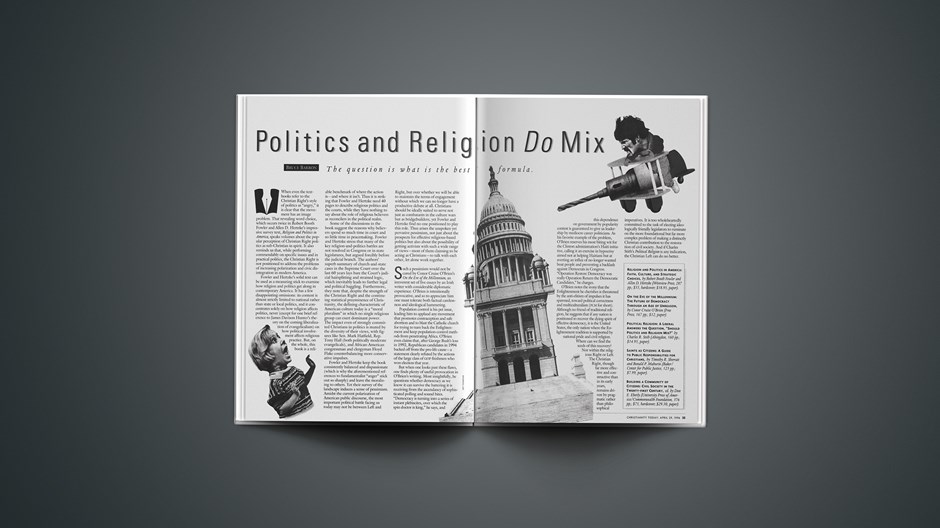
When even the textbooks refer to the Christian Right's style of politics as "angry," it is clear that the movement has an image problem. That revealing word choice, which occurs twice in Robert Booth Fowler and Allen D. Hertzke's impressive survey text, "Religion and Politics in America," speaks volumes about the popular perception of Christian Right politics as sub-Christian in spirit. It also reminds us that, while performing commendably on specific issues and in practical politics, the Christian Right is not positioned to address the problems of increasing polarization and civic disintegration in modern America.
Fowler and Hertzke's solid text can be used as a measuring stick to examine how religion and politics get along in contemporary America. It has a few disappointing omissions: its content is almost strictly limited to national rather than state or local politics, and it concentrates solely on how religion affects politics, never (except for one brief reference to James Davison Hunter's theory on the coming liberalization of evangelicalism) on how political involvement affects religious practice. But, on the whole, this book is a reliable benchmark of where the action is--and where it isn't. Thus it is striking that Fowler and Hertzke need 40 pages to describe religious politics and the courts, while they have nothing to say about the role of religious believers as reconcilers in the political realm.
Some of the discussions in the book suggest the reasons why believers spend so much time in court and so little time in peacemaking. Fowler and Hertzke stress that many of the key religion-and-politics battles are not resolved in Congress or in state legislatures, but argued forcibly before the judicial branch. The authors' superb summary of church-and-state cases in the Supreme Court over the last 60 years lays bare the Court's judicial hairsplitting and strained logic, which inevitably leads to further legal and political haggling. Furthermore, they note that, despite the strength of the Christian Right and the continuing statistical preeminence of Christianity, the defining characteristic of American culture today is a "moral pluralism" in which no single religious group can exert dominant power.
The impact even of strongly committed Christians in politics is muted by the diversity of their views, with figures like Sen. Mark Hatfield, Rep. Tony Hall (both politically moderate evangelicals), and African-American congressman and clergyman Floyd Flake counterbalancing more conservative impulses.
Fowler and Hertzke keep the book consistently balanced and dispassionate (which is why the aforementioned references to fundamentalist "anger" stick out so sharply) and leave the moralizing to others. Yet their survey of the landscape induces a sense of pessimism. Amidst the current polarization of American public discourse, the most important political battle facing us today may not be between Left and Right, but over whether we will be able to maintain the terms of engagement without which we can no longer have a productive debate at all. Christians should be ideally suited to serve not just as combatants in the culture wars but as bridgebuilders; yet Fowler and Hertzke find no one positioned to play this role. Thus arises the unspoken yet pervasive pessimism, not just about the prospects for effective religious-based politics but also about the possibility of getting activists with such a wide range of views--most of them claiming to be acting as Christians--to talk with each other, let alone work together.
Such a pessimism would not be cured by Conor Cruise O'Brien's "On the Eve of the Millennium," an irreverent set of five essays by an Irish writer with considerable diplomatic experience. O'Brien is intentionally provocative, and so to appreciate him one must tolerate both factual carelessness and ideological hammering.
Population control is his pet issue, leading him to applaud any movement that promotes contraception and safe abortion and to blast the Catholic church for trying to turn back the Enlightenment and keep population-control methods from penetrating Africa. O'Brien even claims that, after George Bush's loss in 1992, Republican candidates in 1994 backed off from the pro-life cause--a statement clearly refuted by the actions of the large class of GOP freshmen who won election that year.
Article continues below
But when one looks past these flaws, one finds plenty of useful provocation in O'Brien's writing. Most insightfully, he questions whether democracy as we know it can survive the battering it is receiving from the ascendancy of sophisticated polling and sound bites. "Democracy is turning into a series of instant plebiscites, over which the spin doctor is king," he says, and this dependence on government by popularity contest is guaranteed to give us leadership by mediocre career politicians. As his favorite example of the problem, O'Brien reserves his most biting wit for the Clinton administration's Haiti initiative, calling it an exercise in hypocrisy aimed not at helping Haitians but at averting an influx of no-longer-wanted boat people and preventing a backlash against Democrats in Congress. "Operation Restore Democracy was really Operation Return the Democratic Candidates," he charges.
O'Brien notes the irony that the Enlightenment he cherishes is threatened by the anti-elitism of impulses it has spawned, toward political correctness and multiculturalism (PCM for short). Although no friend of traditional religion, he suggests that if any nation is positioned to recover the dying spirit of effective democracy, it is the United States, the only nation where the Enlightenment tradition is supported by national pride and civil religion.
Where can we find the seeds of this recovery? Not within the religious Right or Left. The Christian Right, though far more effective and constructive than in its early years, remains driven by pragmatic rather than philosophical imperatives. It is too wholeheartedly committed to the task of electing ideologically friendly legislators to ruminate on the more foundational but far more complex problem of making a distinctly Christian contribution to the restoration of civil society. And if Charles Stith's "Political Religion" is any indication, the Christian Left can do no better.
Stith, a Methodist minister and self-described liberal, agrees with the Christian Right that the issue is not whether religion and politics should mix--of course, they should--but how. Unfortunately, Stith exemplifies the cynical definition of a liberal as someone who is tolerant of everyone except conservatives. This stance is particularly ironic because he urges Christians to pursue "the politics of consensus" and says Christian politics should be marked by a spirit of reconciliation. Stith discusses consensus-building with Hispanics, Jews, and women, but he has no time for dialogue with the Christian Right, which he dismisses as a movement "predicated on outdated precepts" and "defined by conflict rather than reconciliation."
Article continues below
The Christian Right needs to be challenged by thoughtful arguments from fellow believers of more liberal political leanings. However, not only does Stith close the door to reconciliation between the Christian Right and Left, but his arguments are shallow and often unfounded rather than thoughtful. He trots out, with no documentation, the tiresome claim that Pat Robertson's style of politics "would result in the obfuscation of the line between church and state." Faulting conservatives for opposing sex education, he makes the dubious claim that "studies" (he cites none) show that sex education reduces teen pregnancy and promiscuity. And he simply asserts, without any acknowledgment of or engagement with opposing views, that Christian principles of equality should lead to support for the era and gay rights.
Politically conservative Christians ought to read this book simply to understand better what liberals think of them and what misconceptions they must dispel. Admittedly, a conservative who reads Stith will feel as if he or she stumbled into the wrong sanctuary while Stith was preaching to the choir. But maybe that is an experience all of us need once in a while to keep us from being satisfied with preaching to our own political choirs.
Why is the Christian Right, as the dominant form of American evangelical political engagement, having such a hard time communicating an effective Christian message to the broader culture? In "Saints as Citizens," Timothy Sherratt and Ronald Mahurin, both professors of political science at Gordon College, have pinpointed the primary answer: evangelicals "do their politics piecemeal, on an issue-by-issue basis." As a result, they are reactive, playing by rules others have set and never grounding their action on identifiably Christian principles.
Having diagnosed the prevalent lack of adequate philosophical reflection, Sherratt and Mahurin proceed to overreact somewhat. They spend nearly half their 120-page book reflecting on the Christian as sojourner and citizen, the nature of the kingdom of God, and the concept of church, providing an excellent theological refresher that made me feel I was retaking my Ph.D. comprehensive exams. They then admit frankly, "This handbook on politics has taken up three chapters without getting close to the subject, or so it must seem." Indeed. This weakness would be less glaring had Sherratt and Mahurin discussed more fully not just why the type of reflection they recommend is necessary, but how it might prove to be productive. They acknowledge that realists and pragmatists will object to the complexity of their project, and they point to Britain's Movement for Christian Democracy as a real-life example of theologically grounded politics. But on the whole, in my judgment, their proposal is too demanding; it expects more theological preparation, with less clarity of destination, than the impatient, pragmatic, beleaguered American church will tolerate.
Article continues below
Perhaps we could find a compromise, combining pieces of Sherratt and Mahurin's reflectiveness with the growing resources of Christian practical expertise to create a movement more Christian in both style and content than any of the current options. But perhaps, as Don Eberly boldly suggests, the problem is not that we are doing politics badly, but that we are doing it at all.
As a former White House aide, Eberly speaks from experience when he says "politics has been oversold." In his probing introduction to "Building a Community of Citizens," he continues his argument (previously presented in his book Restoring the Good Society) that America's crying need is for civic and cultural renewal, a reshaping of the habits of our hearts that no politics, whether conservative or liberal, can reach. Polarization is the enemy of this civic renewal, Eberly suggests, and he even hints indirectly that political movements like the Christian Right may be part of the problem: "Attempts to restore declining cultural values and order through power often only provoke and exacerbate the conflict."
Eberly's paradigm has one major problem of its own: it is hardly apolitical. He stresses the breadth of consensus in support of the values of "civil society," such as self-government, family stability, and mutual respect, but the contributors to his volume range generally from Right to center, not Right to Left. Many of them urge, as one contributor puts it bluntly, "the dramatic decentralization of power and accountability away from the centralized, bureaucratic 'Nanny state' in Washington." But this is not a plank on which to build a new social consensus; rather, it is precisely the root of the intense debate that has produced a partial shutdown of the federal government.
Article continues below
The residual political component of Eberly's paradigm limits its potential as a basis of society-wide consensus. But the paralyzing level of political polarization we experienced in 1995 and continue to face in 1996 makes Eberly's core concern for rebuilding civil society timelier than ever.
A Christian role in restoring civil society would mean not just energetic participation in the voluntary organizations (families, churches, nonprofits) that communicate the essential values of citizenship; we already do plenty of that. It would also mean taking the leadership in restoring a civil form of public discourse, encouraging the sort of reasoned, respectful discussion that divisive political campaigns, governed by the lure of negative advertising, seldom produce. This is no pie-in-the-sky goal; on the contrary, it is achievable wherever we perceive the need for a thoughtful forum for dialogue and step forward to assemble the pieces that can make one happen. As founder of the National Fatherhood Initiative, Eberly has given us a practical example to follow along with a philosophy.
Compare the core value statements promulgated by conservative evangelicals and the liberal Children's Defense Fund, and you will find that their widely noted divergence in political proposals masks a significant convergence in shared concerns. Maybe, as we capitalize on the areas of convergence and seek to bring people of all political persuasions to the same table, we will find that they too are crying out with needs that can be solved not by politics, but only by religion. And maybe we Christians will become known more as the reconcilers rather than as the angry ones.
******************
Bruce Barron was for four years an aide to Congressman (now Senator) Rick Santorum, R-Pa. His book "Politics for the People," a guide to politics for the average reader, has just been released by InterVarsity.















 While we pray for peace, we need moral clarity about this war.
 Church movements need magnetic leaders. But the best leaders need more than charm.
 After this week’s UMC votes on LGBTQ issues, African Methodists should join American conservatives in the new Global Methodist denomination.