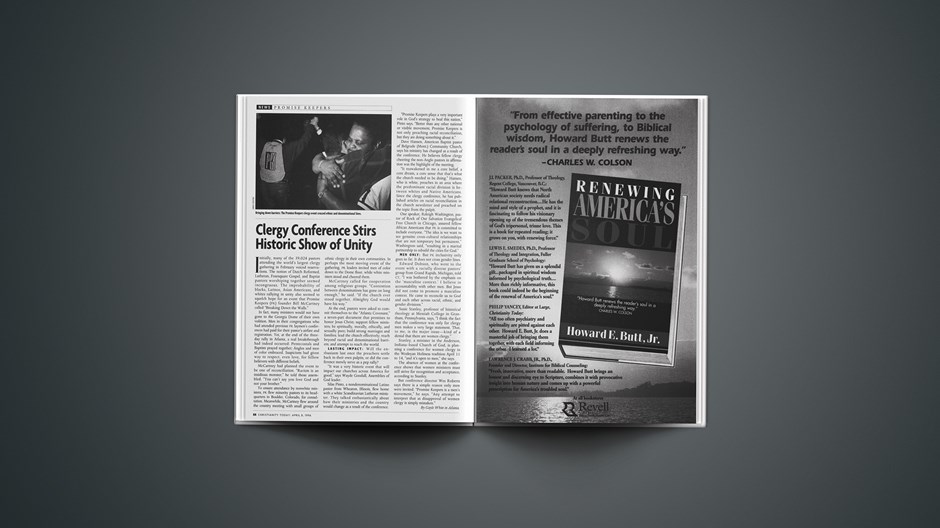
Initially, many of the 39,024 pastors attending the world's largest clergy gathering in February voiced reservations. The notion of Dutch Reformed, Lutheran, Foursquare Gospel, and Baptist pastors worshiping together seemed incongruous. The improbability of blacks, Latinos, Asian Americans, and whites rallying in unity also seemed to squelch hope for an event that Promise Keepers (PK) founder Bill McCartney called "Breaking Down the Walls."
In fact, many ministers would not have gone to the Georgia Dome of their own volition. Men in their congregations who had attended previous PK laymen's conferences had paid for their pastor's airfare and registration. Yet, at the end of the three-day rally in Atlanta, a real breakthrough had indeed occurred: Pentecostals and Baptists prayed together; Anglos and men of color embraced. Suspicions had given way to respect, even love, for fellow believers with different beliefs.
McCartney had planned the event to be one of reconciliation. "Racism is an insidious monster," he told those assembled. "You can't say you love God and not your brother."
To ensure attendance by nonwhite ministers, PK flew minority pastors to its headquarters in Boulder, Colorado, for consultation. Meanwhile, McCartney flew around the country meeting with small groups of ethnic clergy in their own communities. In perhaps the most moving event of the gathering, PK leaders invited men of color down to the Dome floor, while white ministers stood and cheered them.
McCartney called for cooperation among religious groups. "Contention between denominations has gone on long enough," he said. "If the church ever stood together, Almighty God would have his way."
At the end, pastors were asked to commit themselves to the "Atlanta Covenant," a seven-part document that promises to honor Jesus Christ; support fellow ministers; be spiritually, morally, ethically, and sexually pure; build strong marriages and families; lead the church effectively; reach beyond racial and denominational barriers; and attempt to reach the world.
LASTING IMPACT: Will the enthusiasm last once the preachers settle back in their own pulpits, or did the conference merely serve as a pep rally?
"It was a very historic event that will impact our churches across America for good," says Wayde Goodall, Assemblies of God leader.
Silas Pinto, a nondenominational Latino pastor from Wheaton, Illinois, flew home with a white Scandinavian Lutheran minister. They talked enthusiastically about how their ministries and the country would change as a result of the conference.
"Promise Keepers plays a very important role in God's strategy to heal this nation," Pinto says. "Better than any other national or visible movement, Promise Keepers is not only preaching racial reconciliation, but they are doing something about it."
Dave Hansen, American Baptist pastor of Belgrade (Mont.) Community Church, says his ministry has changed as a result of the conference. He believes fellow clergy cheering the non-Anglo pastors in affirmation was the highlight of the meeting.
"It reawakened in me a core belief, a core dream, a core sense that that's what the church needed to be doing." Hansen, who is white, preaches in an area where the predominant racial division is between whites and Native Americans. Since the clergy conference, he has published articles on racial reconciliation in the church newsletter and preached on the topic from the pulpit.
One speaker, Raleigh Washington, pastor of Rock of Our Salvation Evangelical Free Church in Chicago, assured fellow African Americans that PK is committed to include everyone. "The idea is we want to see genuine cross-cultural relationships that are not temporary but permanent," Washington said, "resulting in a marital partnership to rebuild the cities for God."
MEN ONLY: But PK inclusivity only goes so far. It does not cross gender lines.
Edward Dobson, who went to the event with a racially diverse pastors' group from Grand Rapids, Michigan, told CT, "I was bothered by the emphasis on the 'masculine context.' I believe in accountability with other men. But Jesus did not come to promote a masculine context. He came to reconcile us to God and each other across racial, ethnic, and gender divisions."
Susie Stanley, professor of historical theology at Messiah College in Grantham, Pennsylvania, says, "I think the fact that the conference was only for clergy men makes a very large statement. That, to me, is the major issue—kind of a denial that there are women clergy."
Stanley, a minister in the Anderson, Indiana-based Church of God, is planning a conference for women clergy in the Wesleyan Holiness tradition April 11 to 14, "and it's open to men," she says.
The absence of women at the conference shows that women ministers must still strive for recognition and acceptance, according to Stanley.
But conference director Wes Roberts says there is a simple reason only men were invited. "Promise Keepers is a men's movement," he says. "Any attempt to interpret that as disapproval of women clergy is simply mistaken."















 While we pray for peace, we need moral clarity about this war.
 As my doubts about his teachings grew, so did a secret fascination with Jesus.
 The plan would organize UMC churches in four global regions, with each given more leeway around same-sex marriage and other theological issues.






