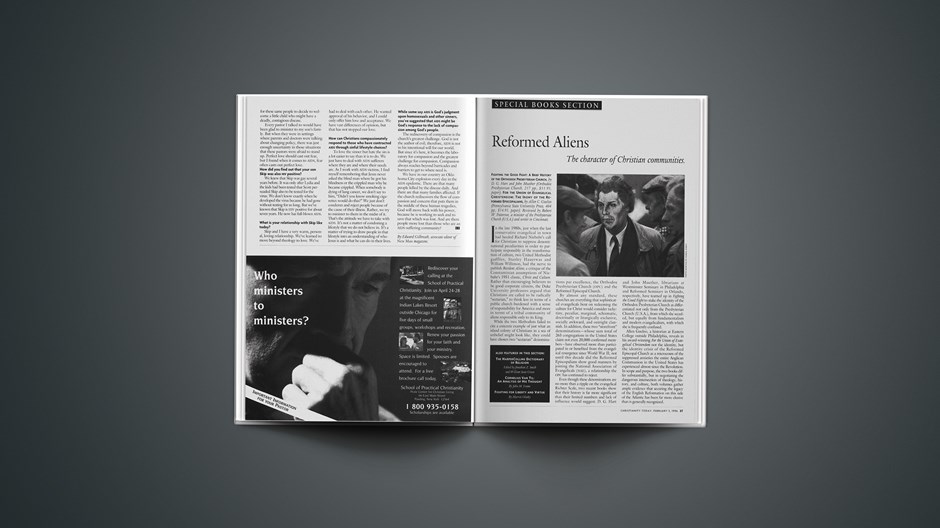
"Fighting the Good Fight: A Brief History of the Orthodox Presbyterian Church," by D. G. Hart and John Muether (Orthodox Presbyterian Church, 217 pp.; $11.95, paper); "For the Union of Evangelical Christendom: The Irony of the Reformed Episcopalians," by Allen C. Guelzo (Pennsylvania State University Press, 404 pp.; $14.95, paper). Reviewed by Robert W. Patterson, a minister of the Presbyterian Church (U.S.A.) and writer in Cincinnati.
In the late 1980s, just when the last conservative evangelical in town had heeded Richard Niebuhr's call for Christians to suppress denominational peculiarities in order to participate responsibly in the transformation of culture, two United Methodist gadflies, Stanley Hauerwas and William Willimon, had the nerve to publish Resident Aliens, a critique of the Constantinian assumptions of Niebuhr's 1951 classic, "Christ and Culture." Rather than encouraging believers to be good corporate citizens, the Duke University professors argued that Christians are called to be radically "sectarian," to think less in terms of a public church burdened with a sense of responsibility for America and more in terms of a tribal community of aliens responsible only to its King.
While the two Methodists failed to cite a concrete example of just what an island colony of Christians in a sea of unbelief might look like, they could have chosen two "sectarian" denominations par excellence, the Orthodox Presbyterian Church (OPC) and the Reformed Episcopal Church.
By almost any standard, these churches are everything that sophisticated evangelicals bent on redeeming the culture for Christ would consider tacky: tiny, peculiar, marginal, schismatic, doctrinally or liturgically exclusive, socially awkward, and outright clannish. In addition, these two "storefront" denominations--whose sum total of 263 congregations in the United States claim not even 20,000 confirmed members--have observed more than participated in or benefited from the evangelical resurgence since World War II; not until this decade did the Reformed Episcopalians show good manners by joining the National Association of Evangelicals (NAE), a relationship the OPC has continued to reject.
Even though these denominations are no more than a ripple on the evangelical Richter Scale, two recent books show that their history is far more significant than their limited numbers and lack of influence would suggest. D. G. Hart and John Muether, librarians at Westminster Seminary in Philadelphia and Reformed Seminary in Orlando, respectively, have teamed up in "Fighting the Good Figh"t to stake the identity of the Orthodox Presbyterian Church as differentiated not only from the Presbyterian Church (U.S.A.), from which she seceded, but equally from fundamentalism and modern evangelicalism, with which she is frequently confused.
Allen Guelzo, a historian at Eastern College outside Philadelphia, reveals in his award-winning "For the Union of Evangelical Christendom" not the identity, but the identity crisis of the Reformed Episcopal Church as a microcosm of the suppressed anxieties the entire Anglican Communion in the United States has experienced almost since the Revolution. In scope and purpose, the two books differ substantially, but in negotiating the dangerous intersection of theology, history, and culture, both volumes gather ample evidence that securing the legacy of the English Reformation on this side of the Atlantic has been far more elusive than is generally recognized.
While "Fighting the Good Fight" was written and published by Orthodox Presbyterians for in-house use, evangelicals should find some kinship with Hart and Muether, whose narrative opens with the northern Presbyterian crisis of the 1920s and 1930s, the watershed event in American church history from which the modern evangelical movement sprung. Central to that crisis was J. Gresham Machen, whose impact Hart has considered at book-length in "Defending the Faith: J. Gresham Machen and the Crisis of Conservative Protestantism in Modern America" (CT, Nov. 14, 1994, p. 98). In a corrective to popular, ecclesiastical, and scholarly prejudice, Hart and Muether portray Machen neither as a fundamentalist nor as an evangelical. He was a traditional, confessional Presbyterian with "Old School" sympathies reflective of the old Princeton Theological Seminary, where he taught for nearly 20 years.
Unlike "New School" Presbyterians, who in the nineteenth century were simply pragmatic evangelicals, the Old Schoolers were precisionists in theology, ministry, and polity. As the writing team puts it, the latter were "sticklers over the niceties of grammar" while the former tolerated slang. As protectors of the King's English, they valued strict subscription to the Westminster Confession, opposing, like good sectarians, church union schemes that called for doctrinal concessions in the name of national influence. The Old Schoolers preferred the institutional church and her sacraments over parachurch organizations, revivalism, and decisionism. Furthermore, in guarding the "spirituality of the church," they were content to leave the transformation of culture in the hands of Providence instead of Christian activists and social reformers.
Article continues below
The authors argue that his Old School "sectarianism" is what led Machen into hot water with the Presbyterian church, first at Princeton and then with the Independent Board of Foreign Missions, culminating in the establishment of Westminster Theological Seminary, his trial and suspension from the ministry, and the founding of a new church. Conceding that Machen shared with fundamentalists opposition to theological liberalism--but for theological and ecclesiastical, not cultural, reasons--they reveal that Machen's ecclesiastical adversaries were not so much liberals as good-old-boy, New School evangelicals who feared that Machen's "sectarianism" threatened the formal unity of the Presbyterian Church and thus what they perceived as her influence on American society.
The rest of this self-described "primer in Orthodox Presbyterian grammar" chronicles how Machen's vision would prevail in the new denomination even though its Moses died six months after leading the exodus out of Egypt. In chapters probing conflicts with Carl McIntire and Gordon Clark, responses to invitations to join the NAE and the Presbyterian Church in America, and deliberations concerning Higher Life teaching, charismatic experience, and theonomy, Hart and Muether illustrate how Machen's descendants have vigorously and judiciously continued fighting the good fight for the King's English. That vigilance also allowed, they claim, Old School convictions more than evangelical pragmatism to shape the OPC's distinctive approach to worship, Christian education, and missions.
Perhaps nothing represents the Orthodox Presbyterian Church turned inside out more than the Reformed Episcopal Church, at least as she was founded in New York in 1873. As the very title of Allen Guelzo's For the Union of Evangelical Christendom suggests, this nineteenth-century effort was essentially a grand ecumenical proposal. Protesting the sectarian exclusiveness, "smells and bells" liturgy, and influence of Anglo-Catholics in the Episcopal Church, the Reformed Episcopalians did not simply charter a club for themselves; they opened an ecclesiastical umbrella and invited all evangelical denominations to join them, in hopes, Guelzo argues, of reversing the decline of Protestant cultural hegemony in post-Civil War America. Viewed through a Presbyterian lens, Reformed Episcopalians were New Schoolers through and through; their plans for federations or church unions would be a nemesis of Machen a half-century later.
Article continues below
Reflecting its academic orientation, Guelzo's detailed study is more comprehensive than Hart and Muether's, not merely rescuing the Reformed Episcopalians from near oblivion, but bridging a historiographical canyon with a fresh and compelling interpretation of American Episcopalianism. Delving into the nooks and crannies of the endless Anglican search for identity in a land without a king, the professor highlights the sudden displacement of evangelicals--who, via the Second Great Awakening and through an accommodation to republican values, had revitalized a church that was in disarray at the end of the American Revolution--by Anglo-Catholics in the midnineteenth century.
Guelzo illustrates how personal that displacement became after the Civil War: the admonition of a second-generation New Jersey rector for preaching in a Methodist church; the disposition, for revising the Book of Common Prayer, of a gifted Chicago preacher who had built a large parish from scratch; and the censure of the assistant bishop of Kentucky, George David Cummins, for presiding at an ecumenical Communion service for the Evangelical Alliance in New York in 1873. That final blow triggered the bishop to resign and, with residual authority, to empower the founding of the Reformed Episcopal Church along the lines of an aborted 1854 evangelical proposal to transform the Episcopal Church into an ecclesiastical republic embracing other evangelical churches and clergy.
The ecumenical call to arms did not strike a responsive chord. In contrast to the Orthodox Presbyterians, the new-breed Episcopalians within the first generation essentially dethroned their beloved bishop's charter vision in a struggle over identity they thought they had resolved. As Guelzo puts it, "in their effort of 1873 to escape the contradictions of Anglicanism, the Reformed Episcopalians only transposed them to an Evangelical key." Unsure how to play the apostolic succession card--to which they had every right under Episcopal law--and perplexed in general about the place of Anglican peculiarities in a pragmatic society, the new church found herself in no man's land: too American for proper Anglicans and too Anglican for good Americans.
Article continues below
Even as the confederate church played a leading public role in the Federal Council of Churches, Guelzo documents her internal floundering in more ways than numerical as the church took on the ethos of a fundamentalist voluntary society grooming presidents of Moody Bible Institute (James Gray and Bishop William Culbertson), Bible prophecy conference regulars like Arno Gaebelein, and editors of the Scofield Reference Bible (Gaebelein and Gray). The author's lesson: the Reformed Episcopalians, every bit as much as the Anglo-Catholics, failed in their attempt to "fend away the shrinking walls of the house occupied by religion in the Victorian world."
Differences in vision and destiny cannot, however, undo the ties that bind the Reformed Episcopal and Orthodox Presbyterian churches, beginning with Philadelphia. Both ecclesiastical experiments are centered in that historic city, perhaps stemming from the influence of their respective seminaries there; the opc was even born in the sanctuary of a Reformed Episcopal church in Philadelphia. Both represent ecclesiastical secessions on Northern soil forged by Southerners raised in Baltimore. Both began with great expectations of displacing, or at least rivaling, the established church that were quickly dashed by a number of identical factors: the relatively early deaths of their leaders (Cummins and Machen both passed away in their midfifties) shortly after secession; discord among secessionists themselves; retaliatory tactics of the denominations from which they withdrew; and abandonment by friends and allies who stayed with the mother church. And both married down, attracting a class of members a few rungs lower on the social ladder than their parents.
Guelzo may look upon the church of which he is a priest with reservations and perhaps as a tragedy in Episcopal history, but Hart and Muether are big on the virtues of Orthodox Presbyterianism. Not that they trumpet the denomination of which they are lay elders, but these librarians admirably catalog the "failures" of their movement as blessings in disguise, enabling Presbyterianism, as they understand it, to be practiced free of the baggage it has accumulated in the United States. Taking a quotation from Mark Noll, a former Orthodox Presbyterian, they are satisfied that their church "has not sold its soul to theological fashion or to the allure of wealth, power, and influence."
Some readers will detect an implied equation between purity and lack of measurable success. Is this a prophetic witness, or merely sour grapes? The stories told so well by Guelzo, Hart, and Muether leave us with much to ponder about the ways of being Christian in America.















 While we pray for peace, we need moral clarity about this war.
 Alcoholism among women is rising. Can the church help?
 Drake and Kendrick Lamar’s rivalry reveals our craving for controversy—and what’s lost when community is based on shared hatred, not love.