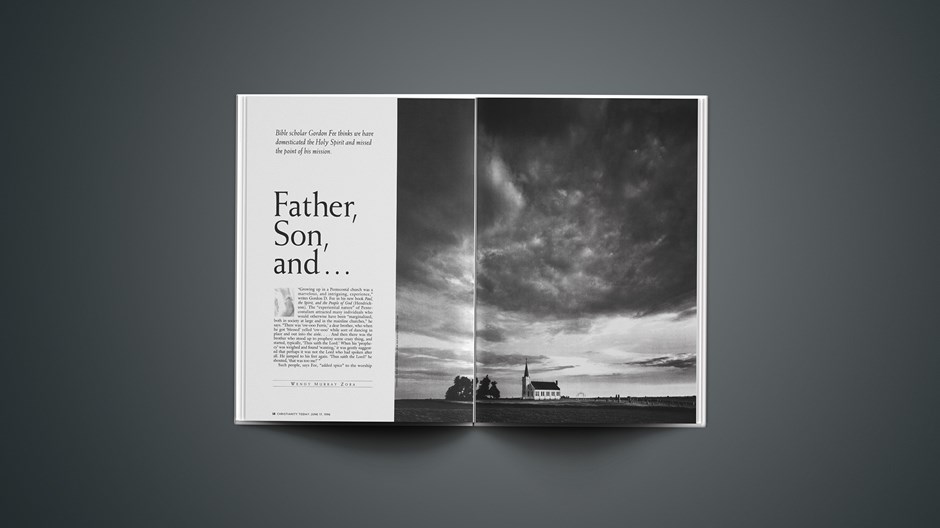
“Growing up in a Pentecostal church was a marvelous, and intriguing, experience,” writes Gordon D. Fee in his new book Paul, the Spirit, and the People of God (Hendrickson). The “experiential nature” of Pentecostalism attracted many individuals who would otherwise have been “marginalized, both in society at large and in the mainline churches,” he says. “There was ‘ow-ooo Ferris,’ a dear brother, who when he got ‘blessed’ yelled ‘ow-ooo’ while sort of dancing in place and out into the aisle. … And then there was the brother who stood up to prophesy some crazy thing, and started, typically, ‘Thus saith the Lord.’ When his ‘prophecy’ was weighed and found ‘wanting,’ it was gently suggested that perhaps it was not the Lord who had spoken after all. He jumped to his feet again. ‘Thus saith the Lord!’ he shouted, ‘that was too me!’”
Such people, says Fee, “added spice” to the worship environment. Spice, however, is not necessarily what churches are looking for in gathered worship. Harvard divinity professor Harvey Cox wrote in a recent article in the Atlantic Monthly (Nov. 1995) that evangelicals who “take their Calvin straight” become skittish at the “sometimes chaotic and unpredictable spirituality of Pentecostals” and that, conversely, some Pentecostals and charismatics bridle at being identified with “cold, rigid, and insufficiently spontaneous” forms of evangelicalism.
This theological tug-of-war has broken out most recently with the brouhaha associated with the Toronto Airport Christian Fellowship. This surprising “revival” has reinvigorated the discussion of how the Holy Spirit visits us. Does he roar? Does he bark? John Wimber—no dissuader of the miraculous—says no, and he dissociated the Toronto church from the Vineyard association. On another front, last spring the Southern Baptist Florida convention recommended that membership credentials be denied to three congregations that affirmed the Toronto “laughing revival.” “You cannot just believe anything or everything and be Baptist,” said the Florida Baptist executive director.
Well, if the Spirit does not bark, and if you cannot believe “anything or everything” about his operations, then how does the Holy Spirit show himself?
Gordon Fee, in his 1994 work God’s Empowering Presence (Hendrickson), answers that question on the basis of Paul’s letters. And the answer is: It is the wrong question. Rather than ask how the Spirit “shows himself,” the church instead should be asking how it shows itself and its witness to be Spirit driven. Fee concludes that the contemporary Western church, Pentecostal and non-Pentecostal, due to enculturation, is missing the point of the Spirit’s coming, and is therefore “quenching the Spirit,” marginalizing and domesticating him, and ultimately making the church’s witness ineffective.
“I do not mean that the Holy Spirit is not present; he is indeed, or we are not of Christ at all,” he writes. He is asserting, however, that Paul’s churches “had the better of it” and that the twentieth-century church should (“dare I say ‘must’ “) attempt to regain lost ground when it comes to living the Christian life in the Spirit.
God’s Empowering Presence
Decades of studying and teaching Paul, and writing commentaries about his letters, led Fee to believe that, when it comes to how Paul understood the role of the local body and how the church operates today, something is skewed. The concern boiled down to how churches understood the person and role of the Holy Spirit. The subject of the Holy Spirit, he noted, had been neglected by much of the academy, especially in Pauline studies. So he undertook an intensive study to search Paul out on these things. The result was the publication of the massive (nearly one thousand pages) God’s Empowering Presence—”a veritable tour de force,” says one reviewer. Another says that the book “is the sort of Pentecostal theology for which serious students of the Bible have been waiting,” since Fee, he says, comes “from a Pentecostal background” and yet is “a first-class scholar.”
Not being held hostage to his tradition, Fee rigorously scrutinizes the Pauline Spirit-material in his attempt to discern the mind of Paul on the role of the Spirit. This Pentecostal scholar has redefined the terms of the discussion about the Holy Spirit in a way that transcends today’s paradigm of “charismatic” or “noncharismatic” orientation. His words are a strong reminder of what God, through his Holy Spirit, intends the church to be.
The Missing Key
One fundamental feature of “Spirit-life” is absent from the churches today, says Fee, and because of its absence, other critical dimensions have been thrown off kilter. That key feature is the sense that “heaven” (not in a spatial sense but understood as a foretaste of a promised future), in all its wholeness, fullness, and beauty, has invaded planet Earth by means of the Spirit. The church is the arena in which that “heavenly invasion” plays itself out. This is not a plea to become “so heavenly minded that the church is no earthly good,” but exactly the opposite, says Fee.
Article continues below
Because the Spirit has “invaded” and has brought a new, forward-looking orientation to the empowered church, because its redemption is sealed and guaranteed, because God’s nature has “infected” human hearts, and because the very power that raised Jesus from the dead is accessible, the church should live differently—as “a colony of heaven.”
“We throw ourselves into the present, precisely because the future is already secured,” says Fee. Living righteously before one another, he says, is not a matter of “doing duties” but of “living the life of heaven now.”
“We are those,” Paul writes to the Corinthians (Fee’s translation), “upon whom the ends of the ages have come” (1 Cor. 10:11). The apostle reiterates this notion when he says that “if anyone is in Christ he is a new creation; the old has gone and the new has come” (2 Cor. 5:17).
Still, he says, the church “lives between the times.” “Heaven” had invaded and planted its flag by means of the cross of Christ. But the war is not over. That is why when Paul talks about Christ, salvation, and the church, he speaks both in terms of the present and the future: “We have been saved,” he writes to the Ephesians (2:8); but he also says we “are being saved” (1 Cor. 1:18) and that “we shall be saved” (Rom. 5:9).
The church lives within a “wonderful tension” of two contradictory realities—heaven and (fallen) earth. If this tension is “strung” too tightly, the church goes into “heavenly overdrive”—claiming too much, too fast, and usually for the wrong reasons. This is what happened at the church in Corinth: they went overboard in their sense of “all this and heaven too” (what Fee calls an “over-realized eschatology”). This was displayed in their proclivities toward immorality (a man taking his father’s wife, 1 Cor. 5) and selfish behavior (wives rejecting sexual relations with their husbands, 1 Cor. 7).
Article continues below
When this tension is too loose, however, the church’s vibrant witness falls flat. Rather than reflecting the rule of heaven, it resembles the reality of the world. That, says Fee, is what typically afflicts the contemporary Western church. The world, not heaven, “is too much with us.”
That is why Paul reprimands the Corinthians for trying to adjudicate grievances against one another in a pagan court (1 Cor. 6). He excoriates them: “Do you not know that the saints will judge the world … will judge angels?… The very fact that you have lawsuits means that you have been completely defeated already!” (vv. 2, 3, 7; all biblical references NIV).
“Paul is trying to tell them,” says Fee, “how stupid it is first to rip somebody off and then to redress the grievance by going to a pagan court!” They are “Spirit-people,” which means they play by the rules of heaven though in an earthly ball court.
Fee argues that contemporary churches, both “charismatic” and “noncharismatic,” do not live as those “whose lives here are determined by the coming age.” This is evident in the variety of subtle concessions that have “snuck up on” the church. Rather than jettison the values and strategies of modern culture, the church, he says, has “bought in to” the values that culture lifts up. So the church’s “heavenly tension” has become loose and fallen flat.
Fee advances a vision of the Holy Spirit’s role and function, as Paul understood it, that enables today’s churches to reassess. His is not a strategic plan for achieving “spiritual correctness” or an attempt to be iconoclastic. Rather, he highlights features in Paul’s writings that have been blurred by today’s cultural assumptions. His work is an attempt to point us back to the Bible and reinvigorate our own vision of how the Spirit mobilizes believers in the local church.
To introduce this new orientation, he says, “I would start with gathering the leadership, taking them away for three days and teaching them from the Scriptures about what it means to be the church. We would do it again in a few months and then we would begin to do it with the people themselves.”
Article continues below
His formidable book has been condensed into the more popular Paul, the Spirit, and the People of God, and in this article his thoughts have been abbreviated to five basic assertions.
1. The coming of the Spirit is God’s promise fulfilled: his presence returned to his people.
Fee explains that the coming of the Holy Spirit meant God had fulfilled what he promised Jeremiah and Ezekiel when he said, “I will make a new covenant with the house of Israel” (Jer. 31:31), and “I will put a new spirit in you” (Ezek. 36:26).
The “old arrangement,” under which God’s presence dwelt first in the tabernacle and later in the temple, proved unworkable for God’s people. God threatened to remove his presence when the wandering Jewish refugees bowed to the calf at Sinai. “Go up to the land flowing with milk and honey,” God said to Moses, “but I will not go with you” (Exod. 33:3). Moses pleaded, “If your presence does not go with us … what else will distinguish your people from all the other people on the face of the earth?” (vv. 15-16). In deference to Moses, God relented.
But more bad things happened. God ultimately said “enough” and removed his presence from the temple: “Then the glory of the Lord departed from over the threshold of the temple” (Ezek. 10:18).
His promise to Ezekiel that “these bones will indeed live. … I will put my Spirit in you” (chap. 37) is fleshed out for Paul in the context of the church: “Don’t you know that you are God’s temple? That God’s Spirit lives in you?” (1 Cor. 3:16). God kept his promise; his presence has returned to his temple. Only this time, you are it! You are his dwelling place. And for that very reason there must be no immorality among you: “God’s temple is sacred and you [plural, meaning the church] are that temple!” That, says Fee, distinguishes the church “from all the other people on the face of the earth.”
But today, it seems, the church has forgotten who it is. In the days of old when God’s presence filled the temple, “the priests could not perform their service because of the cloud” (1 Kings 8:10). When Moses came into God’s presence, he “hid his face” (Exod. 3:6); Elijah “pulled a cloak over his face” in God’s presence (1 Kings 19:13). Worshipers should come into God’s sanctuary—to borrow from Annie Dillard—with “crash helmets” donned in preparation to meet with the living God.
Article continues below
Today, however, when believers gather for worship, there is little sense of that awesomeness of God’s presence. In some liturgical settings kneeling is a gesture of awe, but, says Fee, “for most people it is simply rote.”
In worship, Fee says, “you should have this incredible sense of unworthiness—’I don’t really belong here’—coupled with the opposing sense of total joy—’It is all of grace, so I do belong here.’ What bothers me about some within the Pentecostal and charismatic tradition is the joy without reverence, without awe.” And in other Protestant traditions he believes that there is neither “reverence nor joy.”
In order to recapture that sense of the heaven-invasion, the contemporary church must first remember who it is—the dwelling place for God’s very presence.
2. Through the Spirit, God empowers his people in both ordinary and extraordinary ways.
Not only has God’s presence returned, but it is his empowering presence. God personally and dynamically engages his people as he communicates in perceivable, sometimes extraordinary, ways the very impulses of his heart and purpose. Writes Fee: “The living God is a God of power; and by the Spirit the power of the living God is present with us and for us.”
That means that in the church today—by the Spirit—one person may be given wisdom; another knowledge; another the ability to heal; another the ability to discern spirits (1 Cor. 12). It also means that, by the same Spirit, believers are strengthened in adversity and given great power and endurance (Col. 1:11). It means that Christians are able to rejoice in the face of suffering (Phil. 2) and live in such a way that they “will not gratify the desires of the sinful nature” (Gal. 5). They will be, to quote Martyn Lloyd-Jones, a people of such “joy and happiness and assurance … that they [would be] ready to be thrown to the lions” (cf. 1 Thess. 1:6).
In other words, the Spirit is not merely some abstract “force” or “influence” for Paul. The Spirit is the dynamically engaged presence of God revealing himself in wondrously ordinary and extraordinary ways through the believing members of the empowered church. The charismatic traditions, Fee says, have gotten it right in their predisposition to see God’s great deeds in ordinary circumstances while not shutting out the possibility of God’s great deeds showing themselves in extraordinary circumstances. Some expressions of the church, however, are so devoted to the idea that God speaks through Scripture only that they dismiss outright the possibility of God acting and speaking experientially.
Article continues below
3. The Spirit makes “the many” one.
While “salvation in Christ” can only be realized on an individual level, it is not “individualistic.” Fee stresses that individual salvation is not the “final goal” of God’s saving activity through Christ, according to Paul. Constituting “a people for God’s name” is. When Paul proclaims in 1 Corinthians 12:13 that “we were all baptized by one Spirit into one body—whether Jews or Greeks, slave or free,” he is not outlining the gospel of how people get saved, says Fee. He is, instead, emphasizing that the force of the gospel is seen in how the many (Jew, Gentile, slave, free) become one.
Paul’s key images for the church embody relationally interdependent constructs: temple, family, body. The temple was God’s new dwelling place in the corporate life of the individual members of his church, the “living stones,” to borrow Peter’s imagery.
Paul uses the image of the family in Ephesians (2:19), telling the church that they are members of “God’s household.” Paul carries the idea further when he tells the church in Rome that they have received the “Spirit of adoption” through whom they cry, “Abba, Father” and which “testifies … that we are God’s children” (Romans 8:15-16).
Paul’s body imagery, Fee points out, carries the most pervasive implications. The image reflects the very nature of the Godhead itself in its unity and diversity. The body is unified by “one and the same Spirit,” Paul says (1 Cor. 12:11). Yet it is incumbent upon the body to allow the free expression of its individual parts. That is why Paul goes to great lengths in 1 Corinthians 12 through 14 to strike the right balance between free expression of diverse gifts, on the one hand, and mutual, harmonious, restrained (i.e., tested) orchestration of the gifts for the edification of the body on the other. Where the gifts are not exercised, the Spirit is not operating. But where the body is not edified (with or without “gifts”), the Spirit likewise is not operating.
Article continues below
Our interdependence, Fee says, is particularly seen in Paul’s relentless use of the Greek word allēlōn—“each other.”
Everything is done “allēlōn.” They are members of one another (Rom. 12:5; Eph. 4:25), who are to build up one another (1 Thess. 5:11; Rom. 14:19), to care for one another (1 Cor. 12:25), to love one another (1 Thess. 3:12; 4:9; 2 Thess. 1:3; Rom. 13:8), to pursue one another’s good (1 Thess. 5:15), to bear with one another in love (Eph. 4:2), to bear one another’s burdens (Gal. 6:2), to be kind and compassionate to one another, forgiving one another (Eph. 4:32; cf. Col. 3:13), to submit to one another (Eph. 5:21), to consider one another better than ourselves (Phil. 2:3; cf. Rom. 12:10), to be devoted to one another in love (Rom. 12:10), to live in harmony with one another (Rom. 12:16).
Christians are, before all else, members one of another—members of God’s family. That diminishes self-importance and independent spirituality. That is why in 1 Corinthians (5:1-13) Paul aims his “heaviest artillery,” says Fee, not at the individual living in incest with his step-mother, but at the church for its failure to deal with these matters. “The sinning man is not even spoken to—he is simply to be put outside the believing community. Paul’s rebuke is directed at the church for its arrogance and its failure to act.”
“We enter the kingdom individually,” says Fee, “and I hold a very high value on the individual. But in our culture that is the only value.” The church has been lured away from its corporate consciousness and responsibility due to an “intense possessiveness and individualism.”
Believers, says Fee, go to church more so than they gather as the church. And in that, they miss the purpose of the Spirit calling forth “a people for God’s name.” Fee says that “we find our individual significance as we live it out with people whom we may not always like or feel comfortable with, but whom we love in a new kind of way.”
4. The Spirit’s ministry includes both “fruit” and “gifts.”
Christ’s nature and ministry must be recreated in character (“fruit”) and in service (“gifts”), and both are intended for the benefit of the believing community.
Article continues below
Paul’s most common language for believers, Fee points out, is his use of the term “the saints” (or “holy ones”). Holiness meant righteous living for every believer, not just Christian superstars. “They live differently,” says Fee, “and are empowered to do so because they are Spirit people, whatever else.”
The fruit, as it is described in Galatians 5, is a representative (not exhaustive) list of the traits that mark the Christian who is living “in the Spirit” and in community. “The fruit of the Spirit is a description of corporate life, not individual piety,” says Fee. “The very individualizing of the fruit of the Spirit is part of the problem.
“Individual piety can’t ‘do love’ very well. You have to ‘do love’ in the context of other people. Joy is expressed in relationships, peace has to do with shalom in the community, and patience is long-suffering toward others. This is, after all, written to a community where people are biting and devouring one another” (Gal. 5:15).
“The essential nature of the ‘fruit,’” writes Fee, “is the reproduction of the life of Christ in the believer and the believing community.” Which means, for Paul, there is little sympathy for a Christian who cannot seem to “get the victory” over a besetting sin. Paul would not understand an “appeal to helplessness” on the part of any who claim to walk in the Spirit: “The point of Galatians 5:16 is promise: Walk in the Spirit, and you will not fulfill the desire of the flesh.”
“I’m not a triumphalist,” Fee insists. “I’m a realist. We bump our noses all the time. … However much we may wish it otherwise, at conversion, divine perfection does not set in. But divine infection does. We have been invaded by the living God himself in the person of the Spirit whose goal is to infect us thoroughly with God’s likeness.”
Gifts, on the other hand, embody manifestations of the Spirit, commonly (though not exclusively) exercised in the context of corporate worship, says Fee. These include “forms of service” (Rom. 12:7-8; 1 Cor. 12:28) such as serving, giving, caring, helping; “the miraculous” (1 Cor. 12:9-10; 2 Cor. 12:12), which could include the faith that moves mountains, healings, “working of miracles”; and “inspired utterances,” such as teaching, messages of wisdom, prophecy, knowledge, discernment, revelation, exhortation, glossolalia, interpretation (1 Cor. 12-14). Paul “simply would not have understood the presence of the Spirit that did not also include such manifestations,” writes Fee.
Article continues below
But, he says, churches need not fret that, should the Spirit be loosed, things will “get out of hand.” Worship that is truly Spirit-directed—where fruit tempers the gifts—will be wholeheartedly, vitally Trinitarian. God the Father and Christ the crucified and risen Savior—not Spirit ecstasies—will be exalted.
Fee argues that the church has allowed individualism to misinterpret its understanding of the fruit and gifts of the Spirit. Today’s churches, Fee says, tend to embrace one of two models for the Spirit’s activity, principally in the sense of individual spiritual growth. Those oriented toward the fruit (largely noncharismatics) emphasize a type of individual sanctification that oozes out of the life of the believer, while those who identify with the gift model (the charismatics) emphasize individual enthusiasms and charisms, which become the chief indicators of life in the Spirit.
Both emphases, Fee would say, have skewed understanding of the Spirit’s purpose. Individualistic piety and individual enthusiasms are not “bad things.” But left in separate and individualized contexts, they are not “the whole thing.” The fruit and the gifts, in concert with one another, bring fullness of life to believers, but more so, to the believing community where God intends these blessings to operate.
5. The Spirit, if invited, transforms worship.
Fee says that Paul would not understand today’s churches on several counts. First, the idea that “healthy” churches are big churches is totally foreign to Paul’s thinking. Second, a controlled worship environment coupled with the passivity and individual autonomy of worshipers simply makes no sense from the Pauline perspective. Third, the homogeneous nature of our churches today, he says, is “utterly non-New Testament.”
Fee argues that worship, such as Paul understood it, includes the lively participation of all, and therefore cannot be fully realized in churches where several thousand, even several hundred, worshipers have gathered. There are simply too many people for “each one” (as Paul directs in 1 Corinthians 12) to be given “a manifestation of the Spirit for the common good” (v. 7). Paul’s churches met in homes, so gatherings did not exceed 40 to 70 believers who, orchestrated by the Spirit, shared prayers, songs, teachings, admonitions, and prophetic utterances, as Paul exhorted the Christians at Colossae (3:16), the churches at Ephesus (5:19), as well as the church in Corinth (1 Cor. 14:26) to do. Worship included spontaneous interaction of the gathered worshipers, with the (potential) participation of any under the impulse of the Spirit.
Article continues below
The large-church setting requires worship that is orchestrated, the participation controlled, and the crowds “managed.” Fee is not saying that large church gatherings are necessarily wrong: “There is something to be said for the visibility of a large group of people who hold common faith.” But, he adds, “the bigger the church gets, the less accountability people have. In fact, many people go to large churches in order not to have to be accountable and responsible.”
Further, Fee argues that today’s model for worship inhibits the Spirit’s participation. Many people go to church the same way they go to a baseball game: as spectators. Worship tends to be “performance-oriented,” he says. “We’ve turned it over to a paid group of people to do it for us, and they like doing it and we like for them to do it.” He is not suggesting that structure or form, in and of themselves, inhibit the Spirit’s vitality. (“There is a certain predictable ‘form’ to charismatic services.”) “The form,” says Fee, “is almost irrelevant. Liturgical worship can burst with joy. It doesn’t have to be dead and dry. But it is more a matter of whether the people themselves are Spirit-people, alive to God.” He does suggest, however, that structured worship settings (liturgical or otherwise) need to give the Spirit “elbow room”—”openings for the people of God to respond spontaneously. If everything is done for them, how can the people of God have an opportunity outside the written text to say yes to God?”
Fee believes that the tendency for various sectors of society to gather and worship with their own kind (racially, sociologically, economically, or ethnically) is a serious departure from Paul’s mandate that, through the Spirit, “they all be one in Christ Jesus.” Four words in Paul, says Fee, obliterate the concept of the homogeneous church: “Jew, Gentile, slave, free.”
Article continues below
The living church must be determined by heaven’s rules, not the classist, racist, elitist rules the world sets up. God’s vision for the church is not that those who are comfortable with one another may be one, but that they who are far be drawn near; those that are at enmity be made friends; the ones who were not a people might become the people of God—through the Spirit who makes them one.
The church has settled for less than this, Fee says. Having succumbed to forces causing it to lose its “connection to heaven,” the church has experienced worship that is “dead and deadening—spontaneity by the many gave way to performance by a few.” The result has been anemic churches, says Fee, many of whom pay mere lip service to the Holy Spirit.
A Question
When Jesus told his followers to “ask,” “seek,” and “knock,” he seems to assure them that they would receive what they invoked. “Which of you fathers, if your son asks for a fish, will give him a snake instead?” he says (Luke 11:11). But Jesus’ promise carried with it a seeming incongruity: “If you then, though you are evil, know how to give good gifts to your children, how much more will your Father in heaven give the Holy Spirit to those who ask him!” he said (v. 13).
“But”—one might object—”I was not asking for the Holy Spirit. I was asking for other stuff.” Jesus seems to say, however, that the only answer that truly satisfies is the Spirit.
Christians need not ask whether or not they “have” the Holy Spirit. As J. I. Packer writes (referring to Rom. 8:9), “Every Christian has the Spirit from the moment of his or her believing.” It might not hurt to ask instead, as Packer does: “Does the Holy Spirit have you?”
Is the church living by heaven’s rules in Earth’s arena? Is God’s very presence sought, expected, and perceived in worship? Is his personality and seemingly serendipitous intervention demonstrable in both ordinary and extraordinary moments? Is the church committed more to nourishing an organic “body life” than to herding a pack of sanctified lone rangers? Is the life of Christ being reproduced corporately in spiritual fruit? And is the Spirit orchestrating the church’s mission by means of affirmed and deployed gifts? Does gathered worship leave enough elbow room for the Spirit to speak and edify through the spontaneous interplay of believers?
Gordon Fee says that Moses’ prayer at Mount Sinai lies at the heart of Paul’s understanding of the Spirit: “If your presence doesn’t go with us … what else will distinguish your people from all other people on the face of the earth?” Jesus tells us to ask. Then to seek. And then to knock.
Have something to add about this? See something we missed? Share your feedback here.
Our digital archives are a work in progress. Let us know if corrections need to be made.















 While we pray for peace, we need moral clarity about this war.
 We’ve got little information on Jesus’ appearance and personality. But that’s the way God designed it.españolFrançais
 How groups like Hillsong learned to let go of the literal in favor of creative collaboration.españolPortuguês






