Convinced as he is that the document "Evangelicals and Catholics Together" too readily assumes that evangelicals and Catholics share a common perception of the gospel, R. C. Sproul presents a cogent case that substantial disagreement remains on the doctrine of justification. Whereas both Scripture and the Reformation affirm justification as a divine imputation of righteousness to those who believe, the Roman position enunciated at the Council of Trent maintains that we are justified to the extent that we are morally renewed through human cooperation with God's prevenient and sanctifying grace. Sproul claims with some validity that while Rome asserts justification by grace, it actually teaches righteousness by works, since we are justified according to our response to grace. In the Reformation position, grace is the free, undeserved favor of God to sinful humanity; in the Roman position, grace is the infusion of righteousness that qualitatively alters our being and behavior, thereby making us acceptable to God.
Sproul rightly reminds us that for the Reformers, justification in its wider sense includes inward moral change as well, but only because God sanctifies those whom he justifies. The ground of our acceptance before God is outside us in the alien righteousness of Jesus Christ. Yet the fruits of our justification are worked within us by the Spirit of God, and here the believer has an active role in demonstrating and manifesting God's grace.
Sproul is on firm ground in his insistence that the Reformation position must not be confused with any form of easy believism or cheap grace. Yet it would have been helpful if he had discussed how this position itself could lead to cheap grace by underplaying the need to work out our salvation in fear and trembling, by seeing the Christian life as only an outward sign of salvation rather than the arena in which our salvation is fought for and recovered.
My principal problem with this book is that the author does not appear to have kept abreast of the noteworthy attempts in the ongoing ecumenical discussion to bridge the chasm between Trent and evangelical Protestantism. He might have considered the important document "Justification by Faith" (1983), in which respected Lutheran and Catholic scholars rethink this divisive issue and suggest new ways of stating the doctrine of justification without compromising the tenets of either Reformation or Catholic faith. He might also have given a serious treatment of Hans K?Justification(1964) and his later Great Christian Thinkers (1994), where K?s a Catholic theologian, concludes that Luther was basically right in his understanding of justification. The fact is that an increasing number of Roman Catholic scholars, especially in biblical studies, are coming to acknowledge the forensic or legal thrust of the New Testament concept of justification while Protestant scholars are now recognizing that justification also has a mystical dimension and is therefore more than bare imputation.
Such efforts do not warrant the conclusion that we are simply saying the same thing in different ways, for fundamental differences remain. Because Roman Catholicism tends to call into question the all-sufficiency of the one sacrifice of Christ through both its official teaching and its devotional practice, evangelicals must continue to view it as a partly heterodox communion or one that has a heterodox side. Yet, as evangelicals we should be willing to confess, however painfully, that our churches too are heterodox in the light of both the infallible standard of Scripture and the creeds of the Reformers. Pelagianism and semi-Pelagianism, both of which make divine grace contingent on what we can do through our own power, are probably more rife today among Protestants than Catholics. We should also be ready to acknowledge that it is possible to affirm justification by faith alone (sola fide), as do some existentialist theologians, and still fail to grasp the full import of the gospel. Scripture not only teaches salvation by free grace received through faith, but it also sounds the call to personal holiness, and our Catholic friends remind us that our gospel is truncated unless it is united with the imperatives that accompany it.
Sproul contends that agreement can be reached only if evangelicals abandon their historical position on sola fide or if Rome makes this doctrine an official part of its teaching. Yet there may be another option: to restate the issues of the past in a new way that takes into account both God's sovereign grace and human responsibility in living a life of obedience in the power of this grace. We are justified by faith alone, but faith does not remain alone, and the fruits of our faith play a significant role in how we are finally judged by God (Matt. 25:31-46). Sola fide still constitutes a formidable barrier in Catholic-Protestant relations, but contra Sproul, it must not be deemed insurmountable, particularly if we believe that churches that openly confess Jesus Christ as Lord and Savior can still be reformed and purified by the Holy Spirit.
Article continues below
Donald G. Bloesch is emeritus professor of theology, University of Dubuque Theological Seminary, Dubuque, Iowa.
Faith Alone: The Evangelical Doctrine of Justification,
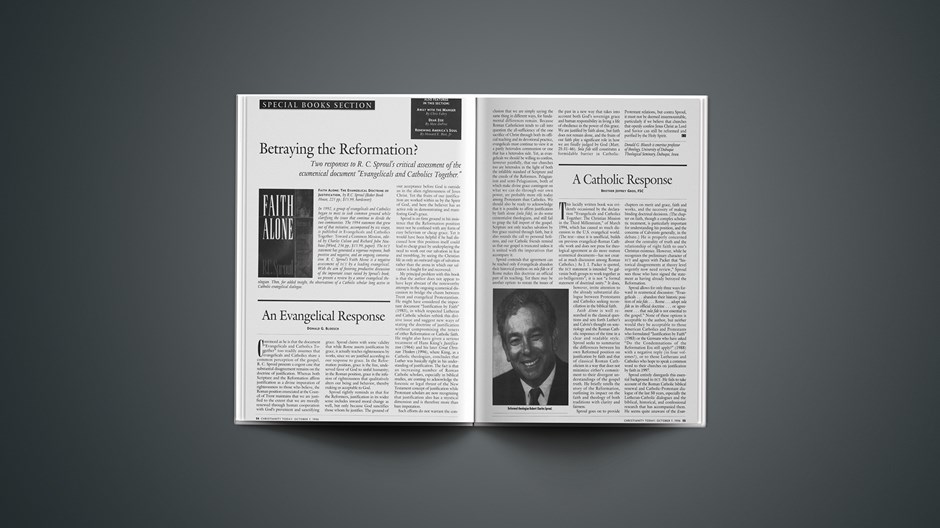
by R.C. Sproul (Baker Book House, 221 pp.; $15.99, hardcover). In 1992, a group of evangelicals and Catholics began to meet to seek common ground while clarifying the issues that continue to divide the two communities. The 1994 statement that grew out of that initiative, accompanied by six essays, is published in Evangelicals and Catholics Together: Toward a Common Mission, edited by Charles Colson and Richard John Neuhaus (Word, 236 pp.; $15.99, paper). The ect statement has generated a vigorous response, both positive and negative, and an ongoing conversation. R. C. Sproul's Faith Alone is a negative assessment of ect by a leading evangelical. With the aim of fostering productive discussion of the important issues raised by Sproul's book, we present a review by a senior evangelical theologian. Then, for added insight, the observations of a Catholic scholar long active in Catholic-evangelical dialogue.
A Catholic Response -by Brother Jeffrey Gros, FSC
This lucidly written book was evidently occasioned by the declaration "Evangelicals and Catholics Together: The Christian Mission in the Third Millennium," of March 1994, which has caused so much discussion in the U.S. evangelical world. (The text-since it is unofficial, builds on previous evangelical-Roman Catholic work and does not press for theological agreement as do more mature ecumenical documents-has not created as much discussion among Roman Catholics.) As J. I. Packer is quoted, the ect statement is intended "to galvanize both groups to work together as co-belligerents"; it is not "a formal statement of doctrinal unity." It does, however, invite attention to the already substantial dialogue between Protestants and Catholics seeking reconciliation in the biblical faith.
Faith Alone is well researched in the classical questions and sets forth Luther's and Calvin's thought on soteriology and the Roman Catholic responses of the time in a clear and readable style. Sproul seeks to summarize the differences between his own Reformed position on justification by faith and that of classical Roman Catholicism in a way that does not minimize either's commitment to their divergent understandings of the gospel truth. He briefly retells the story of the Reformation, outlining its impact on the faith and theology of both traditions with clarity and fairness.
Article continues below
Sproul goes on to provide chapters on merit and grace, faith and works, and the necessity of making binding doctrinal decisions. (The chapter on faith, though a complex scholastic treatment, is particularly important for understanding his position, and the concerns of Calvinists generally, in the debate.) He is properly concerned about the centrality of truth and the relationship of right faith to one's Christian existence. However, while he recognizes the preliminary character of ect and agrees with Packer that "historical disagreements at theory level urgently now need review," Sproul sees those who have signed the statement as having already betrayed the Reformation.
Sproul allows for only three ways forward in ecumenical discussion: "Evangelicals … abandon their historic position of sola fide. … Rome … adopt sola fide as its official doctrine … or agreement … that sola fide is not essential to the gospel." None of these options is acceptable to the author, but neither would they be acceptable to those American Catholics and Protestants who formulated "Justification by Faith" (1983) or the Germans who have asked "Do the Condemnations of the Reformation Era still apply?" (1988) with a negative reply (in four volumes!), or to those Lutherans and Catholics who hope to speak a common word to their churches on justification by faith in 1997.
Sproul entirely disregards this essential background to ect. He fails to take account of the Roman Catholic biblical renewal and Catholic-Protestant dialogue of the last 50 years, especially the Lutheran-Catholic dialogues and the biblical, historical, and confessional research that has accompanied them. He seems quite unaware of the Evangelical Roman Catholic Dialogue on Mission, 20 years of Pentecostal-Vatican dialogue, and the texts of Catholic dialogues with Southern Baptists and the Baptist World Alliance.
Ecumenical discussion must move forward on the basis of the gospel truth, under which all Christians stand to be judged and in the light of which all formulations of the past must be open to interpretation and, if necessary, reform. The differences between Protestants and Catholics remain wide, even when ecumenical scholarship has been taken into account, on issues like satisfaction, purgatory, and the implications of justification by faith for devotion to the saints and Mary. Here again, however, Sproul's polemics would have more credibility had he taken account of the current Roman Catholic positions, in Vatican texts as well as in the dialogues-for example, Pope Paul VI's Indulgentiarum Doctrina (1967). While this official document does not resolve the issues at stake between Christians, it does exemplify Roman Catholic approaches to the development of doctrine-more clearly and authoritatively than Sproul's Hans Küng citation-and again condemns "untimely and superfluous indulgences" and "unlawful profits which blasphemously took away the good name of indulgences."
Article continues below
Faith Alone should goad both Catholics and evangelicals to more exacting study of Christian traditions outside their own heritage. One model is the rich Roman Catholic Luther scholarship of the last half-century, which has made major contributions to mutual understanding and reappraisal of our common ground and differences. It continues to be a scandal of the evangelical mind to live in isolation from the work of Roman Catholic, Orthodox, and ecumenical scholars.
If Sproul's volume clarifies the need for evangelical honesty in theological research, and for Roman Catholic seriousness about the still-standing evangelical critique, it may serve as a stimulus to dialogue at a level it does not itself achieve. All of our Christian churches stand in need of clear preaching on the centrality of Christ, the sole sufficiency of grace in our competitive and merit-oriented culture, and the dynamic and central role of saving faith in Christ's plan. Roman Catholics and evangelicals in the Reformed tradition have in common a high esteem for biblical faith preserved by confessional formulations. That shared legacy makes our relationship particularly important and particularly challenging.
Brother Jeffrey Gros, FSC, is associate director, Secretariat for Ecumenical and Interreligious Affairs, National Conference of Catholic Bishops.
Sola Scriptura! The Protestant Position on the Bible, edited by Don Kistler (Soli Deo Gloria, 280 pp.; $14.95, paper). This collection of essays, from a viewpoint sympathetic to that expressed in R. C. Spoul's Faith Alone, centers on the sufficiency of Scripture as the final authority for faith and practice. Following an introduction by Michael Horton, the volume includes essays by Robert Godfrey ("What Do We Mean by Sola Scriptura?"), James White ("Sola Scriptura and the Early Church"), R. C. Sproul ("The Establishment of Scripture"), John Armstrong ("The Authority of Scripture"), John MacArthur ("The Sufficiency of the Written Word"), Sinclair Ferguson ("Scripture and Tradition"), and Joel Beeke and Ray Lanning ("The Transforming Power of Scripture").















 While we pray for peace, we need moral clarity about this war.
 We’ve got little information on Jesus’ appearance and personality. But that’s the way God designed it.españolFrançais
 Beyoncé’s right. Whether listening to Cowboy Carter or reading theology, diversity is a good thing.






