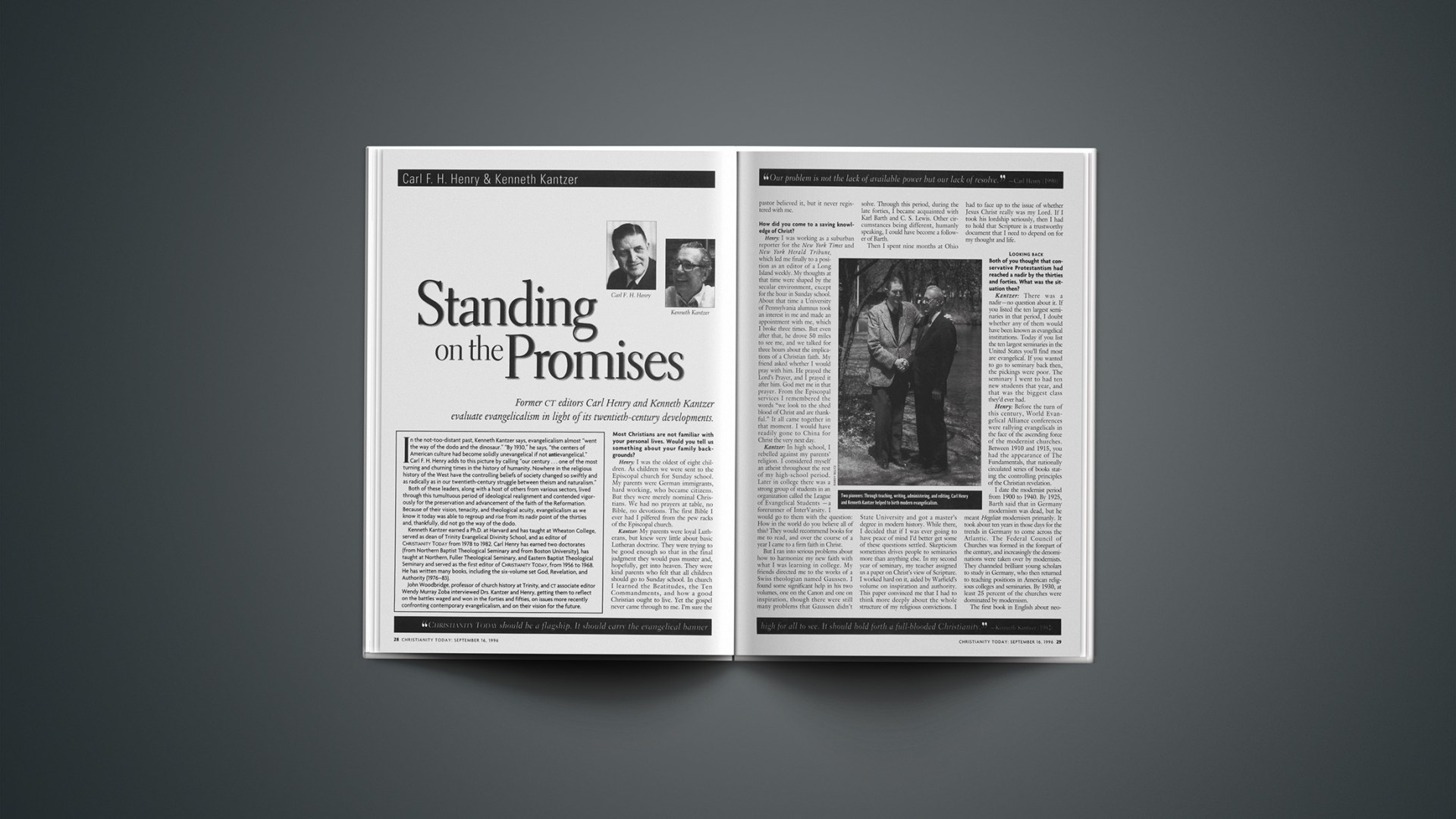

In the not-too-distant past, Kenneth Kantzer says, evangelicalism almost “went the way of the dodo and the dinosaur.” “By 1930,” he says, “the centers of American culture had become solidly unevangelical if not antievangelical.” Carl F. H. Henry adds to this picture by calling “our century … one of the most turning and churning times in the history of humanity. Nowhere in the religious history of the West have the controlling beliefs of society changed so swiftly and as radically as in our twentieth-century struggle between theism and naturalism.”
Both of these leaders, along with a host of others from various sectors, lived through this tumultuous period of ideological realignment and contended vigorously for the preservation and advancement of the faith of the Reformation. Because of their vision, tenacity, and theological acuity, evangelicalism as we know it today was able to regroup and rise from its nadir point of the thirties and, thankfully, did not go the way of the dodo.
Kenneth Kantzer earned a Ph.D. at Harvard and has taught at Wheaton College, served as dean of Trinity Evangelical Divinity School, and as editor of Christianity Today from 1978 to 1982. Carl Henry has earned two doctorates (from Northern Baptist Theological Seminary and from Boston University), has taught at Northern, Fuller Theological Seminary, and Eastern Baptist Theological Seminary and served as the first editor of Christianity Today, from 1956 to 1968. He has written many books, including the six-volume set God, Revelation, and Authority (1976-83).
John Woodbridge, professor of church history at Trinity, and CT associate editor Wendy Murray Zoba interviewed Drs. Kantzer and Henry, getting them to reflect on the battles waged and won in the forties and fifties, on issues more recently confronting contemporary evangelicalism, and on their vision for the future.
Most Christians are not familiar with your personal lives. Would you tell us something about your family backgrounds?
Henry: I was the oldest of eight children. As children we were sent to the Episcopal church for Sunday school. My parents were German immigrants, hard working, who became citizens. But they were merely nominal Christians. We had no prayers at table, no Bible, no devotions. The first Bible I ever had I pilfered from the pew racks of the Episcopal church.
Kantzer: My parents were loyal Lutherans, but knew very little about basic Lutheran doctrine. They were trying to be good enough so that in the final judgment they would pass muster and, hopefully, get into heaven. They were kind parents who felt that all children should go to Sunday school. In church I learned the Beatitudes, the Ten Commandments, and how a good Christian ought to live. Yet the gospel never came through to me. I’m sure the pastor believed it, but it never registered with me.
How did you come to a saving knowledge of Christ?
Henry: I was working as a suburban reporter for the New York Times and New York Herald Tribune, which led me finally to a position as an editor of a Long Island weekly. My thoughts at that time were shaped by the secular environment, except for the hour in Sunday school. About that time a University of Pennsylvania alumnus took an interest in me and made an appointment with me, which I broke three times. But even after that, he drove 50 miles to see me, and we talked for three hours about the implications of a Christian faith. My friend asked whether I would pray with him. He prayed the Lord’s Prayer, and I prayed it after him. God met me in that prayer. From the Episcopal services I remembered the words “we look to the shed blood of Christ and are thankful.” It all came together in that moment. I would have readily gone to China for Christ the very next day.
Kantzer: In high school, I rebelled against my parents’ religion. I considered myself an atheist throughout the rest of my high-school period. Later in college there was a strong group of students in an organization called the League of Evangelical Students -a forerunner of InterVarsity. I would go to them with the question: How in the world do you believe all of this? They would recommend books for me to read, and over the course of a year I came to a firm faith in Christ.
But I ran into serious problems about how to harmonize my new faith with what I was learning in college. My friends directed me to the works of a Swiss theologian named Gaussen. I found some significant help in his two volumes, one on the Canon and one on inspiration, though there were still many problems that Gaussen didn’t solve. Through this period, during the late forties, I became acquainted with Karl Barth and C. S. Lewis. Other circumstances being different, humanly speaking, I could have become a follower of Barth.
Then I spent nine months at Ohio State University and got a master’s degree in modern history. While there, I decided that if I was ever going to have peace of mind I’d better get some of these questions settled. Skepticism sometimes drives people to seminaries more than anything else. In my second year of seminary, my teacher assigned us a paper on Christ’s view of Scripture. I worked hard on it, aided by Warfield’s volume on inspiration and authority. This paper convinced me that I had to think more deeply about the whole structure of my religious convictions. I had to face up to the issue of whether Jesus Christ really was my Lord. If I took his lordship seriously, then I had to hold that Scripture is a trustworthy document that I need to depend on for my thought and life.
Looking back
Both of you thought that conservative Protestantism had reached a nadir by the thirties and forties. What was the situation then?
Kantzer: There was a nadir-no question about it. If you listed the ten largest seminaries in that period, I doubt whether any of them would have been known as evangelical institutions. Today if you list the ten largest seminaries in the United States you’ll find most are evangelical. If you wanted to go to seminary back then, the pickings were poor. The seminary I went to had ten new students that year, and that was the biggest class they’d ever had.
Henry: Before the turn of this century, World Evangelical Alliance conferences were rallying evangelicals in the face of the ascending force of the modernist churches. Between 1910 and 1915, you had the appearance of The Fundamentals, that nationally circulated series of books stating the controlling principles of the Christian revelation.
I date the modernist period from 1900 to 1940. By 1925, Barth said that in Germany modernism was dead, but he meant Hegelian modernism primarily. It took about ten years in those days for the trends in Germany to come across the Atlantic. The Federal Council of Churches was formed in the forepart of the century, and increasingly the denominations were taken over by modernists. They channeled brilliant young scholars to study in Germany, who then returned to teaching positions in American religious colleges and seminaries. By 1930, at least 25 percent of the churches were dominated by modernism.
The first book in English about neo-orthodoxy appeared in the 1930s in England. The year 1940 marked the rise of neo-orthodoxy on the American scene. Neo-orthodoxy, curiously, penetrated the backslidden seminaries and religious colleges much more than the secular universities, which were embracing secular humanism.
Kantzer: In the period up to the middle thirties, if Time magazine wanted a religious voice for the American scene they would go to Harry Emerson Fosdick. He was the primary public voice for religion-not merely for modernism, but for all Christians and religious people-certainly for all Protestants. After the middle thirties, Reinhold Niebuhr became the authority. He would be called neo-orthodox, since he was a left-wing dialectical thinker. He represented Protestant Christianity to the media. Toward the latter part of this century, Time went to Martin Marty, who was a step farther to the right. Did you notice the recent issue of Time magazine that spoke about supernaturalism and the resurrection? The most effectively quoted persons in that article were two convinced evangelicals. That says a lot to me about the extent of the change on our national scene.
In 1942, the National Association of Evangelicals was founded in keeping with Harold Ockenga’s concern to represent the unvoiced multitudes of conservative Christians. As you interacted with these developments, how did you discriminate between those you called “fundamentalist” and those who wanted to call themselves “evangelical”?
Kantzer: Originally, fundamentalists were evangelicals who held to an orthodox Protestant faith. Later, because of their belligerence in fighting modernists (and sometimes, also, each other), there was a tendency to adopt separation as their way of meeting the modernist takeover of schools and churches. Unfortunately, in their revolt against modernism, they sometimes failed to recognize the human aspects of Scripture and of Christ, and so the term fundamentalist became an embarrassment instead of a badge of honor. [J. Gresham] Machen never wished to be called a fundamentalist. I felt the same way.
If somebody called me a fundamentalist back then, I would say, “What do you mean by a fundamentalist? A person who believes the Bible was dictated by God? Or who rejects modern science? I don’t agree with those notions. But if you mean one who agrees with the basic traditional evangelical faith according to the Bible as worked out by the Protestant Reformers and their successors, I stand unequivocally for that.”
Dr. Henry, in 1947 you wrote The Uneasy Conscience of Modern Fundamentalism. In this book, were you trying to distance yourself from fundamentalism in order to found a new movement?
Henry: Not at all. The book was a critique of fundamentalism in terms of its own positioning in the cultural arena. Fundamentalists had largely withdrawn from societal outreach. As far as I was concerned, The Uneasy Conscience of Modern Fundamentalism was an effort to restate where fundamentalism ought to be in the light of its own heritage.
Kantzer: Many of us living at the time never saw ourselves as rebelling against fundamentalism. I saw myself as part of a group of believers who didn’t know where to find a Bible-believing educated pastor. They felt helpless, caught in a culture-wide drift that seemed irresistible. I wanted to help that group of believers. They were my people.
In some evangelical churches I would be under suspicion because I had a Ph.D. from a radical university. They had been burned too often by theological modernists who had infiltrated their school or church. In such churches I would make clear that I held Holy Scripture to be entirely trustworthy, that I believed in the deity of Jesus Christ and in his bodily resurrection from the dead. But I also made clear that I did not hold to ideas like a dictation theory of inspiration. Or that Jesus was not also fully human. Or that because an idea was set forth by modernists, it had to be wrong.
When did tensions begin to emerge between fundamentalists and evangelicals?
Henry: I would go back to 1941, when Carl McIntire beat the NAE to the draw by founding the American Council of Christian Churches. The extreme Right of the fundamentalist movement made up much of McIntire’s movement and adopted a separatist mode.
Kantzer: The fundamentalists came to be thought of increasingly as “second-degree separationists,” who wished not only to separate themselves from modernists and unbelievers, but also from any who belonged to organizations or denominations that openly fostered modernist theology. Many so-called fundamentalists did not adhere to these views. By calling themselves evangelical they hoped to avoid such charges. They wished to hold on to the fundamental doctrines, but they didn’t reject the idea of social action for the public good. They were deeply committed to justice. They were not trying to foist their religion upon the nation by law. Many, including Dr. [Harold] Ockenga, who became their spokesman, were strongly committed to their mainline denominational heritage and did not wish to separate themselves from it.
Henry: The evangelical movement with its concern to articulate a Christian world-and-life view found that the fundamentalist movement’s emphasis on five doctrinal points-the inerrancy of Scripture, the virgin birth and divinity of Christ, the substitutionary atonement, the bodily resurrection, and the second coming of Christ-was much better suited for exposing the compromises of the modernist than for creating a framework for biblical theology. The modernists would say that Jesus survived death, but the fundamentalist would ask, Did he rise bodily? The modernist would speak about the supernatural birth of Jesus; the fundamentalist would ask if he was virgin born. These were serviceable ways of exposing the theological nakedness of the modernist. But they did not serve as comprehensively as did, let’s say, Barth’s God Reveals Himself! The evangelicals began to assume what the fundamentalists never did assume-the costly burden of creating an evangelical scholarship in a world that’s in rebellion.
At the time, was there a widespread fear in certain conservative circles that young people might lose their faith if they attended secular colleges?
Kantzer: The fear was very real, and there was reason for it. You’ve got to remember that almost all the accredited colleges and great universities, and most of the best theological seminaries with good libraries and learned faculty who were writing the books, were solidly against evangelical faith. Youngsters who went to those schools often did get shaken in their faith.
In The Scandal of the Evangelical Mind, Mark Noll talks about a tradition of anti-intellectualism among evangelicals. Did you feel the impact of this tradition in the 1950s?
Kantzer: Underneath there was some anti-intellectualism, but it was not the dominant aspect of the movement. Most fundamentalists believed that the life of the mind was important, but they didn’t know what to do about it. Accredited colleges were liberal. The seminaries were liberal. Young people went to these schools and turned aside from evangelical faith. In most cases, opposition was not so much against the life of the mind, but against the life of the mind that was being cultivated in these liberal schools. It was a dangerous thing to go to seminary.
George Marsden has written about the founding of Fuller Seminary. What were the circumstances, Dr. Henry, of your becoming a professor there?
Henry: Wilbur Smith, who was professor of English Bible at Moody Bible Institute, spoke in chapel at Northern Baptist Seminary. As he left, he said to me, “Has Harold Ockenga been in touch with you?” I said no. “Well, he will be,” said Smith. That was the first hint I had that there was something in the air.
We had a prayer meeting at one of the downtown hotels in Chicago. I argued against launching the seminary that fall. It was already May. But Charles Fuller said he’d make an announcement on the Old-Fashioned Revival Hour, and we’d have all the students we needed.
After a second prayer meeting in June, we were constrained to go ahead. When we began, we had 27 or more students -many from big universities and many of them saying that they had a clear call for ministry but were uncertain about where to attend seminary. The news about Fuller was to them a providential signal that they belonged there.
Given your happy days at Fuller, was it difficult for you to leave in order to assume the editorship of the new journal Christianity Today?
Henry: Yes, indeed. At Christianity Today we were always short one staff member. It was a six-day, and even a seven-day, job. Nevertheless, it gave tremendous influence to the evangelical movement. And in those early years, the mail was voluminous from people on all sides of the theological spectrum. CT had a role in identifying worldwide evangelical scholarship, so that if ever evangelicals were to launch a Christian university, as at that time I hoped they might, CT would have already identified around the world most of the evangelical leaders who were cognitively equipped and had literary gifts.
Kantzer: I accepted the editorship of Christianity Today in response to a request of Billy Graham in 1977. But I never considered myself as primarily an editor. I always considered myself as a theologian who was editing in order to do a job that needed to be done.
I think the great period of CT was while Carl was there, because the magazine was so desperately needed, and on so many things it set the record straight, showing that evangelicals are not necessarily numbskulls.
But when I went to CT, I faced the fact that the large gifts that kept it financially afloat were going to drop to zero. The magazine had to be given more popular appeal if it were to survive. At the same time, I tried to keep the magazine theologically on track, to keep a focus on the evangelical world-and-life view, and to interact with movements and trends both inside and beyond evangelicalism. I think to a large extent that has been the motivating focus with ct ever since.
In summary, what would you say were early key elements of the post-World War II evangelical resurgence?
Henry: 1947 was a turning year. It was the year in which Uneasy Conscience appeared and Fuller was established. Two years later Billy Graham gained national headlines because of the Los Angeles tent meetings. Hearst’s word to his editors to “puff Graham” made him a national figure, and evangelical evangelism became front-page news. We launched the Rose Bowl Easter Sunrise Service that continued for 25 years. In 1950 Graham and Ockenga both spoke in the Rose Bowl, addressing the largest attendance ever at any religious gathering in the Pacific Southwest. All of this signaled a new day.
Kantzer: In addition to the leadership by Billy Graham and Carl Henry at Christianity Today, I would add the founding and growth of scores of evangelical seminaries and graduate schools of theology, the renewed social conscience and sense of political responsibility among evangelicals, a sense of moral obligation and a duty to sacrifice, the religious bankruptcy of older modernism, the recognition (triggered by the Pentecostal/ charismatic movement) that evangelical faith involves emotion and will as well as the mind, and that evangelical faith is a bulwark against moral and spiritual drift. I would be unfaithful if I did not also note the sovereign Spirit of God, who is like the wind that “blows wherever it pleases.”
The evangelical movement today and tomorrowShould there have been a “Battle for the Bible” in recent evangelical history?
Kantzer: Of course! Though the central focus between faith and nonfaith is not the battle for the Bible, but the question of who Jesus Christ is and what are we going to do with him. But the role of the Bible is a very important subsidiary issue. Luther had it right: Christ is the baby, and the Bible is the crib. You don’t worship the crib; but if you want to preserve the baby, you don’t throw the crib out and put your baby in the street. But if the central issue of the gospel of Christ is kept in clear focus, then the place we give to the Bible becomes equally clear.
Henry: There is a danger in shifting the question from objective truth to subjective trust. To talk about the trustworthiness of Scripture, rather than inerrancy, focuses not on the cognitive but rather on the volitional. Because the times have changed, some today treat the inerrancy of Scripture as an evangelical distinctive but not as an evangelical essential. In both of those points you can get into trouble. If you admit error in Scripture, and then go, for example, to Yale or Chicago or any divinity school where people take a critical view of Scripture, then you come out with conflicting pictures of the Lord. You can’t fully detach the question of the identity of Christ from the prior question of the trustworthiness of Scripture.
Could you define inerrancy a little more fully? Kantzer: The word inerrancy is derived from two Latin words meaning “not wandering.” And common usage supplies the object: “not wandering from the truth.” When the Scripture tells us something, it is telling us the truth and nothing false. To use an old InterVarsity phrase, inerrancy is the entire trustworthiness of the Scripture to direct thought and life. If you interpret Scripture properly, you have truth; and not only truth, but divine authority for our belief and behavior.
Henry: The 1949 founding statement of the Evangelical Theological Society reads: “The Bible alone, and the Bible in its entirety, is the Word of God written, and therefore inerrant in the autographs.” The 1978 Chicago Statement on Biblical Inerrancy states that “inerrant signifies the quality of being free from all falsehood or mistake and so safeguards the truth that Holy Scripture is entirely true and trustworthy in all its assertions.”
Some argue today that certain definitions of inerrancy have been shaped more by an Enlightenment heritage of “common sense realism” than by biblical categories. What are your thoughts about that?Henry: An Enlightenment rationalism has penetrated some aspects of the theological debate, especially in the evangelical reliance on empirical proofs where God’s existence is not grounded in his revelation but rather in nature, the pattern of history, or in the mind or conscience of man. But to contend that inerrancy and propositional revelation are fruits of Enlightenment rationalism, I think, is an evasive tactic. It obscures what is really a departure from objective scriptural revelation and makes a concession which involves a shift in epistemic controls.
Kantzer: Different evangelicals appeal to quite varied grounds for holding to the divine inspiration and truth of Scripture. I don’t deny that a person can be an evangelical in some sense without committing himself clearly to inerrancy. Yet this is a basically inconsistent position. I should call such a person a liberal evangelical or an inconsistent evangelical. How consistent is it to affirm that the Bible is entirely trustworthy and at the same time argue that it contains error?
Part of the problem is the use of the expression “propositional truth.” In ordinary language, when we use the word proposition, we think immediately in terms of Euclid’s geometry. Carl and most evangelicals who use that term don’t intend that sense at all. They mean true statements.
What is your assessment of the Evangelicals and Catholics Together statement?Henry: I share the concern about the erosion of Judeo-Christian values in the public arena and the need for cobelligerency in that area. I do think, however, that the effort ran ahead of the evangelical constituency. Evangelicals were not fully prepared for the statement. And there was some ambiguity in the terminology, as was conceded in subsequent meetings, which aimed to rectify this.
Kantzer: I agree. I do not for a moment deny the Christianity of any true Roman Catholic. Many Roman Catholics are certainly evangelical. We share the faith of the Apostles’ Creed and the seven ecumenical councils of the ancient church. We need each other in our battles against secularism and materialism. Yet there are crucial differences that we dare not gloss over, like the hierarchical authoritarianism of the Roman clergy and the gospel of salvation by grace through faith.
At a personal level, what has been the role of prayer in keeping you centered in your own evangelical faith?Kantzer: Prayer lies at the heart of the Christian faith. I think it is a part of my duty and privilege as a Christian to pray to God, though I don’t consider myself a great prayer warrior. I don’t spend as much time as I ought to spend in prayer daily, but I do have a time for prayer every day. My wife and I have a time of devotional reading of the Scripture and prayer every day.
One of the worst memories I have is of a particular evening prayer time. My then five-year-old daughter loved to pray, and she felt exceedingly pious that night. She began to pray all around the world for all her classmates and her friends and her relatives. And I think it was about 15 minutes at least, maybe longer. And finally I broke into it and said, “Now I think it’s time we say amen.” I wished I’d never done that. I wasn’t patient enough with my daughter.
Henry: We had our devotions and discussion in the evening when the children were at home with us. In the years since the children have flown away-my son, Paul, now with his Lord-we have our devotions in the morning after breakfast. We read Scripture, mention special concerns and needs, and pray. I have the gift of a wife who is a woman of great prayer, of missionary interests, and of great faith. And that has been a wonderful blessing through the years. We walked together through the experience of the loss of our son with our hands in the hands of the risen Lord.
How can the next generation keep the evangelical fires burning?Kantzer: We evangelicals need to develop a biblically based world-view and find ways of communicating this to our children and to our world. That involves getting an educated ministry and teachers and particularly penetrating the purveyors of ideas in the public media. Harvard and Yale started primarily with the idea of training men for the ministry. Even Columbia University was started that way. Somehow we have to instill in the minds of our converts and children that they have a commitment to represent Christ in a pagan world, and that they need to present him as a solution to the problems of the mind as well as the heart. Education can’t be neglected or our pagan culture is going to overwhelm us. And we’ll find ourselves very quickly with, instead of 40 percent of the people in church on Sundays, 5 percent or less, like in Germany. Or England, where it’s 2 or 3 percent.
Most of all, we need committed membership in every local church. Only by that means can we reach the disillusioned ones who no longer find liberalism or modernism a viable way to a life that satisfies the mind and the heart.
Henry: The biggest asset that any religion can have is truth. You might say redemption; but Christianity can’t be redemptive unless it’s true. Two things are to be said about the younger generation. There are those who deliberately widen the term evangelical to accommodate their deviations. That is ultimately destructive because it tends to undermine any clear sense of norm. The other is that there is an amazing creativity in the younger generation. I think, for example, of young Christian Koreans when there was a shortage of blood some years ago. They donated blood in vials that bore the legend: “In gratitude for the shed blood of Jesus Christ.”
God can take someone wholly outside the reach of a lethargic church. He can reach someone like C. S. Lewis, who did not come through the inherited institution, or someone like Chuck Colson, who was on the margin of the evangelical society. Or someone like myself, brought up outside an evangelical heritage. The evangelical movement can still make gains that exceed any made this side of the apostolic age, including the Reformation. But they will come only in the context of the bended knee and the throbbing heart.
Copyright © 1996 Christianity Today. Click for reprint information.