With God on Our Side: The Rise of the Religious Right in America By William Martin
Broadway Books
418 pp.; $27.50, hardcover
In an autocracy, one person has his way; in an aristocracy a few people have their way; in a democracy, no one has his way.
—Celia Green, The Decline and Fall of Science
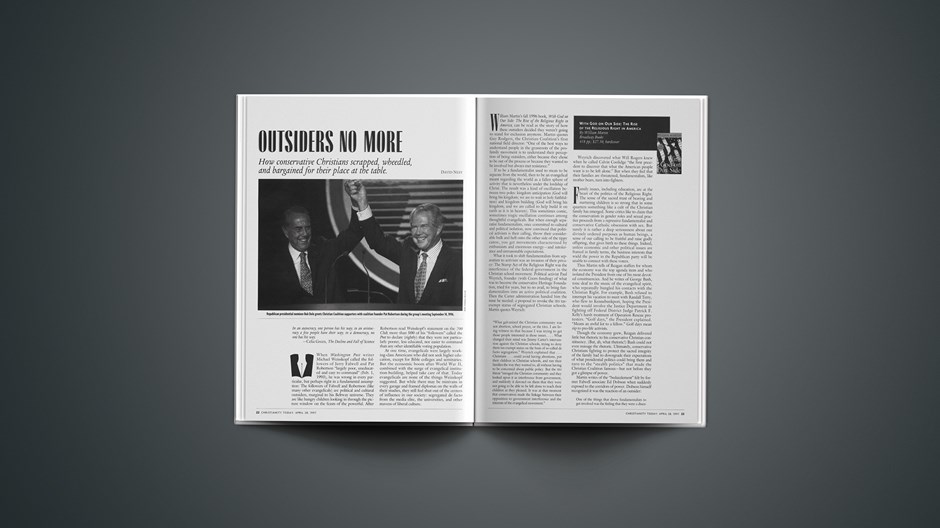
When Washington Post writer Michael Weisskopf called the followers of Jerry Falwell and Pat Robertson "largely poor, uneducated and easy to command" (Feb. 1, 1993), he was wrong in every particular, but perhaps right in a fundamental assumption: The followers of Falwell and Robertson (like many other evangelicals) are political and cultural outsiders, marginal to his Beltway universe. They are like hungry children looking in through the picture window on the feasts of the powerful. After Robertson read Weisskopf's statement on the 700 Club, more than 500 of his "followers" called the Post to declare (rightly) that they were not particularly poorer, less educated, nor easier to command than any other identifiable voting population.
At one time, evangelicals were largely working-class Americans who did not seek higher education, except for Bible colleges and seminaries. But the economic boom after World War II, combined with the surge of evangelical institution-building, helped take care of that. Today evangelicals are none of the things Weisskopf suggested. But while there may be minivans in every garage and framed diplomas on the walls of their studies, they still feel shut out of the centers of influence in our society: segregated de facto from the media elite, the universities, and other mavens of liberal culture.
William Martin's fall 1996 book, With God on Our Side: The Rise of the Religious Right in America, can be read as the story of how these outsiders decided they weren't going to stand for exclusion anymore. Martin quotes Guy Rodgers, the Christian Coalition's first national field director: "One of the best ways to understand people in the grassroots of the pro-family movement is to understand their perception of being outsiders, either because they chose to be out of the process or because they wanted to be involved but always met resistance."
If to be a fundamentalist used to mean to be separate from the world, then to be an evangelical meant regarding the world as a fallen sphere of activity that is nevertheless under the lordship of Christ. The result was a kind of oscillation between two poles: kingdom anticipation (God will bring his kingdom; we are to wait in holy faithfulness) and kingdom building (God will bring his kingdom, and we are called to help build it on earth as it is in heaven). This sometimes comic, sometimes tragic oscillation continues among thoughtful evangelicals. But when enough separatist fundamentalists, once committed to cultural and political isolation, now convinced that political activism is their calling, throw their considerable bulk and heft onto the other side of the tippy canoe, you get movements characterized by enthusiasm and enormous energy—and intolerance and unreasonable expectations.
What it took to shift fundamentalists from separatism to activism was an invasion of their privacy: The Stamp Act of the Religious Right was the interference of the federal government in the Christian school movement. Political activist Paul Weyrich, founder (with Coors funding) of what was to become the conservative Heritage Foundation, tried for years, but to no avail, to bring fundamentalists into an active political coalition. Then the Carter administration handed him the issue he needed: a proposal to revoke the irs tax-exempt status of segregated Christian schools. Martin quotes Weyrich:
"What galvanized the Christian community was not abortion, school prayer, or the ERA. I am living witness to that because I was trying to get those people interested in those issues. … What changed their mind was Jimmy Carter's intervention against the Christian schools, trying to deny them tax-exempt status on the basis of so-called de facto segregation." Weyrich explained that … Christians … could avoid having abortions, put their children in Christian schools, and run their families the way they wanted to, all without having to be concerned about public policy. But the irs threat "enraged the Christian community and they looked upon it as interference from government, and suddenly it dawned on them that they were not going to be able to be left alone to teach their children as they pleased. It was at that moment that conservatives made the linkage between their opposition to government interference and the interests of the evangelical movement."
Weyrich discovered what Will Rogers knew when he called Calvin Coolidge "the first president to discover that what the American people want is to be left alone." But when they feel that their families are threatened, fundamentalists, like mother bears, turn into fighters.
Family issues, including education, are at the heart of the politics of the Religious Right. The sense of the sacred trust of bearing and nurturing children is so strong that in some quarters something like a cult of the Christian family has emerged. Some critics like to claim that the conservatism in gender roles and sexual practice proceeds from a repressive fundamentalist and conservative Catholic obsession with sex. But surely it is rather a deep seriousness about our divinely ordered purposes as human beings, a sense of our calling to be fruitful and raise godly offspring, that gives birth to these things. Indeed, unless economic and other political issues are framed in family terms, the business interests that wield the power in the Republican party will be unable to connect with these voters.
Article continues below
Thus Martin tells of Reagan staffers for whom the economy was the top agenda item and who isolated the President from one of his most devoted constituencies. And he writes of George Bush, tone deaf to the music of the evangelical spirit, who repeatedly bungled his contacts with the Christian Right. For example, Bush refused to interrupt his vacation to meet with Randall Terry, who flew to Kennebunkport, hoping the President would involve the Justice Department in fighting off Federal District Judge Patrick F. Kelly's harsh treatment of Operation Rescue protesters. "Golf days," the President explained. "Means an awful lot to a fellow." Golf days mean zip to pro-life activists.
Though the economy grew, Reagan delivered little but rhetoric to his conservative Christian constituency. (But, ah, what rhetoric!) Bush could not even manage the rhetoric. Ultimately, conservative Christians fighting to protect the sacred integrity of the family had to downgrade their expectations of what presidential politics could bring them and turn to the "stealth politics" that made the Christian Coalition famous—but not before they got a glimpse of power.
Martin writes of the "bedazzlement" felt by former Falwell associate Ed Dobson when suddenly exposed to the corridors of power. Dobson himself recognized it was the reaction of an outsider:
One of the things that drove fundamentalists to get involved was the feeling that they were a disenfranchised people. They didn't belong in the mainstream. No one invited them to the banquets in the public square. They were just kind of idiots, basically. … Then Ronald Reagan and others recognized that we had made a difference. … We were invited to the table for the first time. And that was a great feeling. I remember the first time I went to the White House with Jerry Falwell and ate at the mess hall with two key people in the president's inner circle, and I'm thinking, "Wow, I am sitting here at the White House."
Article continues below
Such inclusion raised unrealistic hopes, of course. And when hope maketh ashamed, anger ensues. This writer once sat with a group of Christian leaders who were preparing for an Oval Office visit with President Bush shortly after evangelical Doug Wead of the public liaison office had been fired. One prominent evangelical spokesman complained bitterly that he had not been consulted by the White House staff when they chose Wead's replacement. His sense of entitlement was intense.
It should be noted that evangelical access to the White House has perhaps been greater under the Clinton administration than it was under previous administrations. Key evangelical leaders have become the President's spiritual advisers, and still others attend the upscale houseparty known as Renaissance Weekend, elbow-to-elbow with the Clintons and other wonks and achievers. But none of this contact seems to issue in policy under either Republican or Democratic administrations.
That may sound pessimistic. But the fat lady has not yet sung, and Martin is not done writing. As a companion to the eponymous pbs television series, With God on Our Side is crafted largely from extensive on-camera interviews. Unlike a history based primarily on documentary evidence, one built from largely oral material will have the warmth and immediacy of its subjects. On this score With God on Our Side does not disappoint. But the book also seems to take these personal reminiscences at face value. Interpretation is largely postponed until the final chapter. There is no flavor of "investigative journalism," and much that is seamy is merely ignored. Martin is a friendly interpreter who finds it necessary to gently correct his subject from documentary sources only twice—occasions where Jerry Falwell's memories served his reputation better than did the facts.
The author, a sociologist at Rice University, stuck close to the documentary's outline, omitting some key players and underplaying others because of the limits of time and the scope of the project. Yet what was published is likely to become the standard account of the Religious Right for both scholars and laity.
The book's 385 pages of body text are scribed with solid, sensible prose. It is the kind of storytelling in which the writer's craft waits in the wings and lets the story take center stage. On rare occasion, Martin's irreverent wit pokes its nose out from behind the curtain to play to the audience. After recounting Pat Robertson's boyish readiness to repeat his 1985 rebuke of Hurricane Gloria, he writes: "If Robertson saw no problems in mixing faith and meteorology, it is hardly surprising that he regarded the wall between church and state as permeable." And of the Moral Majority's demise Martin says: "Jerry Falwell clipped his own wings in 1986."
Article continues below
Martin is not a hack writer hired simply to do the spin-off book to a media event. His interest in the Religious Right is longstanding and began with his personal fascination with radio preachers. In an interview, he told CT, "When I was driving out to preach while I was a student at Abilene Christian College in the 1950s, I used to amuse myself coming back from my preaching appointment on Sunday night by listening to radio preachers on Mexican stations. Then in the late 1960s while working on my dissertation at Harvard and driving back and forth to Rochester, New York, I listened to some of the same preachers on wwda from Wheeling, West Virginia." After Martin got a teaching job, he wrote an article for the Atlantic on radio preachers, and that led to about two dozen other articles on the electronic church—and, he says, 800 pages of a book that never got finished. That experience led him to write a widely noted article about Billy Graham for Texas Monthly, which in turn led him to write the most extensive Graham biography to date, A Prophet with Honor. That biography in turn caught the attention of TV producer Calvin Skaggs, who felt Martin had the kind of approach that he wanted in the TV series as well: one that, in Martin's words, "tried to be fair and non-judgmental but also informed with a critical eye."
God works in mysterious ways. And we thank him that he turned a green student preacher's amusement with radio preachers into a mature sociologist's benevolent scholarship.
-Susan P. Jones, pastor of Arbutus United Methodist Church, Baltimore, Maryland.
Richard Hays's The Moral Vision of the New Testament: A Contemporary Introduction to New Testament Ethics (Harper San Francisco) should come with a warning: "This book is hazardous to shallow thinking and careless living by Christians." In a time when biblical illiteracy is on the rise and moral vision on the decline, Hays offers a strong antidote to both. I found his book to be profound yet accessible; I hope it will be widely read by scholars, clergy, and laity alike.
Article continues below
Much critical discussion of Hays's work will undoubtedly focus on his discussion of selected ethical issues (e.g., violence in the defense of justice, abortion, homosexuality). Even so, I hope more attention is paid to his provocative and insightful proposal that the moral vision of the New Testament is shaped by the interrelations of community, Cross, and New Creation. Taken together, these themes offer a rich context for helping the contemporary church learn to appropriate the ethical witness of the New Testament—a daunting, yet urgent challenge for our time.

















 While we pray for peace, we need moral clarity about this war.
 As my doubts about his teachings grew, so did a secret fascination with Jesus.
 Beyoncé’s right. Whether listening to Cowboy Carter or reading theology, diversity is a good thing.






