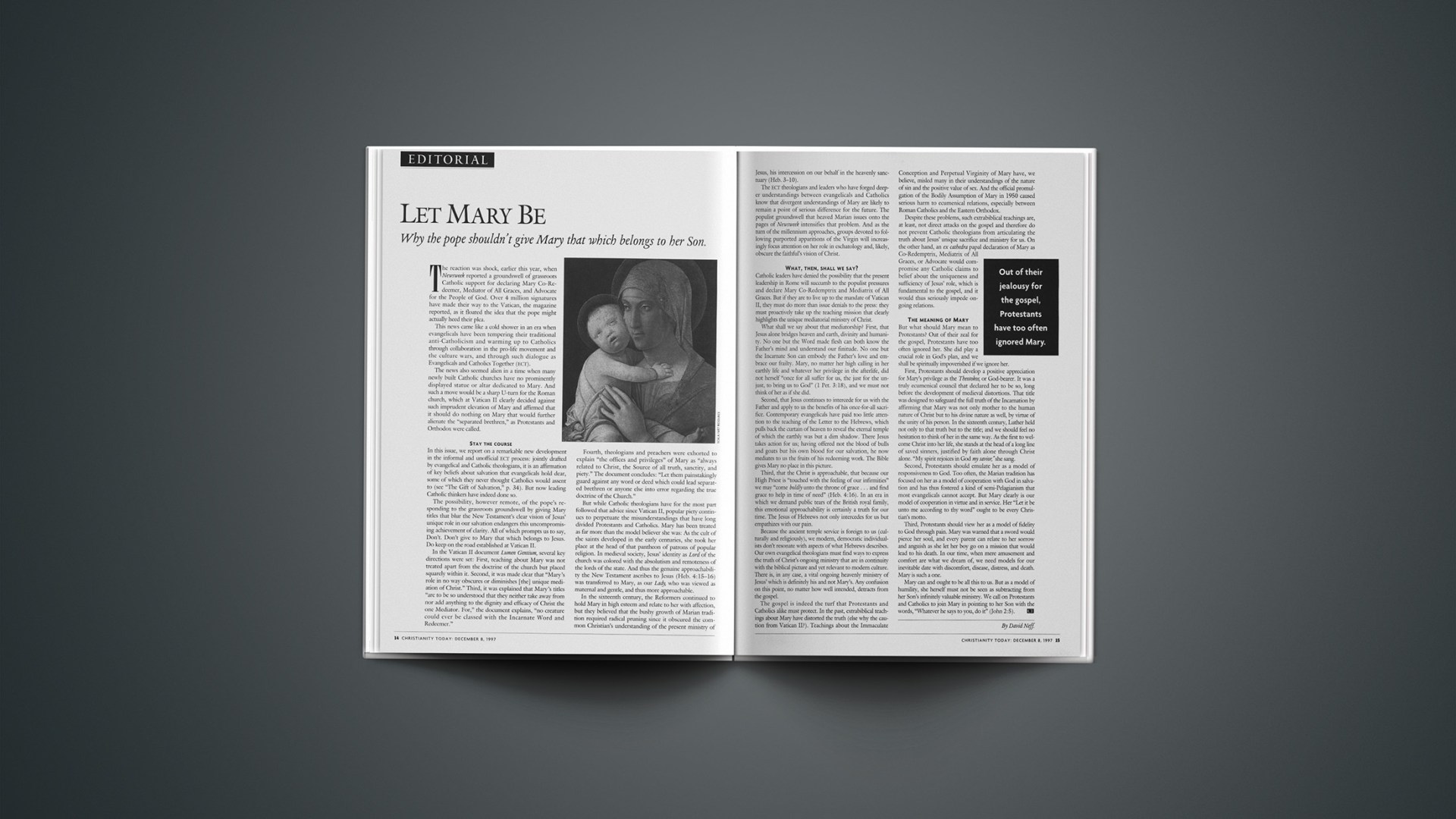

The reaction was shock, earlier this year, when Newsweek reporteda groundswell of grassroots Catholic support for declaring Mary Co-Redeemer,Mediator of All Graces, and Advocate for the People of God. Over 4 millionsignatures have made their way to the Vatican, the magazine reported, asit floated the idea that the pope might actually heed their plea.
This news came like a cold shower in an era when evangelicals have been temperingtheir traditional anti-Catholicism and warming up to Catholics throughcollaboration in the pro-life movement and the culture wars, and throughsuch dialogue as Evangelicals and Catholics Together (ECT).
The news also seemed alien in a time when many newly built Catholic churcheshave no prominently displayed statue or altar dedicated to Mary. And sucha move would be a sharp U-turn for the Roman church, which at Vatican IIclearly decided against such imprudent elevation of Mary and affirmed thatit should do nothing on Mary that would further alienate the “separatedbrethren,” as Protestants and Orthodox were called.
STAY THE COURSE In this issue, we report on a remarkable new development in the informaland unofficial ECT process: jointly drafted by evangelicaland Catholic theologians, it is an affirmation of key beliefs about salvationthat evangelicals hold dear, some of which they never thought Catholics wouldassent to (see “The Gift of Salvation,”p. 34). But now leading Catholic thinkers have indeed done so.
The possibility, however remote, of the pope’s responding to the grassrootsgroundswell by giving Mary titles that blur the New Testament’s clear visionof Jesus’ unique role in our salvation endangers this uncompromising achievementof clarity. All of which prompts us to say, Don’t. Don’t give to Mary thatwhich belongs to Jesus. Do keep on the road established at Vatican II.
In the Vatican II document Lumen Gentium, several key directions wereset: First, teaching about Mary was not treated apart from the doctrine ofthe church but placed squarely within it. Second, it was made clear that”Mary’s role in no way obscures or diminishes [the] unique mediation of Christ.”Third, it was explained that Mary’s titles “are to be so understood thatthey neither take away from nor add anything to the dignity and efficacyof Christ the one Mediator. For,” the document explains, “no creature couldever be classed with the Incarnate Word and Redeemer.”
Fourth, theologians and preachers were exhorted to explain “the offices andprivileges” of Mary as “always related to Christ, the Source of all truth,sanctity, and piety.” The document concludes: “Let them painstakingly guardagainst any word or deed which could lead separated brethren or anyone elseinto error regarding the true doctrine of the Church.”
But while Catholic theologians have for the most part followed that advicesince Vatican II, popular piety continues to perpetuate the misunderstandingsthat have long divided Protestants and Catholics. Mary has been treated asfar more than the model believer she was: As the cult of the saints developedin the early centuries, she took her place at the head of that pantheon ofpatrons of popular religion. In medieval society, Jesus’ identity asLord of the church was colored with the absolutism and remotenessof the lords of the state. And thus the genuine approachability the New Testamentascribes to Jesus (Heb. 4:15-16) was transferred to Mary, as our Lady,who was viewed as maternal and gentle, and thus more approachable.
In the sixteenth century, the Reformers continued to hold Mary in high esteemand relate to her with affection, but they believed that the bushy growthof Marian tradition required radical pruning since it obscured the commonChristian’s understanding of the present ministry of Jesus, his intercessionon our behalf in the heavenly sanctuary (Heb. 3-10).
The ECT theologians and leaders who have forged deeperunderstandings between evangelicals and Catholics know that divergentunderstandings of Mary are likely to remain a point of serious differencefor the future. The populist groundswell that heaved Marian issues onto thepages of Newsweek intensifies that problem. And as the turn of themillennium approaches, groups devoted to following purported apparitionsof the Virgin will increasingly focus attention on her role in eschatologyand, likely, obscure the faithful’s vision of Christ.
WHAT, THEN, SHALL WE SAY? Catholic leaders have denied the possibility that the present leadershipin Rome will succumb to the populist pressures and declare Mary Co-Redemptrixand Mediatrix of All Graces. But if they are to live up to the mandate ofVatican II, they must do more than issue denials to the press: they mustproactively take up the teaching mission that clearly highlights the uniquemediatorial ministry of Christ.
What shall we say about that mediatorship? First, that Jesus alone bridgesheaven and earth, divinity and humanity. No one but the Word made flesh canboth know the Father’s mind and understand our finitude. No one but the IncarnateSon can embody the Father’s love and embrace our frailty. Mary, no matterher high calling in her earthly life and whatever her privilege in the afterlife,did not herself “once for all suffer for us, the just for the unjust, tobring us to God” (1 Pet. 3:18), and we must not think of her as if she did.
Out of their jealousy for the gospel, Protestants have too often ignored Mary.
Second, that Jesus continues to intercede for us with the Father and applyto us the benefits of his once-for-all sacrifice. Contemporary evangelicalshave paid too little attention to the teaching of the Letter to the Hebrews,which pulls back the curtain of heaven to reveal the eternal temple of whichthe earthly was but a dim shadow. There Jesus takes action for us; havingoffered not the blood of bulls and goats but his own blood for our salvation,he now mediates to us the fruits of his redeeming work. The Bible gives Maryno place in this picture.
Third, that the Christ is approachable, that because our High Priest is “touchedwith the feeling of our infirmities” we may “come boldly unto thethrone of grace … and find grace to help in time of need” (Heb. 4:16).In an era in which we demand public tears of the British royal family, thisemotional approachability is certainly a truth for our time. The Jesus ofHebrews not only intercedes for us but empathizes with our pain.
Because the ancient temple service is foreign to us (culturally and religiously),we modern, democratic individualists don’t resonate with aspects of whatHebrews describes. Our own evangelical theologians must find ways to expressthe truth of Christ’s ongoing ministry that are in continuity with the biblicalpicture and yet relevant to modern culture. There is, in any case, a vitalongoing heavenly ministry of Jesus’ which is definitely his and not Mary’s.Any confusion on this point, no matter how well intended, detracts from the gospel.
The gospel is indeed the turf that Protestants and Catholics alike must protect.In the past, extrabiblical teachings about Mary have distorted the truth(else why the caution from Vatican II?). Teachings about the ImmaculateConception and Perpetual Virginity of Mary have, we believe, misled manyin their understandings of the nature of sin and the positive value of sex.And the official promulgation of the Bodily Assumption of Mary in 1950 causedserious harm to ecumenical relations, especially between Roman Catholicsand the Eastern Orthodox.
Despite these problems, such extrabiblical teachings are, at least, not directattacks on the gospel and therefore do not prevent Catholic theologians fromarticulating the truth about Jesus’ unique sacrifice and ministry for us.On the other hand, an ex cathedra papal declaration of Mary asCo-Redemptrix, Mediatrix of All Graces, or Advocate would compromise anyCatholic claims to belief about the uniqueness and sufficiency of Jesus’role, which is fundamental to the gospel, and it would thus seriously impedeongoing relations.
THE MEANING OF MARY But what should Mary mean to Protestants? Out of their zeal for the gospel,Protestants have too often ignored her. She did play a crucial role in God’splan, and we shall be spiritually impoverished if we ignore her.
First, Protestants should develop a positive appreciation for Mary’s privilegeas the Theotokos, or God-bearer. It was a truly ecumenical councilthat declared her to be so, long before the development of medieval distortions.That title was designed to safeguard the full truth of the Incarnation byaffirming that Mary was not only mother to the human nature of Christ butto his divine nature as well, by virtue of the unity of his person. In thesixteenth century, Luther held not only to that truth but to the title; andwe should feel no hesitation to think of her in the same way. As the firstto welcome Christ into her life, she stands at the head of a long line ofsaved sinners, justified by faith alone through Christ alone. “My spiritrejoices in God my savior,” she sang.
Second, Protestants should emulate her as a model of responsiveness to God.Too often, the Marian tradition has focused on her as a model of cooperationwith God in salvation and has thus fostered a kind of semi-Pelagianism thatmost evangelicals cannot accept. But Mary clearly is our model of cooperationin virtue and in service. Her “Let it be unto me according to thy word” oughtto be every Christian’s motto.
Third, Protestants should view her as a model of fidelity to God throughpain. Mary was warned that a sword would pierce her soul, and every parentcan relate to her sorrow and anguish as she let her boy go on a mission thatwould lead to his death. In our time, when mere amusement and comfort arewhat we dream of, we need models for our inevitable date with discomfort,disease, distress, and death. Mary is such a one.
Mary can and ought to be all this to us. But as a model of humility, sheherself must not be seen as subtracting from her Son’s infinitely valuableministry. We call on Protestants and Catholics to join Mary in pointing toher Son with the words, “Whatever he says to you, do it” (John 2:5).
Copyright © 1997 Christianity Today. Click for reprint information.