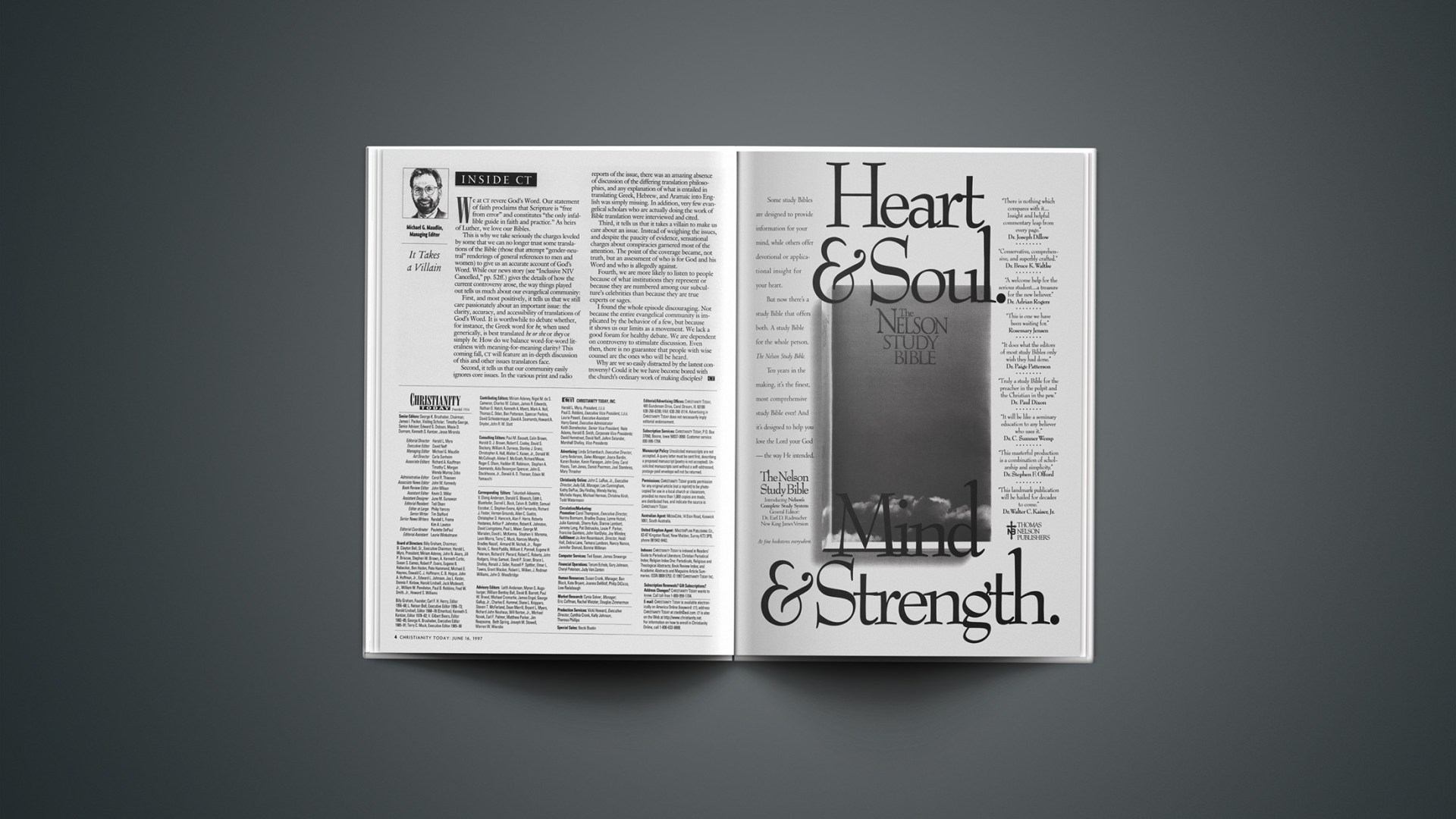

We at CT revere God's Word. Our statement of faith proclaims that Scripture is "free from error" and constitutes "the only infallible guide in faith and practice." As heirs of Luther, we love our Bibles.
This is why we take seriously the charges leveled by some that we can no longer trust some translations of the Bible (those that attempt "gender-neutral" renderings of general references to men and women) to give us an accurate account of God's Word. While our news story (see "NIV on Trial," pp. 52ff.) gives the details of how the current controversy arose, the way things played out tells us much about our evangelical community:
First, and most positively, it tells us that we still care passionately about an important issue: the clarity, accuracy, and accessibility of translations of God's Word. It is worthwhile to debate whether, for instance, the Greek word for he, when used generically, is best translated he or she or they or simply he. How do we balance word-for-word literalness with meaning-for-meaning clarity? This coming fall, CT will feature an in-depth discussion of this and other issues translators face.
Second, it tells us that our community easily ignores core issues. In the various print and radio reports of the issue, there was an amazing absence of discussion of the differing translation philosophies, and any explanation of what is entailed in translating Greek, Hebrew, and Aramaic into English was simply missing. In addition, very few evangelical scholars who are actually doing the work of Bible translation were interviewed and cited.
Third, it tells us that it takes a villain to make us care about an issue. Instead of weighing the issues, and despite the paucity of evidence, sensational charges about conspiracies garnered most of the attention. The point of the coverage became, not truth, but an assessment of who is for God and his Word and who is allegedly against.
Fourth, we are more likely to listen to people because of what institutions they represent or because they are numbered among our subculture's celebrities than because they are true experts or sages.
I found the whole episode discouraging. Not because the entire evangelical community is implicated by the behavior of a few, but because it shows us our limits as a movement. We lack a good forum for healthy debate. We are dependent on controversy to stimulate discussion. Even then, there is no guarantee that people with wise counsel are the ones who will be heard.
Why are we so easily distracted by the lastest controversy? Could it be we have become bored with the church's ordinary work of making disciples?
Copyright © 1997 Christianity Today. Click for reprint information.