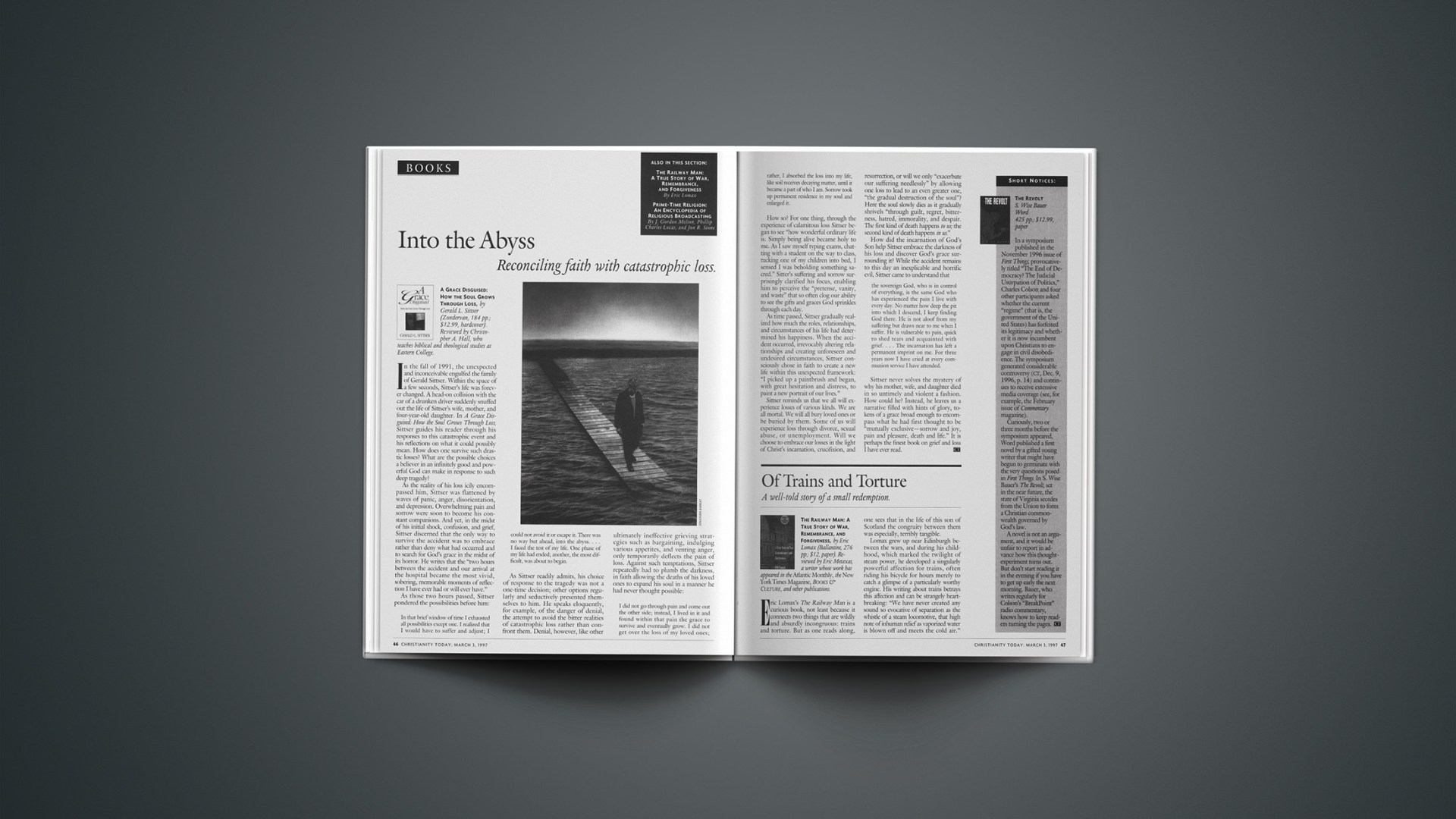

A Grace Disguised: How the Soul Grows Through Loss,by Gerald L. Sittser (Zondervan, 184 pp.; $12.99, hardcover). Reviewed by Christopher A. Hall, who teaches biblical and theological studies at Eastern College.
In the fall of 1991, the unexpected and inconceivable engulfed the family of Gerald Sittser. Within the space of a few seconds, Sittser’s life was forever changed. A head-on collision with the car of a drunken driver suddenly snuffed out the life of Sittser’s wife, mother, and four-year-old daughter. In A Grace Disguised: How the Soul Grows Through Loss, Sittser guides his reader through his responses to this catastrophic event and his reflections on what it could possibly mean. How does one survive such drastic losses? What are the possible choices a believer in an infinitely good and powerful God can make in response to such deep tragedy?
As the reality of his loss icily encompassed him, Sittser was flattened by waves of panic, anger, disorientation, and depression. Overwhelming pain and sorrow were soon to become his constant companions. And yet, in the midst of his initial shock, confusion, and grief, Sittser discerned that the only way to survive the accident was to embrace rather than deny what had occurred and to search for God’s grace in the midst of its horror. He writes that the “two hours between the accident and our arrival at the hospital became the most vivid, sobering, memorable moments of reflection I have ever had or will ever have.”
As those two hours passed, Sittser pondered the possibilities before him:
In that brief window of time I exhausted all possibilities except one. I realized that I would have to suffer and adjust; I could not avoid it or escape it. There was no way but ahead, into the abyss. … I faced the test of my life. One phase of my life had ended; another, the most difficult, was about to begin.
As Sittser readily admits, his choice of response to the tragedy was not a one-time decision; other options regularly and seductively presented themselves to him. He speaks eloquently, for example, of the danger of denial, the attempt to avoid the bitter realities of catastrophic loss rather than confront them. Denial, however, like other ultimately ineffective grieving strat-egies such as bargaining, indulging various appetites, and venting anger, only temporarily deflects the pain of loss. Against such temptations, Sittser repeatedly had to plumb the darkness, in faith allowing the deaths of his loved ones to expand his soul in a manner he had never thought possible:
I did not go through pain and come out the other side; instead, I lived in it and found within that pain the grace to survive and eventually grow. I did not get over the loss of my loved ones; rather, I absorbed the loss into my life, like soil receives decaying matter, until it became a part of who I am. Sorrow took up permanent residence in my soul and enlarged it.
How so? For one thing, through the experience of calamitous loss Sittser began to see “how wonderful ordinary life is. Simply being alive became holy to me. As I saw myself typing exams, chatting with a student on the way to class, tucking one of my children into bed, I sensed I was beholding something sacred.” Sitter’s suffering and sorrow surprisingly clarified his focus, enabling him to perceive the “pretense, vanity, and waste” that so often clog our ability to see the gifts and graces God sprinkles through each day.
As time passed, Sittser gradually realized how much the roles, relationships, and circumstances of his life had determined his happiness. When the accident occurred, irrevocably altering relationships and creating unforeseen and undesired circumstances, Sittser consciously chose in faith to create a new life within this unexpected framework: “I picked up a paintbrush and began, with great hesitation and distress, to paint a new portrait of our lives.”
Sittser reminds us that we all will experience losses of various kinds. We are all mortal. We will all bury loved ones or be buried by them. Some of us will experience loss through divorce, sexual abuse, or unemployment. Will we choose to embrace our losses in the light of Christ’s incarnation, crucifixion, and resurrection, or will we only “exacerbate our suffering needlessly” by allowing one loss to lead to an even greater one, “the gradual destruction of the soul”? Here the soul slowly dies as it gradually shrivels “through guilt, regret, bitterness, hatred, immorality, and despair. The first kind of death happens to us; the second kind of death happens in us. “
How did the incarnation of God’s Son help Sittser embrace the darkness of his loss and discover God’s grace surrounding it? While the accident remains to this day an inexplicable and horrific evil, Sittser came to understand that
the sovereign God, who is in control of everything, is the same God who has experienced the pain I live with every day. No matter how deep the pit into which I descend, I keep finding God there. He is not aloof from my suffering but draws near to me when I suffer. He is vulnerable to pain, quick to shed tears and acquainted with grief. … The incarnation has left a permanent imprint on me. For three years now I have cried at every communion service I have attended.
Sittser never solves the mystery of why his mother, wife, and daughter died in so untimely and violent a fashion. How could he? Instead, he leaves us a narrative filled with hints of glory, tokens of a grace broad enough to encompass what he had first thought to be “mutually exclusive—sorrow and joy, pain and pleasure, death and life.” It is perhaps the finest book on grief and loss I have ever read.
Copyright © 1997 Christianity Today. Click for reprint information.