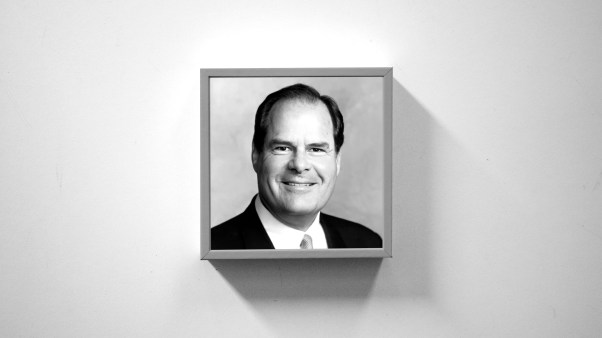



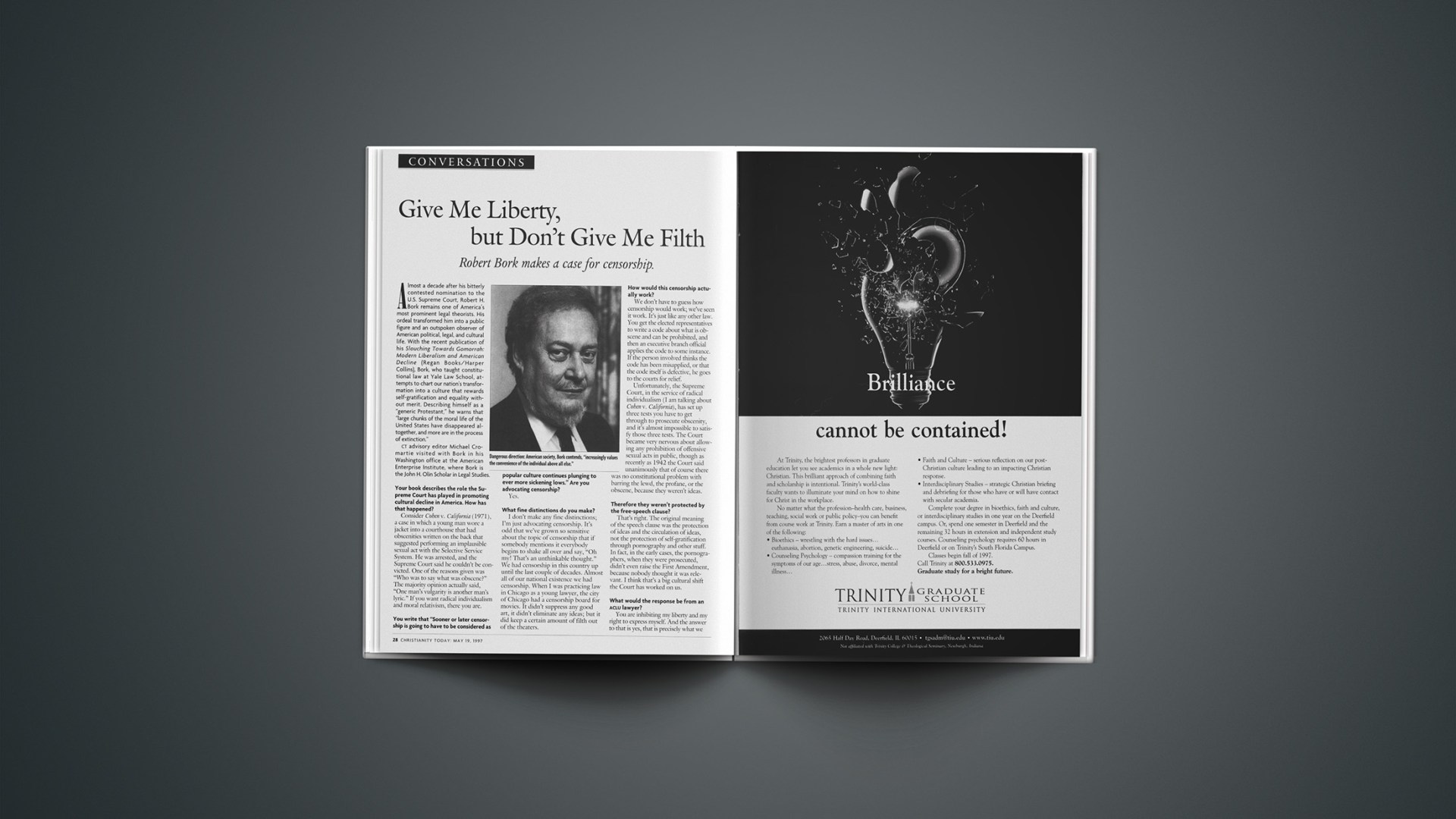

Almost a decade after his bitterly contested nomination to the U.S. Supreme Court, Robert H. Bork remains one of America's most prominent legal theorists. His ordeal transformed him into a public figure and an outspoken observer of American political, legal, and cultural life. With the recent publication of his Slouching Towards Gomorrah: Modern Liberalism and American Decline (Regan Books/Harper Collins), Bork, who taught constitutional law at Yale Law School, attempts to chart our nation's transformation into a culture that rewards self-gratification and equality without merit. Describing himself as a "generic Protestant," he warns that "large chunks of the moral life of the United States have disappeared altogether, and more are in the process of extinction."

CT advisory editor Michael Cromartie visited with Bork in his Washington office at the American Enterprise Institute, where Bork is the John H. Olin Scholar in Legal Studies.
Your book describes the role the Supreme Court has played in promoting cultural decline in America. How has that happened?
Consider Cohen v. California (1971), a case in which a young man wore a jacket into a courthouse that had obscenities written on the back that suggested performing an implausible sexual act with the Selective Service System. He was arrested, and the Supreme Court said he couldn't be convicted. One of the reasons given was "Who was to say what was obscene?" The majority opinion actually said, "One man's vulgarity is another man's lyric." If you want radical individualism and moral relativism, there you are.
You write that "Sooner or later censorship is going to have to be considered as popular culture continues plunging to ever more sickening lows." Are you advocating censorship? Yes.
What fine distinctions do you make? I don't make any fine distinctions; I'm just advocating censorship. It's odd that we've grown so sensitive about the topic of censorship that if somebody mentions it everybody begins to shake all over and say, "Oh my! That's an unthinkable thought." We had censorship in this country up until the last couple of decades. Almost all of our national existence we had censorship. When I was practicing law in Chicago as a young lawyer, the city of Chicago had a censorship board for movies. It didn't suppress any good art, it didn't eliminate any ideas; but it did keep a certain amount of filth out of the theaters.
How would this censorship actually work? We don't have to guess how censorship would work; we've seen it work. It's just like any other law. You get the elected representatives to write a code about what is obscene and can be prohibited, and then an executive branch official applies the code to some instance. If the person involved thinks the code has been misapplied, or that the code itself is defective, he goes to the courts for relief.
Unfortunately, the Supreme Court, in the service of radical individualism (I am talking about Cohen v. California), has set up three tests you have to get through to prosecute obscenity, and it's almost impossible to satisfy those three tests. The Court became very nervous about allowing any prohibition of offensive sexual acts in public, though as recently as 1942 the Court said unanimously that of course there was no constitutional problem with barring the lewd, the profane, or the obscene, because they weren't ideas.
Therefore they weren't protected by the free-speech clause? That's right. The original meaning of the speech clause was the protection of ideas and the circulation of ideas, not the protection of self-gratification through pornography and other stuff. In fact, in the early cases, the pornographers, when they were prosecuted, didn't even raise the First Amendment, because nobody thought it was relevant. I think that's a big cultural shift the Court has worked on us.
What would the response be from an ACLU lawyer? You are inhibiting my liberty and my right to express myself. And the answer to that is yes, that is precisely what we are after. We're talking almost entirely about obscenity in various forms. We're not talking about anything else.
The fact is, we have a hard time censoring parts of rap music that are so obviously detrimental to African-American culture. It's detrimental to everybody's culture. Some of those rappers are white, and 75 percent of the best-selling rap records are sold to white suburban teenagers. Which tells you a couple of things, one of them being the collapse of moral courage. Where are their parents? Why haven't they said to them, "Get that stuff out of here and don't ever listen to it again"? They don't.
Some have argued that moral and cultural decline or renewal are not really affected by the law or by politics. Do you agree? Politics is not the same as culture. Even if we had a conservative President and a conservative Congress, that would not affect what is taking place in the universities, in Hollywood, the network news, and so forth. Politics has an indirect bearing on culture, because a President, for example, can use the bully pulpit of the presidency to influence attitudes. Whether he can influence them more than the universities and television is a highly dubious proposition.
On "life issues," you've had some evolution in your own thinking. You now see them as crucial core issues. How have your views changed? I describe in the book that my view has changed because I had just never thought about abortion much. I lived in a culture where people took abortion for granted—a little inconvenient because it was illegal, but there was nothing immoral about it. It wasn't until much later that I came to realize that this was not just a lump of tissue but an individual human being, that I began to get nervous and my view began to change.
You explain that changing our views on abortion will also affect the way we look at many other things. This, I think, is a society and culture that increasingly values the convenience of the individual above all else, which is another way of saying radical individualism or radical autonomy. Having children is often inconvenient. I cite the figures that the reasons women give for having an abortion show that over 90 percent of abortions are for convenience, not for any medical problem or for any other problem; 43 percent of them are repeat abortions, so it's mainly a birth-control device.
Now, of course, we're moving on to assisted suicide and euthanasia, which is presented as a way of allowing people to die with dignity and not in agony. But the fact is that most of them will have nothing to do with that. Even most of Kevorkian's patients are not terminally ill. (I guess you can't call them "patients"—Kevorkian's "subjects.") Most of the people who will be killed under assisted suicide will not necessarily be terminally ill; they will be people who are burdens on their families. As I say in the book, people tend to be inconvenient at both ends of their lives. We kill them in the womb, and then we kill them in the nursing home.
Can this culture in decline turn itself around? I'm sure it can, but whether it will is a much harder question. The signs aren't good. I think if enough people who are aware of the kind of thing I describe in the book—that our culture is in decline in almost every area, from popular music to religion—and if they realized there was a common cause to this, they might begin to resist what is happening. When I say "resist," I don't mean trying to elect a President or anything as grand as that. They might try to resist it in their public schools, they might try to resist it in their church, they might try to resist it in the universities where they work. By and large, the people who are making this cultural attack are a minority, even in the universities. But they are activists, and they control the dialogue.
The other thing is that there may be signs of a religious renewal in this country. It's not quite clear that there is, but Promise Keepers clearly reflects a religious impulse. The evangelical movement is certainly growing stronger. And one can hope that the more orthodox people in Catholicism, Protestantism, and Judaism will stiffen their spines and do battle in those denominations.
Michael Cromartie, senior fellow at the Ethics and Public Policy Center in Washington, D.C.
Copyright © 1997 Christianity Today. Click for reprint information.