Sometimes you have to suffer as much from the church as you do for it, said Flannery O'Connor. Some of my friends share her sentiment. Caught in the crossfire of church conflict, they considered giving up on the church entirely. Bruised and abused, they wondered, Is it worth all the hassle? And they asked me, "Church—who needs it?"
"I gave up my faith in the church a long time ago, even though I still believe in it." I told them that my faith isn't ultimately in the church. "That is misplaced faith, idolatry. My faith is in God. But I still believe in the church because it is central to what God is doing in the world—forming a reconciled and reconciling people who are a light to the nations."
One of the besetting sins of American Christianity is its failure to take the church seriously, to see its essential role in the mission of God. There is in the United States a growing phenomenon of Christians unconnected to any church, a gap between what George Gallup calls "believers and belongers." A simple comparison of the number of people who say they believe Jesus Christ is God or Son of God (84 percent) with the number who attend church regularly (43 percent) illustrates this gap. And, church-growth specialists tell us, younger believers have little sense of belonging to any church tradition. The "Jesus and me" spirituality of parachurch Christianity has triumphed over the corporate consciousness of the historic churches. Is this not a contradiction of terms: a churchless Christian? A freelance disciple? To become a Christian disciple means not just deciding to follow Jesus, but also joining with a community of disciples bound together by their common commitment to their Lord.
Sometimes we get things turned around: We put our faith in the church rather than in the Head of the church. When we develop unrealistic expectations of the church, we become frustrated and bitter or, worse, disillusioned. At no time is the tendency toward disillusionment more pronounced than when there are apparently irreconcilable differences in the church over matters about which people feel deeply. But as one wit put it, if we become disillusioned, perhaps we didn't have the right to be "illusioned" in the first place. Misplaced faith always disappoints.
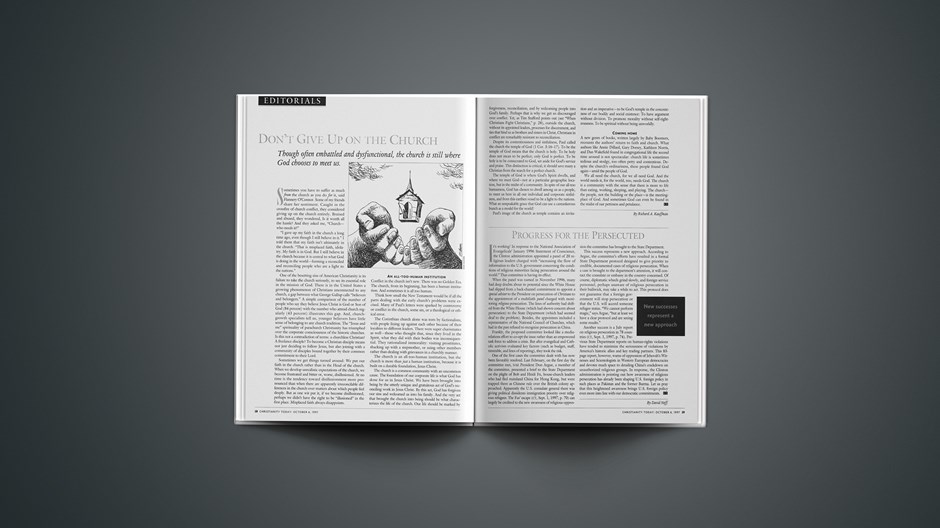
AN ALL-TOO HUMAN INSTITUTION
Conflict in the church isn't new. There was no Golden Era. The church, from its beginning, has been a human institution. And sometimes it is all too human.
Think how small the New Testament would be if all the parts dealing with the early church's problems were excised. Many of Paul's letters were sparked by controversy or conflict in the church, some sin, or a theological or ethical error.
The Corinthian church alone was torn by factionalism, with people lining up against each other because of their loyalties to different leaders. There were super charismatics as well—those who thought that, since they lived in the Spirit, what they did with their bodies was inconsequential. They rationalized immorality: visiting prostitutes, shacking up with a stepmother, or suing other members rather than dealing with grievances in a churchly manner.
The church is an all-too-human institution, but the church is more than just a human institution, because it is built on a durable foundation, Jesus Christ.
The church is a common community with an uncommon cause. The foundation of our corporate life is what God has done for us in Jesus Christ. We have been brought into being by the utterly unique and gratuitous act of God's reconciling work in Jesus Christ. By this act, God has forgiven our sins and welcomed us into his family. And the very act that brought the church into being should be what characterizes the life of the church. Our life should be marked by forgiveness, reconciliation, and by welcoming people into God's family. Perhaps that is why we get so discouraged over conflict. Yet, as Tim Stafford points out (see "When Christians Fight Christians," p. 28), outside the church, without its appointed leaders, processes for discernment, and ties that bind us as brothers and sisters in Christ, Christians in conflict are remarkably resistant to reconciliation.
Despite its contentiousness and sinfulness, Paul called the church the temple of God (1 Cor. 3:16-17). To be the temple of God means that the church is holy. To be holy does not mean to be perfect; only God is perfect. To be holy is to be consecrated to God, set aside for God's service and praise. This distinction is critical; it should save many a Christian from the search for a perfect church.
The temple of God is where God's Spirit dwells, and where we meet God—not at a particular geographic location, but in the midst of a community. In spite of our all-too humanness, God has chosen to dwell among us as a people, to meet us here in all our individual and corporate sinfulness, and from this earthen vessel to be a light to the nations. What an unspeakable grace that God can use a cantankerous bunch as a model for the world!
Article continues below
Paul's image of the church as temple contains an invitation and an imperative—to be God's temple in the concreteness of our bodily and social existence: To have argument without division. To promote morality without self-righteousness. To be spiritual without being unworldly.
COMING HOME
A new genre of books, written largely by Baby Boomers, recounts the authors' return to faith and church. What authors like Annie Dillard, Gary Dorsey, Kathleen Norris, and Dan Wakefield found in congregational life the second time around is not spectacular: church life is sometimes tedious and stodgy, too often petty and contentious. Despite the church's ordinariness, these people found God again—amid the people of God.
We all need the church, for we all need God. And the world needs it, for the world, too, needs God. The church is a community with the sense that there is more to life than eating, working, sleeping, and playing. The church—the people, not the building or the place—is the meetingplace of God. And sometimes God can even be found in the midst of our pettiness and petulance.
















 While we pray for peace, we need moral clarity about this war.
 Church movements need magnetic leaders. But the best leaders need more than charm.
 Drake and Kendrick Lamar’s rivalry reveals our craving for controversy—and what’s lost when community is based on shared hatred, not love.