The nation's largest Lutheran group has embraced greater unity with several Protestant denominations and has taken a step toward theological reconciliation with Roman Catholics.
But the Churchwide Assembly of the Evangelical Lutheran Church in America (ELCA) was unable to muster a two-thirds majority for closer relations with the Episcopal Church, in part because of differing theological views over the office of bishop. Nevertheless, the ELCA voted to keep conversations going with the Episcopalians and discuss the matter in 1999.
CLOSING THE RIFT: In its August gathering in Philadelphia, the 5.2 million-member ELCA agreed to share Holy Communion, pastors, and members with the 2.7 million-member Presbyterian Church (U.S.A.), 400,000-member Reformed Church in America, and 1.5 million-member United Church of Christ. Those denominations endorsed the proposal at conventions earlier in the summer.
The Lutheran-Reformed agreement heals a nearly 450-year-old rift among leaders of the Protestant Reformation. The split dates to the sixteenth century—a period when Martin Luther and Reformed theologian John Calvin agreed on the authority of the Bible and the belief that salvation is a gift based on faith. Lutherans, however, later split with the Calvinists over an understanding of the Eucharist.
Lutherans believe in the presence of Christ in the bread and wine of the sacrament. Reformed churches emphasize the presence of Christ in the community gathered by the Holy Spirit.
The new agreement declares:
—Recognition of each church's baptisms and Eucharists.
—Joint worship services and freedom for members to transfer to the other's churches.
—Mutual recognition of clergy with assignments across denominational lines. (Clergy will minister under the regulations of host denominations.)
—Common commitment to evangelism, witness, and service.
—A means of joint decision-making on critical issues of faith and church life.
—Mutual lifting of past condemnations between the traditions.
The ELCA voted to endorse the full communion pact, despite objections that the United Church of Christ is a congregational body that cannot impose doctrine on individual congregations.
JUSTIFICATION: In a closer move to Catholics, the ELCA voted 958 to 25 to endorse an international joint declaration on justification, the Christian doctrine on how sinful people are reconciled to God.
Along with the agreement, mutual sixteenth-century official condemnations will be wiped away by saying they will "no longer apply" to the churches. That means the Counter Reformation Council of Trent's condemnation of the Lutherans will not be reversed, but simply ended. The declaration has yet to be approved by the Vatican or most other Lutheran groups worldwide.
Regarding the role of good works in justifying sinners to God, the statement says good works are "an appropriate response to God's loving embrace, not something that makes the embrace possible." Good works and faith in justification have been the source of centuries of theological dispute since the Protestant Reformation.
EPISCOPAL FAULT LINE: On a vote of 640 to 397, Lutherans balked at closer relations with the Episcopal Church, falling six votes shy of the necessary two-thirds required for passage.
Debate centered on the doctrine of apostolic succession. This principle, supported by Catholics, Orthodox, and Anglicans, establishes bishops as the heirs of Christ's twelve apostles.
Opponents within the ELCA believed the denomination would have relinquished too much theological ground if it approved the concordat (CT, April 7, 1997, p. 55).
Under the concordat, the Episcopal Church would recognize the ordinations of all current Lutheran pastors. Future ordinations would require that both a Lutheran and Episcopal bishop be present. Also, all future Episcopal and Lutheran bishops would be jointly consecrated for life. Yet, Lutherans would retain their bishops in office for a six-year term as they presently do. Episcopal bishops do not serve a set term of office in a diocese. And after they retire, Episcopal bishops keep their seats in the denomination's House of Bishops.
Lutheran objections to the idea of bishops for life was strongest from Lutherans suspicious of church hierarchy.
Supporters of full communion argued that, before being excommunicated, Luther wanted to continue the historic episcopate.
In arguing acceptance of the accord, Russell Meyer, a Lakeland, Florida, ELCA pastor, asked, "Are we willing to accept the gift of healing for something taken away from us a long time ago? The Episcopalians are willing to return this gift to us in a way that we can retain our own understanding of ministry."
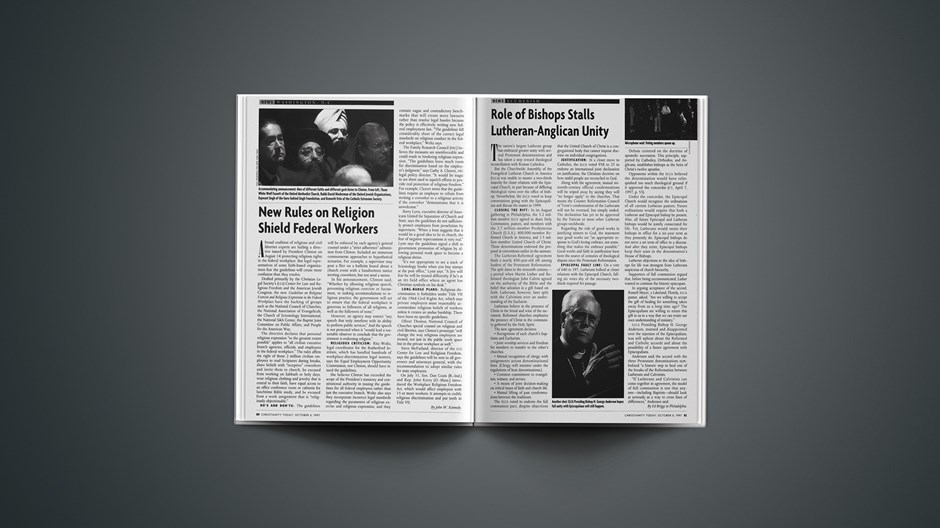
ELCA Presiding Bishop H. George Anderson, stunned and disappointed over the rejection of the Episcopalians, was still upbeat about the Reformed and Catholic accords and about the possibility of a future agreement with Episcopalians.
Anderson said the accord with the three Protestant denominations symbolized "a historic step to heal one of the breaks of the Reformation between Lutherans and Calvinists.
"If Lutherans and Calvinists can come together in agreement, the model of full communion is one that anyone—including Baptists—should look at seriously as a way to cross lines of differences," Anderson said.















 While we pray for peace, we need moral clarity about this war.
 We’ve got little information on Jesus’ appearance and personality. But that’s the way God designed it.españolFrançais
 How groups like Hillsong learned to let go of the literal in favor of creative collaboration.españolPortuguês






