The phone rang one evening in our house in San Jose, Costa Rica. I
was lying in bed reading a book to Angie, who was at that time three years
old. At the other end of the line was the familiar voice of a key Miskito
leader in the armed resistance that had been fighting against the Nicaraguan
government, a person who had become a close friend in the previous year.
"John Paul," he said. "I have some difficult news. I have been informed by
a very good source that there is a plan to kidnap your daughter. They want
you out of the country."
Even now, I can still feel the shiver, the blood draining from my face, and
the pounding of my heart.
"What are you talking about?" I responded, my drying mouth struggling to
stammer intelligent words.
"I cannot give you details on the phone," he said. "We can talk tomorrow.
But listen, it is very serious and it includes the three-letter boys," a
reference to the Central Intelligence Agency (CIA). "You have
to tell your wife to break all her routines. Don't let her go to school tomorrow.
Don't open your doors. Watch carefully."
The words seemed unreal, like a dream. I knew we couldn't talk, but I could
not let him go.
"Come on," I heard myself saying, "how serious is this?"
I will never forget his last words. "John Paul," he responded, "You are one
of us now."
I hung up the phone and went back to Angie, who seemed never to go to sleep.
My mind was racing, and a nagging question kept cropping up: "What in the
world have I gotten us into?"
What I had gotten us into was peacemaking. I was part of a team of church
leaders who were working intensely to bring together the leaders of the
Nicaraguan government and the East Coast resistance for negotiations aimed
at ending the nearly eight-year-old war. While other, more key mediators
were located inside the country, they had difficulty traveling because of
the tense relationship between Nicaragua and the rest of the region. In the
months prior to this phone call, I had become a communication link, often
shuttling messages between opposition leaders located in Costa Rica and
Sandinista officials in Managua, Nicaragua.
The day after that chilling phone call, with even more frightening information,
we shuttled the family out of the house and the country. In the next weeks
and months I returned on my own to continue the work. Eventually, negotiations
were arranged and a cease-fire was put in place, but in the process, those
who did not want a separate Indian negotiation increased their threats and
violence. During that restless night—and many times since—I have often
been haunted by a nagging thought: "Peace is a noble pursuit, but at what
price?"
Since those years in Nicaragua, I have had many opportunities to work in
settings of protracted conflict and wars. Wars emerge for complex reasons
with many levels of activity and consequence—from the histories of animosity
and strife between peoples that date back generations to the interactions
of nations and their powerful but complicated interests.
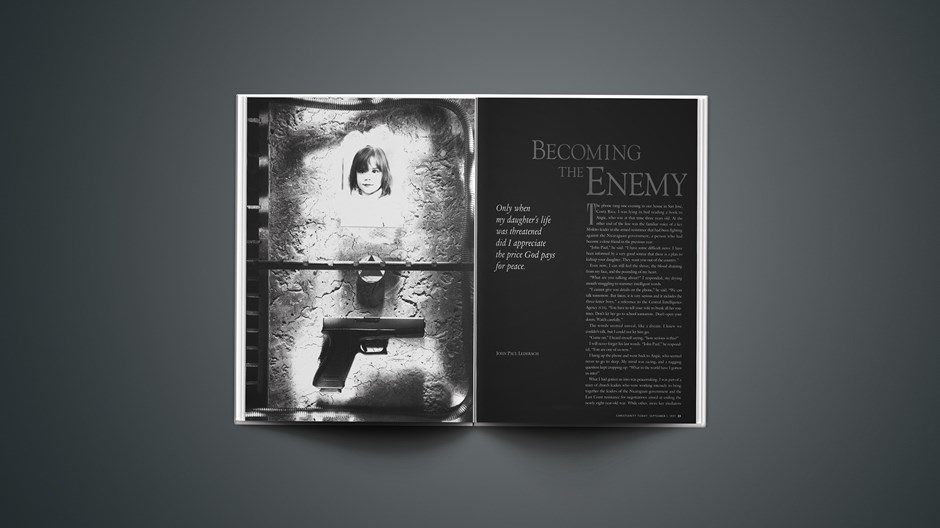
In the name of God, who
in their right mind would
threaten a three-year-old
child as a means of pursuing an
insignificant political objective?
Those who, like myself, operate in an Anabaptist framework often talk of
peace; yet, in real-life international conciliation, peace-building represents
an enormously complex task. In the midst of war, to understand the feelings
and perceptions of people involved is already difficult. To help create the
space needed for reconciliation seems remote at best and, most of the time,
a hopelessly utopian dream. Consistently, I find myself faced with perplexing
questions: How do we move from the words about peace to the practice of
reconciliation? How can we promote a concern for human life and justice in
settings of devastating violence and oppression?
Much of my time is spent working with and between enemies. Time and
again—whether in Nicaragua, Somalia, or the Philippines—I am with people
who threaten, and feel threatened by, each other, who have both experienced
and engaged in the taking of life, who are suspicious and suspected, who
know hate and have hated. As a peacemaker I have, perhaps ironically, become
increasingly wrapped up in the question of enemies. How can I ever understand
their intense level of fear and animosity?
From these experiences and questions, I have struggled with the challenge
of understanding the varied images of enemies in the Bible. This very personal
journey began with that crazy phone call, because it represented the first
time in my life that I had come face to face with an enemy that truly wanted
to harm me and those I loved. The events of that night and my work since
then have led me to reconsider two seemingly contradictory biblical images
of enemies found in the Bible—the cry to crush them and the call to love
them.
CRUSH MY ENEMIES
For many years my convictions about peace did not push me to engage the Old
Testament stories of crushing the enemy. It was not until I "became one of
them" and entered that terrible world of paranoia and fear that I connected
in a personal and vicarious way to the sentiment of crushing enemies found
in the Old Testament.
Article continues below
While it was foreign to my experience to truly feel both threat and hatred,
after the phone call those emotions became real. At various points, I could
hear my inner community of little voices crying out, "Lord, who are these
people? In the name of God, who in their right mind would threaten a
three-year-old child as a means of pursuing an insignificant political objective?
What kind of people would do this?"
My sense of anger and injustice only increased with the knowledge that behind
it all were nameless, faceless entities. I had become the enemy of people
who could hide, who could ruin lives, who for a few dollars could have me
killed. At the same time, these were people who would never become known,
much less held accountable. For the first time, I experienced the presence
of true evil in a personal way. It was through these events that my heart
bypassed my peace-loving mind and connected to the crying voice of the psalmist
and the powerful message, "Lord, deliver me and crush my enemies."
Listen carefully to the psalmist's words:
I am distraught by the noise of the enemy,
because of the clamor of the wicked.
For they bring trouble upon me,
and in anger they cherish enmity against me . …
Confuse, O Lord, confound their speech;
for I see violence and strife in the city . …
Let death come upon them;
let them go down alive to Sheol;
for evil is in their homes and in their hearts.
(Ps. 55:2b-3, 9, 15, NRSV)
The wicked go astray from the womb;
they err from their birth, speaking lies.
They have venom like the venom of a serpent, …
O God, break the teeth in their mouths;
tear out the fangs of the young lions, O LORD!
Let them vanish like water that runs away;
like grass let them be trodden down and wither.
Let them be like the snail that dissolves into slime;
like the untimely birth that never sees the sun . …
The righteous will rejoice when they see vengeance done;
they will bathe their feet in the blood of the wicked.
People will say, "Surely there is a reward for the righteous;
surely there is a God who judges on earth."
(Ps. 58:3-4a, 6-8, 10-11)
I would venture a guess that these texts are rarely preached from pulpits,
certainly not in churches from my tradition. During the time I worked in
Central America I had been close to and known the violence of war and all
that it brings. I knew families that had lost their parents, children, brothers,
and sisters. I had friends who lost limbs and even their lives. No matter
how much I knew, it was only after the experiences of direct manipulation
and the threat of violence against me that I began to understand the deep
anger that accompanies fear, the frustration of helplessness, and the bitter
taste of enmity. To be "one of them" was to experience, in ever so small
a dose, the deep cry for a just God and the absolute dependence on God for
deliverance.
Article continues below
GOING DOWN THE RIVER OF HATE
In the months that followed, in spite of initial pressures and threats, we
achieved a measure of success by helping to bring leaders of the two sides
in the Miskito-Sandinista conflict to negotiations. As part of their initial
accords, they agreed to a trip into the East Coast of Nicaragua, the home
territory of the indigenous leaders. For many of the exiled leaders, this
was the first time in years they had returned to their homeland. For every
one of them, it was the first time they had returned in the open presence
of former enemies.
This was a time of both expectation and vulnerability. What was accomplished
formally at the negotiating table in the capital cities was not easily
implemented nor even shared in the villages where the war itself had raged.
Our conciliation team was asked to accompany the returning leaders to meet
their communities and talk about the peace process. It was an invitation
to walk into the heart of reconciliation and all its challenges.
As one can imagine, it seemed a logical proposal, but it was not an easy
task. People on both sides had questions and suspicions. The protocol and
formality of negotiations in Managua hotels were gone. In the villages, it
was an organic process where people stood face to face with the very enemies
they had sought to control, enemies who, in many instances, had killed members
of their own immediate families. We traveled by riverways days and long hours
into the remote areas of the country.
For the first time, in some of the villages, people came forward to speak
about local difficulties dealing with leaders on both sides of the conflict.
In one particular village, people talked at length, detailing the atrocities
committed by a particular local Sandinista military leader who was present
at the meeting.
In situations where great pain and emotion are expressed it is difficult,
if not impossible, to control what emerges from every event. That night,
this Sandinista leader and several of his men were attacked and very seriously
wounded. The word about this outbreak of violence spread ahead of us rapidly;
by the time we reached the main city in the northeast, the Sandinista
sympathizers were up in arms against what they saw as inflammatory speeches
by the returning indigenous leaders. Demands were made that no further speeches
be made since they created the conditions for violence.
Article continues below
Puerto Cabezas was the largest of the Miskito centers. The indigenous leaders
were adamant about holding the public meeting to talk of the peace process
in accordance with the agreements reached in the capital with the top-level
Sandinistas. However, the local Sandinista leaders were of a different mind.
In some instances they orchestrated open and violent responses to the returning
Indians. As the day approached for the main event, an impasse set in: Miskito
leaders said they would hold the public meeting; Sandinista leaders said
they could not guarantee anyone's safety if they did.
The conciliation team literally worked day and night to stave off the violence,
but inevitably the relationship deteriorated. The open meeting was set for
noon. The afternoon and evening before, we had separate meals with both sides
where we once again pleaded for restraint. We decided that, in accordance
with our role as reconcilers, we would accompany Indian leaders throughout
the day in the hopes that our presence might lower the likelihood of violence.
In the morning, before we left the house where we were staying, we gathered
to pray as a team. We prayed by name for the leaders and key persons on all
sides, for those who were friends, and for those who we knew were angry and
volatile.
Soon it became clear that a worst-case scenario was developing. The meeting
was to be held in the baseball stadium. During the morning, people gathered
in the stadium, but soon mobs appeared, particularly Sandinista youth armed
with clubs, chains, and machetes. The public meeting could barely be heard
over the din of angry voices. As one of the Moravian pastors opened with
prayer, machine guns crackled behind us, mostly as a disruption, creating
confusion. When the speeches finally ended, some members of our team accompanied
the Indian leaders to their houses. I remained behind with Carlitos, a fellow
member of the conciliation team, to drive out the pick-up that had been used
as a podium for the speeches. In the streets around the stadium, hand-to-hand
fighting and rioting broke out. Just as we were about to leave the stadium,
a large mob rushed inside. They entered the only exit we had for leaving
the grounds, and out of the chaos, a young Sandinista recruit pointed at
me and shouted, "There's the gringo. Get him! Get him!"
Article continues below
I had become the enemy of
people who could hide, who
could run lives, who for a few
dollars could have me killed.
At the sound of that voice there is a picture that has remained frozen in
my memory. In this picture I can look out into that crowd and see the faces
of young people, some whom I knew. There was a certain frenzy in their faces
as their eyes turned and riveted on me. I was the enemy. Only this time,
I represented the enemy they could never touch. What had for years been the
source of their economic hardships, the source of the weapons for their enemies,
the source of their oppression was now within their grasp. I represented
America and all the suffering they could never alleviate. In their eyes I
could see the years of frustration, of lost loved ones, of a pain that festers
into resentment and boils over into an uncontrolled anger.
The rest is a blur of a few seconds. We leaped for the truck and started
the 15 yards through the mob toward the only exit. The first thing that hit
us was a logging chain that shattered the windshield, sending glass into
our arms and faces. By the time we had gone a few feet, there was not a window
left in the truck. I can still feel the blows of stones, a two-by-four landing
on my shoulder, and the splatter of Carlitos's warm blood that hit my cheek
from a blow he received in the back of the head. Miraculously, he did not
pass out as he drove slowly through the stoning gauntlet.
Minutes later, we were in the local hospital, where we were cleaned and stitched
up by a Cuban doctor. I remember sitting in that hospital waiting room, my
eyes and head jerking at the sound of shouts or gunshots. My mind was racing
with one thought, "Just take me to a safe place." I felt a fear that crossed
over into paranoia.
In less than a year, I had been accused of being a Sandinista spy, my daughter's
life had been threatened, I had received multiple assassination threats,
I had been called a dog of the CIA, and I had been stoned.
I no longer question the suspicious, paranoid attitudes of those in war,
for I know the craziness of a fearful mind that looks behind every person
for a threat. I no longer wonder how it is possible that one group could
see another as a real threat to their existence, for I know what it feels
like to be falsely accused, arrested, and interrogated. I no longer doubt
the reality of an anger that flows into hate, for I have experienced such
an anger within my own heart, and I have been the object of such hatred.
Article continues below
When I hear those powerful, almost embittered words from the psalmist, I
no longer have a need to dismiss them. Instead, in so many of the conflicts
I see today around our globe, I am drawn to the cry that flows from the angry
heart. I have come to believe much more deeply in the proper place of righteous
indignation. In too many places around the world I have felt and seen waters
running down a river of pain, echoing the psalmist's cry. I am convinced
that reconciliation has a home in that river that seeks deliverance and justice.
A PARENT'S ULTIMATE SACRIFICE
Buried within these experiences with real enemies I have also heard another
voice. It was the voice of God's search for reconciliation, a call to love
those who do you harm. As I write these lines, I am working with Angie's
Sunday-school class some six years after the events just described. This
week their assignment is to memorize John 3:16: "For God so loved the world
that he gave his only Son, that whoever believes in him should not perish
but have eternal life."
Since our time in Central America, having worked these past years in the
context of wars, this most popular verse has taken on a whole new meaning.
We have traditionally understood John 3:16 as a creedal formula. We tend
to place the emphasis on the "whoever believes in him shall be saved" portion.
What counts, in terms of faith, is the belief.
But look again. Embedded in the verse is a story of a parent who gave up
a child. As a parent who has had my only child threatened, this story of
God's loss of a son is all too real. In all my life I have never experienced
anything so precious as the gift of Angie and Joshua. Even with all the
challenges, all the energy expended, all the sleepless nights and the sibling
fights, nothing matches the gift of a life placed in our hands for nurture,
love, and growth. This is why the phone call shook me awake and made me see
things differently, for I was faced with the reality of an ultimate sacrifice.
Is there anything you feel
is so important that you would
give up your child to achieve it?
When I said that I could feel the blood drain from my face as I listened
to the words on the phone that night, I meant it literally. I felt an immense
internal sense of my heart being crushed. I could face a threat against me.
But how could I face a threat to my only child? What activity could ever
be worth losing my daughter? Was pursuing peace in Nicaragua worth the life
of my child? Think about it: Is there anything you feel is so important that
you would give up your child to achieve it?
Article continues below
Looking again at John 3:16, we find this is the very choice at the heart
of God's search for reconciliation. What I find incomprehensible is that
God, as a parent, gave up this most precious gift in order to be reconciled
with erring, belligerent enemies. I can understand sacrifice for family or
friends. I would not hesitate to give a risky blood transfusion if it meant
saving the life of my child. But to do this for enemies is beyond understanding.
I can no longer take John 3:16 as simply a short formula for salvation. It
also embodies a foundational ethic of reconciliation, an ethic based on a
willingness to make the ultimate sacrifice on behalf of an enemy. It is an
ethic undergirded and made possible only through the immeasurable love and
grace of God. As the hymn states it, "O love of God, how rich and pure! /
How measureless and strong! / It shall forevermore endure— / The saints'
and angels' song." It is a love like that described by the apostle Paul,
who suggested that "neither death, nor life, nor angels, nor rulers, nor
things present, nor things to come, nor powers, nor height, nor depth, nor
anything else in all creation, will be able to separate us from the love
of God."
I have experienced that love in many ways, from the protection of our family
in Central America to the grace that covers a multitude of shortcomings.
Yet, while I aspire to bring this love to the world, I recognize that I barely
understand its real height and depth, much less am I fully able to practice
and live by it. I only know that this love ultimately sustains life and is
the essence of the very nature of God, who sought reconciliation with the
enemy through the sacrifice of his only child.
SEEING THE FACE OF GOD IN THE ENEMY
Several points have been important in my own understanding that may contribute
to developing a practical theology of the enemy.
First, the obvious: enemies are present throughout the faith story. In fact,
without enemies, the story of faith itself, of reconciliation with God, cannot
be told.
As Christians, we do ourselves little favor by developing theologies of easy
peace accomplished through promises of humanistic love. Quite frankly, there
is nothing human about loving your enemy. To live faithfully in the face
of enemies is possible only with a deep spiritual connection to God's love
and a willingness to live as vulnerably as Jesus.
Article continues below
I am struck with the story of Jacob and Esau's reconciliation (Gen. 32-33).
As the story develops, we find Jacob fearful of his brother's rage. His brother
had become his worst enemy. In the midst of the journey toward his brother,
Jacob fights all night with God in person, whom he claims to have "seen face
to face." Then, rising in the morning, Jacob humbles himself before his feared
enemy, only to discover the emotional release of reconciliation, at which
point he then exclaims to his brother, the former enemy, "To see your face
is like seeing the face of God."
This is the journey of reconciliation, a journey where we struggle directly
with God and ultimately seek the face of God in the enemy.
Second, a theology of the enemy must integrate the cry for deliverance with
the acknowledgment and rightful place of anger. Ironic as it may sound, I
have come to the conclusion that the only really good peacemakers are angry
pacifists who have touched the river of human pain.
Yet, facing the enemy is only possible to the degree that we are rooted in
God's sustaining love and struggle with the seemingly impossible sacrifice
God's love for us represents. To pursue reconciliation, we ourselves must
embrace the long, sleepless night of fighting with God in ourselves before
we can journey toward God and seek his face in our enemy.
This is the paradox and challenge of the enemy: to acknowledge the rightful
place of anger in the cry for deliverance and simultaneously to move toward
God's sacrificial, unending love. In the end, the journey of reconciliation
inevitably takes us toward the enemy, and it seeks the face of God.
John Paul Lederach is director of the conflict analysis and transformation
program, Eastern Mennonite University, Harrisonburg, Virginia. This article
is from a forthcoming book to be published by Herald Press.
















 While we pray for peace, we need moral clarity about this war.
 But let’s not mistake it for calling.
 After this week’s UMC votes on LGBTQ issues, African Methodists should join American conservatives in the new Global Methodist denomination.