We are at an impasse over race because we cannot forgive, declared Spencer Perkins in what became his last public statement. Speaking at a conference on racial reconciliation last January, the activist and writer confessed his past struggles in dealing with "white folks" and how he discovered a radical way forward in healing our racial divide. The following week he died of heart failure at the age of 44. Perkins, along with Chris Rice, directed Reconcilers Fellowship in Jackson, Mississippi, coauthored More than Equals: Racial Healing for the Sake of the Gospel (IVP), and coedited Reconcilers magazine.
It was winter 1970, and my mother was taking my seven siblings and me to visit our father in the hospital. No auto accident or natural illness had landed him in this life-threatening condition. Rather, it was the nightsticks and fists of white law-enforcement officers that had nearly beaten him to death for his civil-rights activities.
My sister Joanie, then 14 years old, took one look at my battered father and stormed out of the room repeating angrily, "I hate white people. I will never like them!"
My mother tried to convince her that her attitude was not very Christlike. But at that moment, with my father lying bruised and swollen, I could tell that even though my mother knew the right things to say, her heart was not in the words she spoke.
Not that it would have mattered. My sister was having no part of those tired, old words—love and forgiveness—anyway. Those white people were not going to get off that easily. All of us siblings wanted those men to get what they deserved. To our knowledge, they never did.
Today, to the casual observer, my sister looks as though she has reneged on her vow. She has white friends, attends an interracial church, and functions well in a white environment. But all her life, like many African Americans, Joanie has had a safe, time-tested method for emotionally dealing with whites.
There is a scene from the movie Roots that illustrates the way blacks tend to label whites. Tom and his family (newly freed slaves) have befriended a poor white couple. Against tradition, George and Mary treat their new black friends as equals. One night Tom is visited by white night riders, tied to a tree, and about to be horse-whipped for being "uppity." In a backhanded way, George saves Tom's life by demanding that he deliver the whipping.
Afterward, Tom's young son sits in tears on the porch with Mary. Summoning all the hate and bitterness an eight-year-old can muster, he vents his feelings. "I hate white folks," he sobs bitterly. "And if I get a chance I'll do to them what they did to my daddy."
"But what about me and George?" Mary asks. "We're white."
The boy looks up as if surprised that Mary could say such a silly thing. "But you and George are different," he says. "You good white people."
This is precisely how many blacks deal with whites today. From a distance, they are "white folks" and therefore suspect. Once we get to know them up close and personal, we may mentally remove them from the "bad" category.
Explaining this procedure is risky. Generalizations are always dangerous; and many of my black brothers and sisters feel that revealing our secrets in mixed company borders on treason. But there are also many of us African Americans who are growing tired of the tiptoeing that takes place in so many racial-reconciliation gatherings. For us, it is time to move into deeper waters.
White folks
There is an automatic mental procedure that takes place for many blacks upon first meeting a white. First a decision must be made as to whether or not we will give him or her the time of day. If so, then, immediately the "Is he for real or phony?" antennas are raised, the "white superiority" sensors powered up, and the "racism" detector activated—all in an effort to analyze quickly any "vibes" and interpret any data, verbal or nonverbal, from the subject. All this is necessary to determine whether the white person deserves special consideration as an "individual," that is, a "good white person," or as a "typical" white person who should be quickly relegated to the simple category "white folks," as in "You know how white folks is."
Whether the label is deserved or undeserved, in the minds of most blacks, all white people are "white folks" until they prove themselves "different." It is part life experience, part self-preservation, and part projection. I have questioned very intelligent black people who admit that this "sizing up" of whites is often not very objective. But it takes place just the same.
Now, before you white readers get too indignant, you need to acknowledge that many of you do something similar when you meet a black person: "Is this a run-of-the-mill black or is he or she an exception that I can respect and treat like a peer?"
This is not intended to be another hoop for whites to jump through. This is about black responsibility in the reconciliation process.
Obviously, this judging is unfair to whites. But most blacks don't care about the fairness of it. They have a convenient ration-alization that goes something like this: In the grand historical scheme of fairness, the incidence of blacks beating the system, blacks placing unfair demands on whites, and whites getting the short end of the stick today is only a brief moment in history—whether this happens through the courts or through affirmative action. And these minor inconveniences whites experience don't even deposit an ounce of weight toward balancing the cosmic scales of historical justice.
Article continues below
There is a problem for those of us who believe that God intends for all believers to be one family and that our faith should supersede our race: We sense that something is not right in our attitudes about whites. Something has been conspicuously missing in our dialogue about racial justice and reconciliation. It is the one characteristic that sets our God and faith apart from all the other religions. It is our secret weapon and the major reason why Christians have the best shot at making racial reconciliation a reality.
I am not all that excited about bringing up the subject of grace. It's similar to the way white people don't like apologies for slavery and the injustices of the past because of where that may lead—to a demand for reparations.
Part of my consciousness trembles because it has already calculated the consequences of allowing grace to take its rightful place in reconciliation. That part of me already knows where I am heading with this and that it will not go over very well with my homeys. Still, I know that it is the truth according to the gospel of Jesus.
Irreconcilable differences
For more than 10 years, Chris Rice, my white ministry partner, and I have preached the importance of relationships in achieving racial reconciliation. We are so adamant about this because most of what we have learned and now teach comes out of our own relationship.
For what was not the first time nor likely to be the last, Chris and I had come to what seemed like insurmountable obstacles in our relationship. By summer's end, both of us held tightly to a long mental list of ways that each of us had hurt or disappointed the other. We were close to settling for irreconcilable differences and going our separate ways.
But in order to demonstrate that we were good Christian boys, we sought the counsel of some dear friends. In my mind, we were just going through the motions. The damage was already done. The pain was too great. Neither of us was prepared for the overwhelming simplicity, the complete absurdity, and illogical genius of God's amazing grace.
Article continues below
The brand of Christianity that both Chris and I feebly attempt to live by demands that we make a good-faith effort to follow when we feel God is leading. Trying to live up to that commitment allowed us to be bushwhacked by John and Judy Alexander and their ramblings about grace.
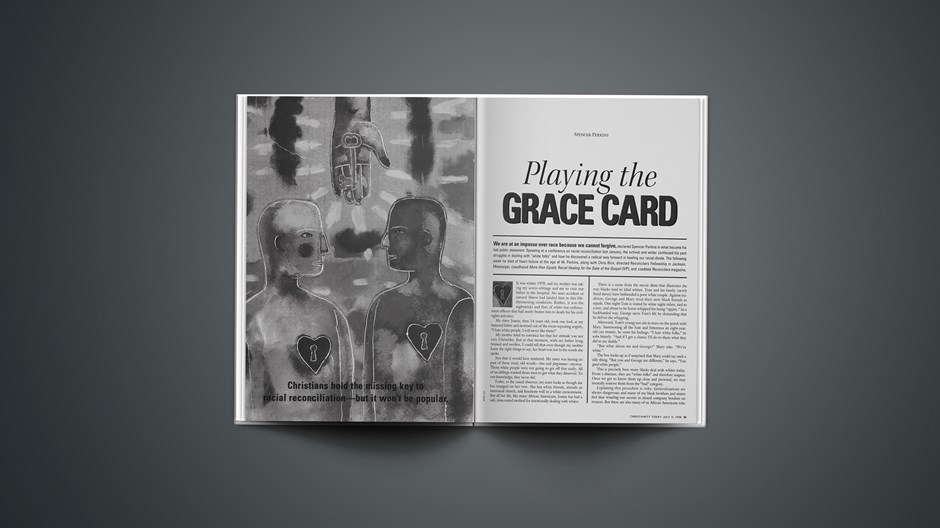
Practicing forgiveness will mean
beginning to dismantle the old
"white folks" category and practicing
seeing whites as individuals.
"Yeah, yeah, I know all about grace," I thought. I could quote John 3:16 when I was knee high to a duck. Grace is God's love demonstrated to us, even though we don't deserve it. But in all my 43 years of evangelical teaching, I never understood until now that God intended for grace to be a way of life for his followers. Maybe I'm the only one who missed it, but judging by the way that we all get along, I don't think so. Sure, I knew that we are supposed to love one another as Christ loved us. But somehow it was much easier for me to swallow the lofty untested notion of dying for each other than simply giving grace to brothers and sisters on a daily basis, the way God gives us grace. Maybe I'm dense, but I just never got it.
At our relationship's weakest moment, Chris and I saw, as clearly as we had ever seen anything, that only by giving each other grace could we find healing and restoration. We could either hold on to our grievances and demand that all our hurts be redressed, or we could follow God's example, give each other grace, and trust God when we lacked the ability to forgive. We chose grace.
I heard a well-known Christian black woman tell about her grown daughter getting into a fight with a white woman on an airplane. Although she taught her children all their lives to be nonviolent, a smile crept across her face and a gleam of pleasure twinkled in her eyes as she described how her daughter "gave that white woman a black eye." Although this woman believed wholeheartedly in racial reconciliation, there was still something deep down in her that felt it was payback every time a white person got the short end of the stick at the hands of someone black. And she's not alone.
Because blacks have suffered unjustly at the hands of whites, our brand of Christianity has allowed us to hang on to this particular category of unforgiveness. Sure, we say that we are willing to forgive, and we do. But that special dispensation is reserved for whites who prove that they are "worthy."
Article continues below
I stumbled across Philip Yancey's landmark book, What's So Amazing About Grace, just when Chris and I were discovering grace all over again. God was attacking me with grace from all angles. According to Yancey, "Grace is unfair, which is one of the hardest things about it. It is unreasonable to expect a woman to forgive the terrible things her father did to her just because he apologizes many years later. … Grace, however, is not about fairness."
It is just as unreasonable for blacks to forgive whites for past and present mistreatment. But grace is not about being fair. We wouldn't dare demand fairness from God. What's so amazing about grace is that God forgives us and embraces us even though we don't deserve it. What's new about grace, at least for me, is that because we are grateful for what God did for us, we allow him to do the same to others through us. This means that if I know this loving God who is so full of grace, then I will forgive, accept, and embrace those who, like me, don't deserve my grace and forgiveness.
Our willingness and ability to give grace or to forgive others is an accurate indicator of how well we know God.
A new player
We African Americans have rightly considered much of white Christianity illegitimate because it accommodated itself so conveniently to racism. But lately I have been questioning our own brand of Christianity. What does our inability to forgive and embrace undeserving whites say about our knowledge of and intimacy with this God of grace?
When I was much younger and just beginning to wrestle with the concept of reconciliation, I was occasionally asked if I had forgiven the men who beat and almost killed my father, or the white classmates who made my life hell while I was integrating a segregated school. At that time, my response always focused on the ones who had committed the offense. "They've never asked me to forgive them," I would say. End of discussion.
However, Jesus knew that the only sure way to peace on earth and peace of mind was for humans to practice forgiveness. His last words on the cross were spoken aloud so that we would have an example to follow. "Father, forgive them because they don't know what they are doing." Jesus forgave without being asked. For our own sakes, not the offenders', we are expected to do the same.
Black Christians possessing a truly Christlike faith would not only be compelled, but would also be willing and empowered to forgive specific white offenders. Moreover, we would have the faith and compassion to begin practicing forgiveness to the nameless collective we refer to as "white folks."
Article continues below
I believe that African Americans will easily grasp the implications and magnitude of totally and unconditionally forgiving "white folks." Some blacks will find ways to justify themselves. Others will rise to the challenge. My sister, who vowed as a child never to like white people, is just now beginning the process.
In December she participated in a first-of-its-kind gathering in our city. We brought together 25 black Christian leaders and 25 white Christian leaders for an intense, honest, off-the-record dialogue on racial reconciliation. I have been participating in racial dialogue gatherings for more than 15 years, and everyone agreed that none of us had ever been involved in anything this honest. Two days after the gathering, in our small group meeting, my sister bravely confessed through her tears that she, for the first time in her life, had begun the process of forgiving "white folks."
For Joanie and many other African Americans, practicing forgiveness will mean beginning to dismantle the old "white folks" category and practicing the discipline of seeing whites as individuals. It will mean responding with Christlike compassion and kindness to whites who reach out a hand, instead of going through the process of determining whether or not they are "worthy." It will mean no longer being obsessed with the blindness of our white brothers and sisters at the expense of tolerating our own.
And finally, reconciliation will ultimately mean not only forgiving and tolerating, but fully embracing each other as brothers and sisters, all of us equally unworthy in the eyes of God.
No, it ain't fair, but it's right. And God understands that there will be slip-ups and wrong turns, moments of anger and unforgiveness. But as we grow in our discipleship of grace, each day will bring more victories. And when we fail, our God, who is full of grace, is eager to forgive. The more I have come to know this divine quality, the dearer he becomes to me, and the more I want to demonstrate this quality to others.
What about justice?
I grew up in one of the most justice-oriented families in this country. My father has been called a modern-day prophet of justice. Two of his most popular books are entitled Let Justice Roll Down and With Justice for All.
Nothing that I have been learning about grace and forgiveness diminishes my belief in Christians working for justice, especially on behalf of the poor and oppressed. I know many tired soldiers who, like me, have fought for social justice most of their lives. Nothing in the Scriptures even hints that these modern-day prophets of justice should soften their message.
Article continues below
But I know that some of them have carried an extra weight of resentment against people they consider oppressors and against people of privilege who seem to care nothing about the poor. I recognize it in them because I feel it in myself. But what I have found and latched onto is a whole new way of looking at those who refuse to hear the message of justice.
Although we must continue to speak on behalf of those who are oppressed and warn oppressors, my willingness to forgive them is not dependent on how they respond. Being able to extend grace and to forgive people sets us free. We no longer need to spend precious emotional energy thinking about the day oppressors will get what they deserve.
What I am learning about grace lifts a weight from my shoulders, which is nothing short of invigorating. When we can forgive and accept those who refuse to listen to God's command to do justice, it allows them to hear God's judgment without feeling a personal judgment from us. Which, in the end gives our message more integrity. The ability to give grace while preaching justice makes our witness even more effective.
Taking baby steps
"Daddy, come quick," shouted my four-year-old daughter. "Someone stole the presents from under the Christmas tree."
At first I thought it was a joke that the children were playing on me. But immediately I could see that they were visibly upset. Apparently someone had come into our house while we slept, picked out some choice presents, removed the blanket that covers my favorite chair, and used it to haul away about a dozen or so gifts that were to be given to the children and to friends and family on Christmas morning.
To say that the children were angry would be an understatement. My 11-year-old son, Jonathan, after realizing that among the gifts stolen were his brand new Nike sneakers, stormed out of the house in tears.
I sat silent on my coverless chair, stunned, fuming. I had seen the children's Christmas special How the Grinch Stole Christmas dozens of times since childhood. But I never believed such a tale could come true. How do you forgive a person like this? How do I teach my children to practice forgiveness?
Because it is unnatural, we have to practice forgiveness, like any other discipline. According to Dr. King, "Forgiveness is not just an occasional act: It is a permanent attitude."
Article continues below
Later that day I put the question to my son, "How should we respond as Christians to the person who tried to steal our Christmas?"
"Yeah, yeah, I know, Dad," he said. "Even though he doesn't deserve it, we're supposed to give him grace."
Sure, I knew that the words that came out of his mouth were almost the complete opposite of what he was feeling in his heart (I knew because I felt the same way). But I also knew we had to start somewhere. And if, one step at a time, our discipleship as Christians could include giving each other grace, if our children could learn and practice forgiveness as well as they practice praise and worship, if we could literally create a counterculture of grace, then just maybe, as we all mature in our faith, our hearts could finally line up with our words.
















 While we pray for peace, we need moral clarity about this war.
 Church movements need magnetic leaders. But the best leaders need more than charm.
 Why Wayne Grudem’s interpretation of Ephesians 5:21 is untenable.