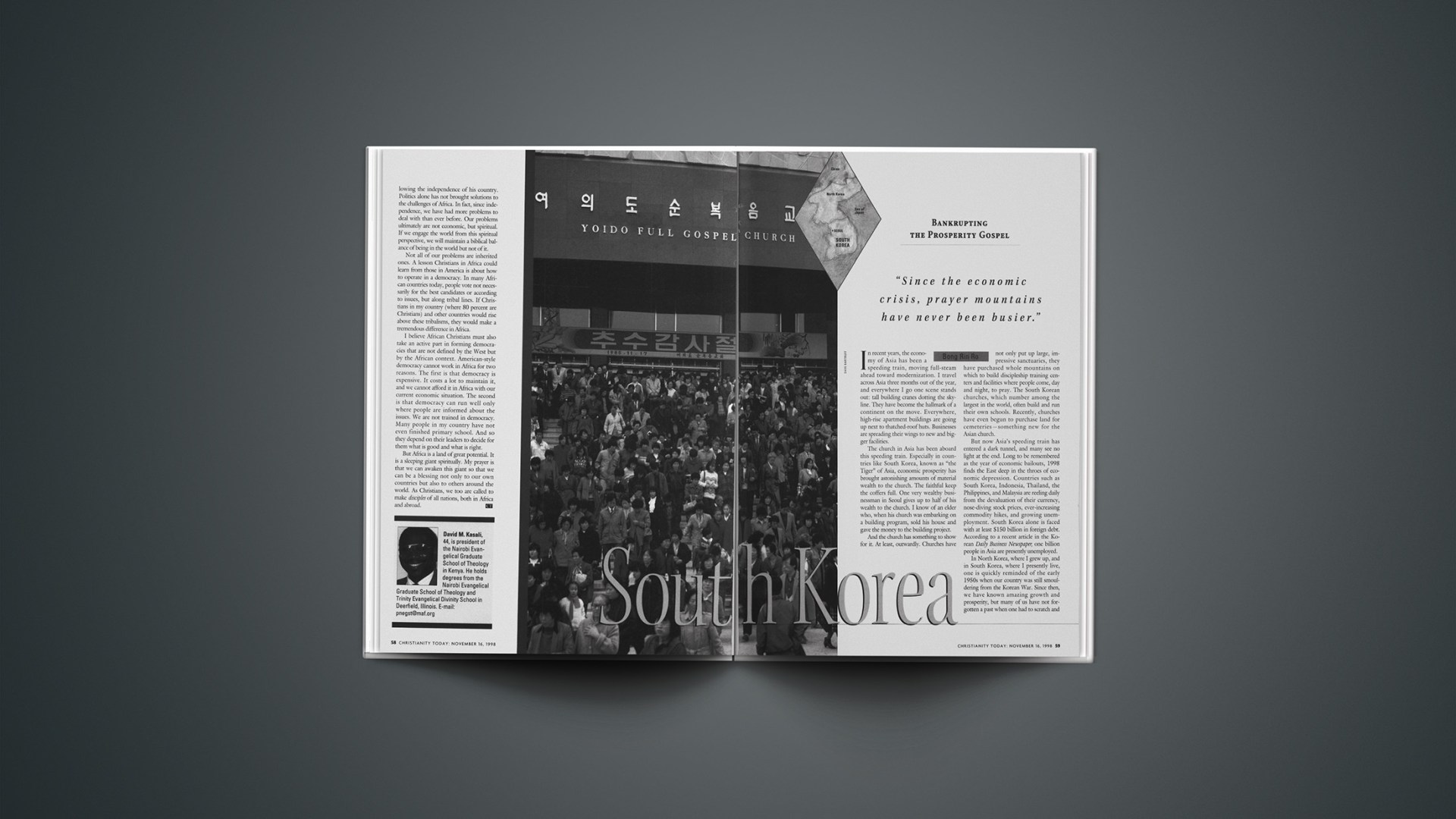

South Korea
“Since the economic crisis, prayer mountains have never been busier.”
In recent years, the economy of Asia has been a speeding train, moving full-steam ahead toward modernization. I travel across Asia three months out of the year, and everywhere I go one scene stands out: tall building cranes dotting the skyline. They have become the hallmark of a continent on the move. Everywhere, high-rise apartment buildings are going up next to thatched-roof huts. Businesses are spreading their wings to new and bigger facilities.
The church in Asia has been aboard this speeding train. Especially in countries like South Korea, known as “the Tiger” of Asia, economic prosperity has brought astonishing amounts of material wealth to the church. The faithful keep the coffers full. One very wealthy businessman in Seoul gives up to half of his wealth to the church. I know of an elder who, when his church was embarking on a building program, sold his house and gave the money to the building project.
And the church has something to show for it. At least, outwardly. Churches have not only put up large, impressive sanctuaries, they have purchased whole mountains on which to build discipleship training centers and facilities where people come, day and night, to pray. The South Korean churches, which number among the largest in the world, often build and run their own schools. Recently, churches have even begun to purchase land for cemeteries—something new for the Asian church.
But now Asia’s speeding train has entered a dark tunnel, and many see no light at the end. Long to be remembered as the year of economic bailouts, 1998 finds the East deep in the throes of economic depression. Countries such as South Korea, Indonesia, Thailand, the Philippines, and Malaysia are reeling daily from the devaluation of their currency, nose-diving stock prices, ever-increasing commodity hikes, and growing unemployment. South Korea alone is faced with at least $150 billion in foreign debt. According to a recent article in the Korean Daily Business Newspaper, one billion people in Asia are presently unemployed.
In North Korea, where I grew up, and in South Korea, where I presently live, one is quickly reminded of the early 1950s when our country was still smouldering from the Korean War. Since then, we have known amazing growth and prosperity, but many of us have not forgotten a past when one had to scratch and claw for the next meal. While we are not facing anything like the devastation of war, Asians are clearly shaken—and the church along with it. Amidst this economic gloom, the church is stopping to take stock, to ask itself some tough questions.
The mood, especially in South Korea, has turned toward repentance. Listen in on almost any Sunday morning Protestant worship service in the urban areas—where the effects on the church of secularism and materialism are most keenly felt—and you will most likely hear prayers of confession, confession of arrogance and of indifference toward God in the face of affluence. Prayer mountains have never been busier. People are there to plead with God for healing, both spiritual and financial healing. While I have not noticed a particular increase in church attendance since the economic crisis hit South Korea, I have noticed a new fervency in prayer. Churches were calling for special all-night prayer sessions, and attendance in early-morning prayer meetings is on the increase.
It is not altogether surprising that the Asian church is turning toward repentance in the face of economic crisis. In Asian countries of great affluence, such as South Korea, “Prosperity Theology” has long been taught from the pulpits. At its core is this reasoning: The more you give to God, the more he will bless. Forget him, and hard times are bound to come. In South Korea, such thinking reflects a strong shamanistic influence.
As a child, I remember walking by the open door of a house and hearing the awful wailing of the Mudang woman—a kind of shaman witch doctor—who had been called into a home where there was a crisis. The woman would dance in order to drive out the spirit that had caused the crisis. As the Mudang danced, the members of the family would put money into her pockets. They believed the more money they gave, the more blessings they would receive. Now that the “blessings” are drying up for the Asian Christians, they are beginning to look inward.
“The South Korean church, with over 5,500 missionaries in more than 100 countries, is scrambling to come up with new ideas of how to continue funding its mission endeavors.“
For example, the church in South Korea is finally recognizing its materialism and secularism—trends that have been predicted by some who have charted the tremendous church growth in our country during the 1980s. To these ecclesiastical watchdogs, it was just a matter of time until the South Korean church would be facing the kinds of things the church in the West is facing. They have been proven right. Decay has set in. Already in 1994, a statistical bulletin put out by the government’s Ministry of Information posted a 4 percent decline in church attendance. That decline has continued, and pastors are feeling it at the grassroots level. One pastor of a 6,000-member church in Seoul reently told me his church has experienced a 43 percent decline in giving since the economic crisis became full-blown. That same church has laid off nine of its pastoral staff and cut a number of its projects for the year. Construction on a building project had to be halted for lack of funds.
Since the Asian churches, particularly the churches in South Korea and India, have become sending churches, missions have also taken a severe hit in the economic fallout. The South Korean church, with over 5,500 missionaries in more than 100 countries, is scrambling to come up with new ideas of how to continue funding its mission endeavors. In November of 1997, the South Korean World Missions Association arranged meetings among the missions executives of South Korea to deal with the critical situation arising from the 100 percent devaluation of the South Korean currency. In January, the same group adopted a strategy that included seven recommendations to its 58 member agencies. Included among the recommendations was one that supporting churches raise 40 to 50 percent more support for each missionary, while the missionary in the field cut living expenses by 50 to 60 percent. They encouraged South Korean missionaries to send their children to local indigenous schools rather than to expensive foreign schools. And the South Korean World Missions Association recommended mission administrators reduce overhead costs and cut back on travel expenses for executives.
Pastors and denominational leaders are also hearing the summons. In the countries of Asia where economic prosperity has flourished, the pastor has also participated in the blessings. A long-time concern stemming from the rapid growth and economic prosperity of the church in South Korea has been the politics of money. Money has been the cancer eating away at integrity within the church. Bribery has been common in church politics. I know of one pastor of a large church who was running for the position of moderator of his denomination. At the annual convention, he paid the hotel bill for key delegates in return for their votes.
The current crisis has also been a reminder to the church about its social responsibility. Many Christian leaders in South Korea have forgotten that the South Korean church has flourished in part because of a document called “The Nevius Papers.” In 1890, a British missionary from China, John Nevius, visited South Korea, bringing with him the three indigenous principles of missions upon which the South Korean church was founded: self-support, self-propagation, and self-government. While Nevius made the three principles famous for the South Korean church, another of his principles was that the church should offer help to those in economic need.
After the Korean War in 1950, it was the church that helped pick up the pieces, offering food and clothing to a nation that, basically, had lost everything. While much of the relief came from the West, it was channeled through the churches. The churches came to be known as the place one could go for help. Thousands of South Koreans flocked to the church to fill their empty bowls with rice. In fact, the churches grew so fast during that time that soon their members became known as “rice Christians”—giving rise to the concern about easy believism among the church members of South Korea. Nevertheless, during that time, the church established a strong reputation for its concern for the needy. But in recent years, the church in Asia has, to a great extent, forgotten the widows and the orphans, the underfed, the elderly, unwed mothers, prostitutes. Some have leveled the charge that the churches of South Korea were so busy with their expansionistic plans that they had forgotten people in need.
Because of the crisis, this is beginning to change. The church is calling believers to return to a renewed faith and practice, to a new purity of lifestyle, and to a new financial integrity. Foremost in many church leaders’ minds is how to minister to the unemployed. Several churches I know of are making housing available for their members who can no longer afford to pay rent. Churches are setting up committees to plan programs for the unemployed—helping them with such practical matters as writing resumes and preparing for job interviews. Some churches are offering psychological counseling for the unemployed as well.
Recent months have brought a “gold drive” to South Korea, initiated by churches and civic groups. The citizenry was called upon to donate their gold—rings, bracelets, watches—to help pay off the national debt. Pastors announced the drive from their pulpits. Some even took off their gold rings during their sermons and placed them in special baskets. Many churches are sponsoring clothing drives and are recycling appliances and household items among their membership.
In Asia today, where only 8 percent of the 3 billion people claim to be Christians and where the traditional religions of Buddhism, Hinduism, and Islam are prevalent, many non-Christians are asking, “What are the real differences between Christianity and Buddhism?” Now, however, we have a chance to show the world the love and care for the community that has, for centuries, been a hallmark of Christianity.
In my early years, I lived in North Korea. My father died during the Korean War of complications from malnutrition. Before he died, he wrote in his Bible this simple request: “Please return to North Korea some day and establish a church.” It has been the goal of my life to go back to North Korea someday and fulfill my father’s request.
My story, I believe, represents where the Asian church is today. We are passing through a dark tunnel, but we have not forgotten our heavenly Father’s request to build his church. God has chosen the Asian church to proclaim his message of salvation to the nations. Ours is a young church compared to the West’s. But it is a strong church, one that I believe will rise to the challenge before it—that of using the current crisis as an opportunity for cleansing and renewal so that it may give itself more diligently than ever before to the task of world evangelization.
Bong Rin Ro was interviewed by Ruth Senter, a freelance journalist and a former editor of CAMPUS LIFE magazine, who lives part-time in Seoul, South Korea.
Bong Rin Ro, 63, is academic dean and professor of church history and missions at the Torch Trinity Graduate School of Theology, Seoul, South Korea. E-mail: ttmklee@unitel.co.kr
Copyright © 1998 Christianity Today. Click for reprint information.