
During her 26 years as an elementary public school teacher, Barbara Vogel has comforted her students through the horrors of the Challenger space shuttle explosion, Oklahoma City federal building bombing, and multiple school shootings. But she says nothing prepared her for the response of her fifth-grade students at Highline Community School in Aurora, Colorado, to a newspaper article she read to them on slavery in Sudan.
“They sat at my feet and tears streamed down their faces,” Vogel recalls. It happened in February 1998, just after the students had studied the Civil War. “They thought slavery was over. So did I,” Vogel says. “The first thing they said was, ‘What are we going to do about this?’ ” Vogel did not want to stand in the way of her students’ idealism and budding sense of citizenship. “We became instant abolitionists,” she says.
Following one of their class rules, “Do small things with great love,” a quotation from Mother Teresa that hangs across five feet of the classroom wall, the students soon discovered through Internet research that the Swiss group Christian Solidarity International (CSI) buys back Sudanese slaves for about $50 each, and a Boston-based organization, the American Anti-Slavery Group, raises money for CSI’s slavery redemption efforts. They studied the United Nations’ Declaration on Human Rights. “These are all God’s people, and you do not own another person,” Vogel says.
The students began to wonder if they could buy back a slave. They launched a STOP (Slavery That Oppresses People) campaign, writing thousands of letters to government leaders and celebrities such as President Clinton, Steven Spielberg, and Oprah Winfrey. They collected allowance money, organized lemonade-stand sales, and sold used toys to raise money. After publicity on national television shows, the fifth graders, along with Vogel’s new fourth-grade class last fall, began receiving individual and corporate donations from around the country. With every $50 raised, the students added a new brown-paper cutout of a freed slave to the classroom wall. After 17 months of fundraising and awareness-raising efforts, the students had raised $50,000, enough to free 1,000 slaves.
AMERICA’S YOUNG ABOLITIONISTS: The students—whom Vogel calls “patriots” and “humanitarians”—have sparked what some are calling the largest abolitionist crusade in America since the Civil War. Individuals, churches, and more than 100 schools in eight countries—from the elementary through university level—have followed suit:
In Miami, grade-school students performed a play about slavery, raising $700 to buy back Sudanese slaves.
Good Shepherd Community Church near Port land, Oregon, has raised $74,000 for slave redemptions, $5,000 of which came from a teenager who had been saving money for a car.
Christian students at more than 60 Christian and secular universities have joined Freedom House’s Campaign of Conscience for Sudan, writing letters to congressional representatives and holding prayer vigils and public demonstrations. One staff member at Southern Wesleyan University in South Carolina braved three nights of below-freezing temperatures in a mock slave pen until 75 percent of the student body sent e-mails to Congress.
Momentum has been growing among American Christians to do something about the captives in Sudan. But recently, evidence has surfaced that suggests purchasing the freedom of slaves may be doing more harm than good. Christians are now deeply divided over the issue, which may serve to diffuse charitable interest in one of the worst humanitarian crises in recent decades.
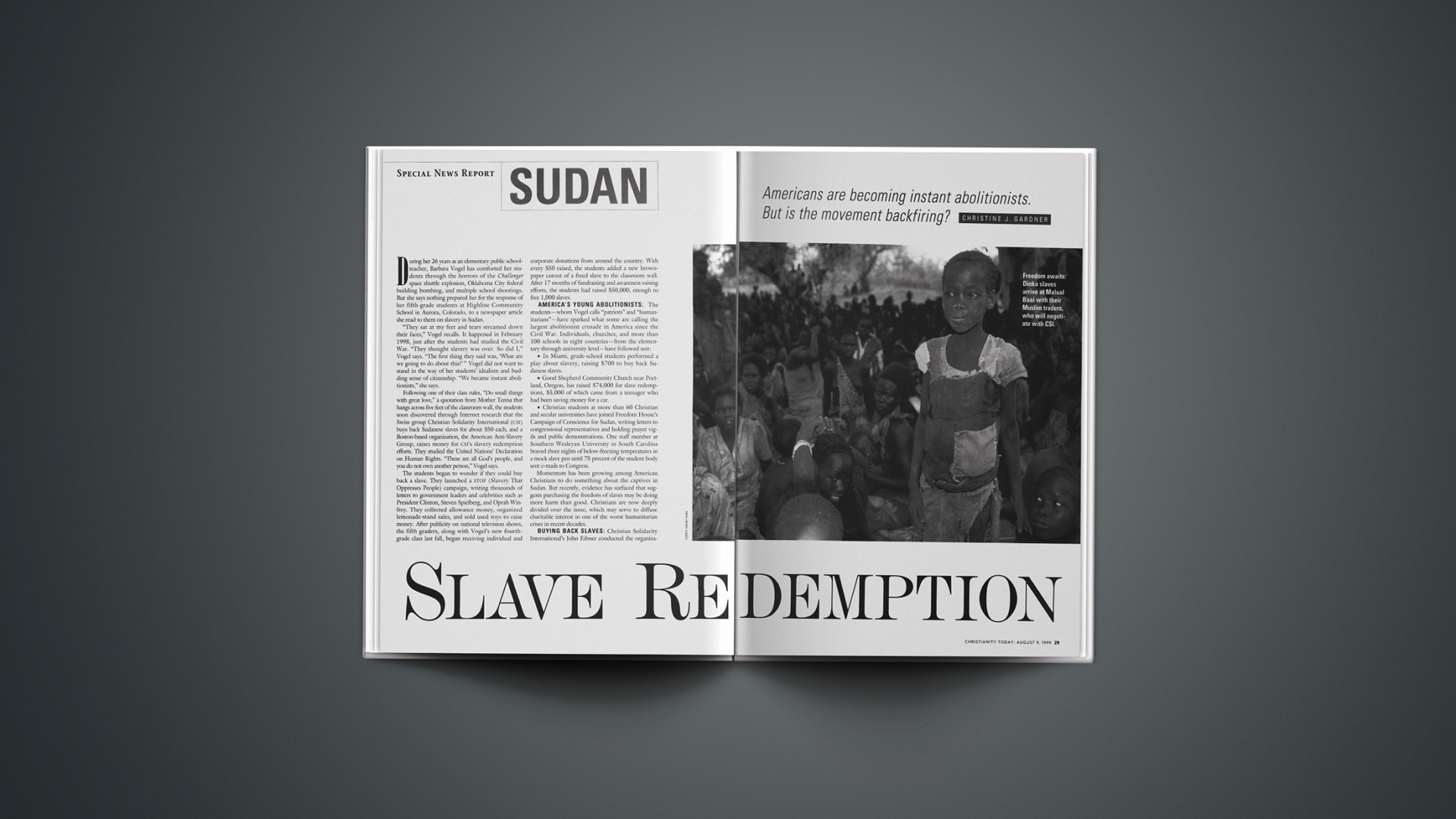
BUYING BACK SLAVES: Christian Solidarity International’s John Eibner conducted the organization’s first slave redemptions in Sudan in 1995. Since then, CSI has freed nearly 8,000 slaves in the southern state of Bahrel Ghazal. Armed with U.S. dollars from supporters such as Vogel’s young abolitionists that he exchanges into Sudanese pounds, Eibner travels to Sudan every two months. Until 1997, CSI paid about $100 for each slave to a trader. Now, the organization pays about $50. A few other groups also engage in slave redemptions, such as Britain’s Christian Solidarity Worldwide (associated with Baroness Caroline Cox), but CSI remains the leader in terms of the large number of slaves recovered at one time and the total number of slaves redeemed.
Although chattel slavery has existed in Sudan for centuries, the Khartoum government, led by the fundamentalist National Islamic Front party, has used slavery as an instrument of war to destabilize and Islamize the south.
With the mandate of jihad (holy war) to subjugate the African “infidels,” government-backed militias raid the ethnic Dinka villages, burn homes, steal food, destroy crops, and slay animals and men.
Women and children are captured as booty and relocated hundreds of miles to the north. Some raiders keep their human prizes as slaves or sell them on the open market in the north. Eibner says the slaves are often beaten, starved, given Arabic names, and forced to recite Muslim prayers. Women are used as concubines and often subjected to female genital mutilation.
Sudan, the largest and arguably poorest country in Africa, has been em broiled in a devastating civil war since 1983 (CT, Aug. 10, 1998, p. 24). With the discovery of oil fields in the south, the Khartoum government ended southern autonomy and reignited its campaign to forcibly Islamize the Christian and animist south (CT, April 29, 1996, p. 52– AOL only). The south rebelled, forming the Sudanese People’s Liberation Army (SPLA) to fight government troops and government-backed Popular Defense Forces. Humanitarian groups estimate nearly 2 million southern Sudanese have died from war and famine since 1983.
In the face of such horrific conditions, Eibner is convinced of the morality of redeeming slaves. “We have the means to free them,” he says. “We must do everything possible to get them out of bondage.”
Because some of the slaves are Christians, Eibner is shocked that American Christians have not rallied around the cause sooner. “They are part of our body,” he says. “Through them, we are being persecuted. We should be suffering. But are we? Where is the outcry?”
HIGH COST OF FREEDOM: Like Eibner, Christian Freedom International (CFI) head Jim Jacobson is outraged at the proliferation of slavery in Sudan. Jacobson had served as the U.S. director of CSI for three years before an internal dispute caused the unraveling of affiliate organizations Christian Solidarity World wide and Jacobson’s CFI, which he formed last year.
As recently as last year, Jacobson traveled to Sudan and personally redeemed a dozen slaves. “This is such an emotional issue,” he says. “If I can save the life of one individual, I’m going to do it.”
But after eye-opening trips to Sudan in February and April this year, Jacobson reversed CFI’s policy: he is now firmly against redemptions, which he says are fueling both a slave economy and the war with their investment of Western money. He says the going rate for a slave in northern Sudan is $15, making it more profitable for traders to sell slaves to redeemers for $50 to $100. The profits are being used “to buy more guns, to hire more people, to abduct more innocent people,” he says. A four-page May letter from Jacobson to CFI supporters calls the policy switch a “painful decision,” adding that donations for slave redemptions will be reimbursed or reassigned to other CFI projects.
Jacobson believes humanitarian groups such as CFI and CSI generally understood that involvement in the slave trade formed the purpose of documenting the atrocities and raising global awareness. “It’s a situation of the best intentions gone awry,” he says.
He contends both abductions and redemptions are increasing in size and frequency. He once witnessed 1,700 people redeemed simultaneously. “The temptation is enormous to bring about fraud and corruption,” he reports. He says he interviewed redeemed slaves who told of people who had been redeemed more than once. “It’s become a real cottage industry,” Jacobson states.
CSI’s Eibner insists slavery in Sudan is politically, not economically, motivated. “The money we bring in is really peanuts,” he says. Eibner defends CSI’s work by pointing to the village leaders who asked for assistance in purchasing abducted family members. “If there was any reason to believe that what we were doing resulted in more slave raids—more women and children being taken into bondage, more villages burned, men being shot, more cows and goats being stolen—they would discontinue this,” he says.
But villagers in the south, who have been ravaged by decades of war and famine, may also have a stake in the slave trade. In the village of Nyamlell in Bahr el Ghazal, the site of numerous slave redemptions, Jacobson says he witnessed villagers lining up children to be re deemed who had not been abducted.
Slave redemption supporters believe the risk of fraud is a small price to pay for small but sure victories in an otherwise complex and convoluted war.
MIXED MESSAGES: While the debate rages among Western Christians and humanitarian groups over slave redemptions, Sudanese Christians themselves are surprisingly silent on the issue. Leaders of the New Sudan Council of Churches (NSCC), whose six member denominations in southern Sudan are the African In land Church, the Sudan Interior Church, and the evangelical, Presbyterian, Coptic Orthodox, and Catholic churches, have said they have “no position” on the subject.
Speaking at a Chicago-area consultation of church leaders sponsored by World Relief in March, NSCC general secretary Haruun Ruun told stunned participants that “one cannot look at slavery in isolation from the other issues of racism and economics—these issues cannot be viewed piecemeal.”
Charles Jacobs, president of the American Anti-Slavery Group, says he is “flabbergasted” at the NSCC’s response: “It seems to me silence in the face of such horror would be rather unchristian.”
World Relief president Clive Calver, who has worked with the NSCC on reconciliation meetings between tribes in the south, says the church leaders are more concerned about the famine and the lack of discipleship training for the growing church. “We’re imposing our priority issues onto their agenda,” Calver says. Slavery is a trendy issue for Americans, he says. For the southern Sudanese, it is pragmatics: Calver estimates that fewer than 50,000 are under threat of slavery, but 2.4 million could die of starvation. “We jump up and down about the forcible Islamization of a child who has been kidnapped and taken into slavery, while we sit by and watch as half a dozen children starve to death,” he says. The NSCC also could be concerned with its relations with the Muslim-controlled government in Khartoum and with Christian congregations in northern Sudan.
The fast growth of the church in southern Sudan has led to increased attention from Western Christians. Calver, who made his fourth trip to Sudan in June, says the church is “exploding.” The three largest NSCC denominations claim a combined membership of more than 6 million. Andrew Wawa, a Sudanese leader of the African Inland Church (AIC), says his denomination started in 1985 with ten churches. Now there are more than 100.
Wawa believes the slave abductions have been used as part of a “depopulation program” against Christians. But the NSCC’s Ruun, who also is Sudanese, emphasizes that the civil war is not just an Islamic crusade against Christians. “It is a racial, economic, and religious war,” he says. “Religion is used to manipulate people.”
Although statistics vary on the numbers of Christians and animists in the south, there may be far more animists than missionaries would like to admit. Philippe Guiton, Sudan program director for World Vision, says, “The people in the south don’t really understand what it means to be a Christian.” With no remaining educational system and high illiteracy rates, few southern Sudanese are able to read the Bible. Animists are eager to pose as believers. Conversions and baptisms may be occurring in large numbers, but Sudanese church leaders readily admit that discipleship training is difficult if not impossible to establish amid warfare.
One possible sign of the lack of discipleship of young believers—and another reason why Sudanese church leaders may choose not to state a position on slavery —is that slavery continues to exist among tribes in the south. This unexpected reality suggests the possibility that Christians may be perpetrators as well as victims of slavery.
Recently, the NSCC and humanitarian groups facilitated reconciliation talks between the warring Dinka and Nuer tribes in the south. One of the peace treaty requirements stipulated returning all people they had abducted. The United Nations Children’s Fund (UNICEF) has also acknowledged the existence of slavery among tribes in the south. But CSI’s Eibner points out that slavery in the south is not used as an institutionalized tool of war.
Using the divide-and-conquer principle of war, the Khartoum government appears to be exploiting the intertribal tensions in the south. “The deaths that have happened from fighting between the tribes is more than the deaths from the fighting between the north and south,” says Emmanuel Lowila, project director for the NSCC. The war is between north and south, Muslims and non-Muslims, but the intertribal complexities may make the situation difficult for Sudanese church leaders to explain to Westerners.
AFRICAN AMERICANS DIVIDED: As Sudanese church leaders have been reluctant to discuss slavery, African Americans have been slow to join the abolition movement.
“There is a desensitizing to human-rights abuses in general,” says Chuck Singleton, senior pastor of the 11,000-member Loveland Church in Rancho Cucamonga, California, one of the largest African-American churches in the country. “Most Americans—and that includes most African Americans—are drunk on the prosperity of the nineties, and the remoteness of the problem in the Sudan makes it somewhat surreal.”
The sluggish and fragmented response by African Americans can be attributed to the community’s visible—and non-evangelical—national leaders. Outspoken Nation of Islam leader Louis Farrakhan has publicly denied the existence of slavery in Sudan, which Singleton says has discouraged abolitionist fervor. “In the black community, there has been a real call for unity. So one who speaks out of place, speaks out of turn. There is little tolerance for the voice crying in the wilderness.” But Singleton has decided to be that voice. He formed the Congress on Modern Pan-African Slavery (COMPAS) in 1996 to lobby against slavery in Sudan and the West African nation of Mauritania. COMPAS stages protests every three months in front of the Sudanese and Mauritanian embassies in Washington, D.C. The organization also mails 100,000 copies of a quarterly newsletter to mostly black mainline churches. Known for his public challenges to Farrakhan, Singleton says the Nation of Islam leader has started softening his position on slavery.
Jesse Jackson has not supported abolition efforts, either. Singleton says Jack son is taking an “overly conservative approach,” not wanting to break the illusion of black unity.
National Black Evangelical Association (NBEA) leaders say the organization does not have a stated position on the issue and is instead deferring to individual congregations.
Clarence Hilliard, social action chair for the NBEA and pastor of the 70-member Austin Corinthian Baptist Church in Chicago, says African-American churches do not have the money to help Sudanese. “A lot of black churches are just trying to survive right here,” he says.
Hilliard criticizes white churches for a sudden interest in Sudan slavery. “It’s a little issue that is not going to have a great deal of effect on the status quo,” he says. “It’s more or less just to salve our own conscience.”
Hilliard is not surprised that Sudanese church leaders are not more upset about slavery. “Slavery has always been a part of Africa,” he says. “It’s old hat to them. And they’ve got to deal with so many basic issues of feeding people and just survival.”
Meanwhile, Singleton views the Sudanese church leaders’ silence as an indication of the large amount of political pressure under which they are working. “They know the significant repression that can come from the wrong words spoken, especially spoken on foreign soil,” he says. “You could lose your life.”
The social order in Sudan needs to be changed, Hilliard says. “The black community is not going to just get caught up in the Band-Aid kind of things,” he says. “They want to see a real solution.” He believes the real enslavement in Africa is the dependency of Africans on development loans from international donors. “It be comes a tool of oppression,” Hilliard says.
Singleton agrees that liberty and self-determination for the southern Sudanese should be the goal. He recently asked a Dinka tribesman who had fled to New York what would motivate him to return to his homeland. Singleton says the African responded, “Freedom to plant and grow my own food is more important than eating your food.”
UNICEF OPPOSITION: Slave redemption is not just an issue among Christians, but it has its critics among international human-rights advocates. UNICEF has called the practice “intolerable.” In a controversial statement in March, executive director Carol Bellamy said, “UNICEF does not engage in or encourage the buying and selling of human beings.” Prior to the statement, UNICEF had been notice ably silent on the issue, although the agency has worked in the nation for the past decade as a key leader of Operation Lifeline Sudan, which coordinates delivery of food and humanitarian assistance.
Peter Crowley, UNICEF’s senior program officer for child rights, agrees with other humanitarian agencies that slavery should be eliminated, but he disagrees on the tactic of paying for freedom. “This approach does not address underlying causes,” he says.
Crowley says he appreciates CSI for raising public consciousness, but he finds it ironic that the focus is on slavery and not the war. “This is only one small part of a humanitarian and human-rights tragedy that has been taking place for 16 years, and the world has seemed quite content to ignore it until now.”
Eibner returns the criticism, saying that UNICEF is to blame for injecting “multimillions” of Western funds into Sudan, in part fueling the $1 million-a-day war. He believes the statement served as a means to gain favor with the Khartoum government. “UNICEF has made these criticisms simply to divert attention from its own inactivity and silence,” Eibner asserts. UNICEF’s proposed four-point plan—a commitment to end the slave trade in Sudan; freedom of movement for international verifiers; retrieval, tracing, and reunification programs; and free access to document the effort—is awaiting a budget and Khartoum support.
In May, the Sudanese government announced plans to set up a committee to explore ways of eradicating slave abductions. UNICEF has been asked to provide financial and technical support. “Our involvement can help international observers recognize the objectivity and sincerity of the effort,” Crowley says.
But UNICEF has been criticized for aligning too closely with the Khartoum government. Humanitarian groups have questioned the connection between Operation Lifeline Sudan’s notification to the Sudanese government of when and where food drops will occur and the subsequent raids in those villages days later. Crowley points out that UNICEF’s position on slavery has created tension with the government of Sudan. “The idea that we are involved in some sort of cozy, uncritical partnership is nonsense.”
But CFI’s Jacobson disagrees. He recently visited the southern Sudan village of Akoch. Days after a relief drop, the village was raided and 70 people were abducted to help carry the food.
American Anti-Slavery Group’s Charles Jacobs acknowledges that slave redemptions will not end slavery, a point reinforced in UNICEF’s statement. But he says, “It would be intolerable to let those people sit there and rot.”
Crowley, however, is concerned the attention given to slave redemptions—particularly by the Colorado schoolchildren—projects the false hope that life will be better once an abducted child returns. In many cases, slaves return to find some or all family members dead, homes destroyed, no food, and the daily threat of violence. “The goodwill is clear, and one must applaud it,” Crowley says, “but one hopes that children understand the wider issues and complexities so they are not led to think that by paying their fifty dollars they’re buying a wonderful new life for the children.”
POLITICS OF HOPE: While Christians and human-rights advocates disagree on slave redemptions, all concur that for slavery to stop, the war must end. For most, this means political and diplomatic action from the U.S. government.
In its recent foreign policy, the United States has treated Sudan as a terrorist nation. Osama bin Laden, presumed mastermind of last year’s bombings of two U.S. embassies in Africa (CT, Oct. 5, 1998, p. 30), lived in Khartoum until 1996. In 1997, the United States placed sanctions on Sudan.
Ralph Winter, executive director of the U.S. Committee for Refugees, says Sudan’s human-rights abuses do not receive more U.S. government attention because of racism. “If 2 million Europeans of any stripe had died, I think the conflict would be in the news more,” Winter says. “Africans don’t represent a strategic priority for the United States and their lives are devalued.”
But the United States holds economic, if not humanitarian, interests in Sudan. As a leading producer of gum arabic, used in a wide variety of products from cosmetics to carbonated beverages, Sudan receives millions of dollars from U.S. corporations through significant exemptions in existing trade sanctions. Southern oil fields have also caught the attention of the West. Calgary-based Talisman Energy, Inc., Canada’s largest independent oil company, is scheduled to begin exports by next month.
The attention-raising efforts of the Colorado schoolchildren and others have prompted some lawmakers to take action. In June, Sen. Sam Brown back (R.-Kan.) led a fact-finding mission to refugee camps in southern Sudan, accompanied by Rep. Tom Tan credo (R.-Colo.) and Rep. Donald Payne (D.-N.J.). Payne, a former chair of the Congressional Black Caucus, has introduced a House resolution calling for the release of all slaves and the provision of arms for the rebel SPLA. Brown back submitted a companion resolution.
Brownback has called on the Sudanese government “to stop terrorizing its people with civilian bombing, slavery, government-manufactured famine, and forced religious conversions.” He also supports increasing sanctions and expanding food distributions beyond the current unstructure.
Perhaps the most effective role the United States can play is to help the Inter-Governmental Authority for Development (IGAD) broker a peace agreement. IGAD, consisting of neighboring African nations, initiated a peace plan for Sudan in 1993 that calls for self-determination for the south and the separation of church and state. Observers note that a national referendum could help end slavery by giving the Khartoum government an incentive to raise living conditions to ensure the south votes for unity.
CFI’s Jacobson insists Western dollars and Sudanese middlemen must be removed from the slave trade. He suggests creating an “underground railroad” and hiring Sudanese to travel north and steal slaves back. Jacobson also supports the demolition of the railroad linking Khartoum and Bahr el Gazal, often called the “train of death” because of its frequent use in transporting slaves to the north. The provision of trucks and arms could allow villagers to flee quickly when raiders approach, or allow them to defend themselves.
Peace may not come quickly to Sudan, but the divisive debate about slave redemptions actually is helping the issue gain momentum. However, lasting peace —and an end to slavery—may be more difficult to achieve than writing a $50 check. “We know that money won’t stop this problem,” says teacher Vogel.
But Vogel, a Catholic, continues to encourage her students in their abolitionist efforts. She points to the impact the campaign is having on the lives of our nation’s future leaders. “These children will grow up to make the world a better place.”
At age 10, Nicole Cimino already is an experienced fundraiser and human-rights advocate. Between tennis matches, she is spending her summer selling lemonade and writing letters to political leaders, including President Clinton, about slavery in Sudan. Cimino, who will be a fifth grader in Vogel’s class this fall, disdainfully recalls the reply her class received from the leader of the free world. “We asked for his help, but it wasn’t the response we wanted,” she says. “It was a picture with his dog and cat and a letter that didn’t say anything.”
Although Sudan is far away from Colorado, Cimino believes she has much in common with 10-year-olds there. “They want to go to school. They want to play with their friends. They want to be free,” she says.
Cimino’s classmate Charles Hayes likes to quote famous American blacks such as Frederick Douglass, Harriet Tubman, and Thurgood Marshall. “God must have put us here on earth for a reason,” he says. “That reason was not to put people in slavery or to separate races. He put us here to live free.”
This summer, at a family reunion in North Carolina, Hayes is collecting do nations for slave redemptions. But he is realistic that raising enough cash to buy back every slave will not end slavery. “I don’t think it’s about money,” Hayes says. “I think it’s about awareness.”
Hayes knows some people do not agree with his efforts to redeem slaves. He also knows that life may not be any better for freed slaves. But he senses that he and his classmates are providing the opportunity for a better future.
“At least if we get them out of slavery, they have more hope than they had in slavery,” Hayes says. “If they die in slavery, they die with no hope.”
Copyright © 1999 Christianity Today. Click for reprint information.