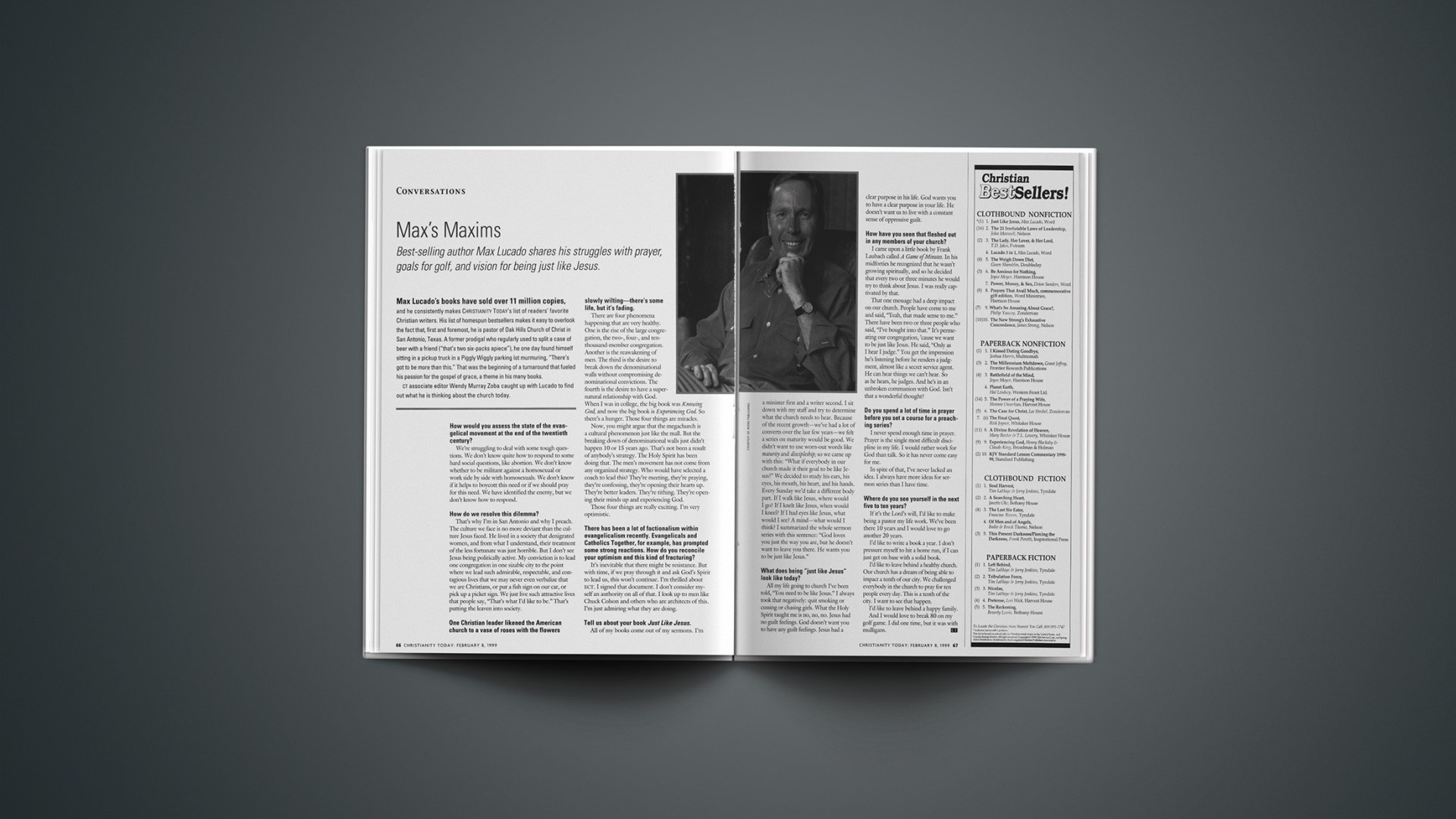

Max Lucado’s books have sold over 11 million copies,
and he consistently makes Christianity Today’s list of readers’ favorite Christian writers. His list of homespun bestsellers makes it easy to overlook the fact that, first and foremost, he is pastor of Oak Hills Church of Christ in San Antonio, Texas. A former prodigal who regularly used to split a case of beer with a friend (“that’s two six-packs apiece”), he one day found himself sitting in a pickup truck in a Piggly Wiggly parking lot murmuring, “There’s got to be more than this.” That was the beginning of a turnaround that fueled his passion for the gospel of grace, a theme in his many books.
CT associate editor Wendy Murray Zoba caught up with Lucado to find out what he is thinking about the church today.
How would you assess the state of the evangelical movement at the end of the twentieth century? We’re struggling to deal with some tough questions. We don’t know quite how to respond to some hard social questions, like abortion. We don’t know whether to be militant against a homosexual or work side by side with homosexuals. We don’t know if it helps to boycott this need or if we should pray for this need. We have identified the enemy, but we don’t know how to respond.
How do we resolve this dilemma? That’s why I’m in San Antonio and why I preach. The culture we face is no more deviant than the culture Jesus faced. He lived in a society that denigrated women, and from what I understand, their treatment of the less fortunate was just horrible. But I don’t see Jesus being politically active. My conviction is to lead one congregation in one sizable city to the point where we lead such admirable, respectable, and contagious lives that we may never even verbalize that we are Christians, or put a fish sign on our car, or pick up a picket sign. We just live such attractive lives that people say, “That’s what I’d like to be.” That’s putting the leaven into society.
One Christian leader likened the American church to a vase of roses with the flowers slowly wilting—there’s some life, but it’s fading. There are four phenomena happening that are very healthy. One is the rise of the large congregation, the two-, four-, and ten-thousand-member congregation. Another is the reawakening of men. The third is the desire to break down the denominational walls without compromising denominational convictions. The fourth is the desire to have a supernatural relationship with God. When I was in college, the big book was Knowing God, and now the big book is Experiencing God. So there’s a hunger. Those four things are miracles.
Now, you might argue that the megachurch is a cultural phenomenon just like the mall. But the breaking down of denominational walls just didn’t happen 10 or 15 years ago. That’s not been a result of anybody’s strategy. The Holy Spirit has been doing that. The men’s movement has not come from any organized strategy. Who would have selected a coach to lead this? They’re meeting, they’re praying, they’re confessing, they’re opening their hearts up. They’re better leaders. They’re tithing. They’re opening their minds up and experiencing God.
Those four things are really exciting. I’m very optimistic.
There has been a lot of factionalism within evangelicalism recently. Evangelicals and Catholics Together, for example, has prompted some strong reactions. How do you reconcile your optimism and this kind of fracturing? It’s inevitable that there might be resistance. But with time, if we pray through it and ask God’s Spirit to lead us, this won’t continue. I’m thrilled about ECT. I signed that document. I don’t consider myself an authority on all of that. I look up to men like Chuck Colson and others who are architects of this. I’m just admiring what they are doing.
Tell us about your book Just Like Jesus. All of my books come out of my sermons. I’m a minister first and a writer second. I sit down with my staff and try to determine what the church needs to hear. Because of the recent growth—we’ve had a lot of converts over the last few years—we felt a series on maturity would be good. We didn’t want to use worn-out words like maturity and discipleship; so we came up with this: “What if everybody in our church made it their goal to be like Jesus?” We decided to study his ears, his eyes, his mouth, his heart, and his hands. Every Sunday we’d take a different body part. If I walk like Jesus, where would I go? If I knelt like Jesus, when would I kneel? If I had eyes like Jesus, what would I see? A mind—what would I think? I summarized the whole sermon series with this sentence: “God loves you just the way you are, but he doesn’t want to leave you there. He wants you to be just like Jesus.”
What does being “just like Jesus” look like today? All my life going to church I’ve been told, “You need to be like Jesus.” I always took that negatively: quit smoking or cussing or chasing girls. What the Holy Spirit taught me is no, no, no. Jesus had no guilt feelings. God doesn’t want you to have any guilt feelings. Jesus had a clear purpose in his life. God wants you to have a clear purpose in your life. He doesn’t want us to live with a constant sense of oppressive guilt.
How have you seen that fleshed out in any members of your church? I came upon a little book by Frank Laubach called A Game of Minutes. In his midforties he recognized that he wasn’t growing spiritually, and so he decided that every two or three minutes he would try to think about Jesus. I was really captivated by that.
That one message had a deep impact on our church. People have come to me and said, “Yeah, that made sense to me.” There have been two or three people who said, “I’ve bought into that.” It’s permeating our congregation, ’cause we want to be just like Jesus. He said, “Only as I hear I judge.” You get the impression he’s listening before he renders a judgment, almost like a secret service agent. He can hear things we can’t hear. So as he hears, he judges. And he’s in an unbroken communion with God. Isn’t that a wonderful thought?
Do you spend a lot of time in prayer before you set a course for a preaching series? I never spend enough time in prayer. Prayer is the single most difficult discipline in my life. I would rather work for God than talk. So it has never come easy for me.
In spite of that, I’ve never lacked an idea. I always have more ideas for sermon series than I have time.
Where do you see yourself in the next five to ten years? If it’s the Lord’s will, I’d like to make being a pastor my life work. We’ve been there 10 years and I would love to go another 20 years.
I’d like to write a book a year. I don’t pressure myself to hit a home run, if I can just get on base with a solid book.
I’d like to leave behind a healthy church. Our church has a dream of being able to impact a tenth of our city. We challenged everybody in the church to pray for ten people every day. This is a tenth of the city. I want to see that happen.
I’d like to leave behind a happy family.
And I would love to break 80 on my golf game. I did one time, but it was with mulligans.
Copyright © 1999 Christianity Today. Click for reprint information.