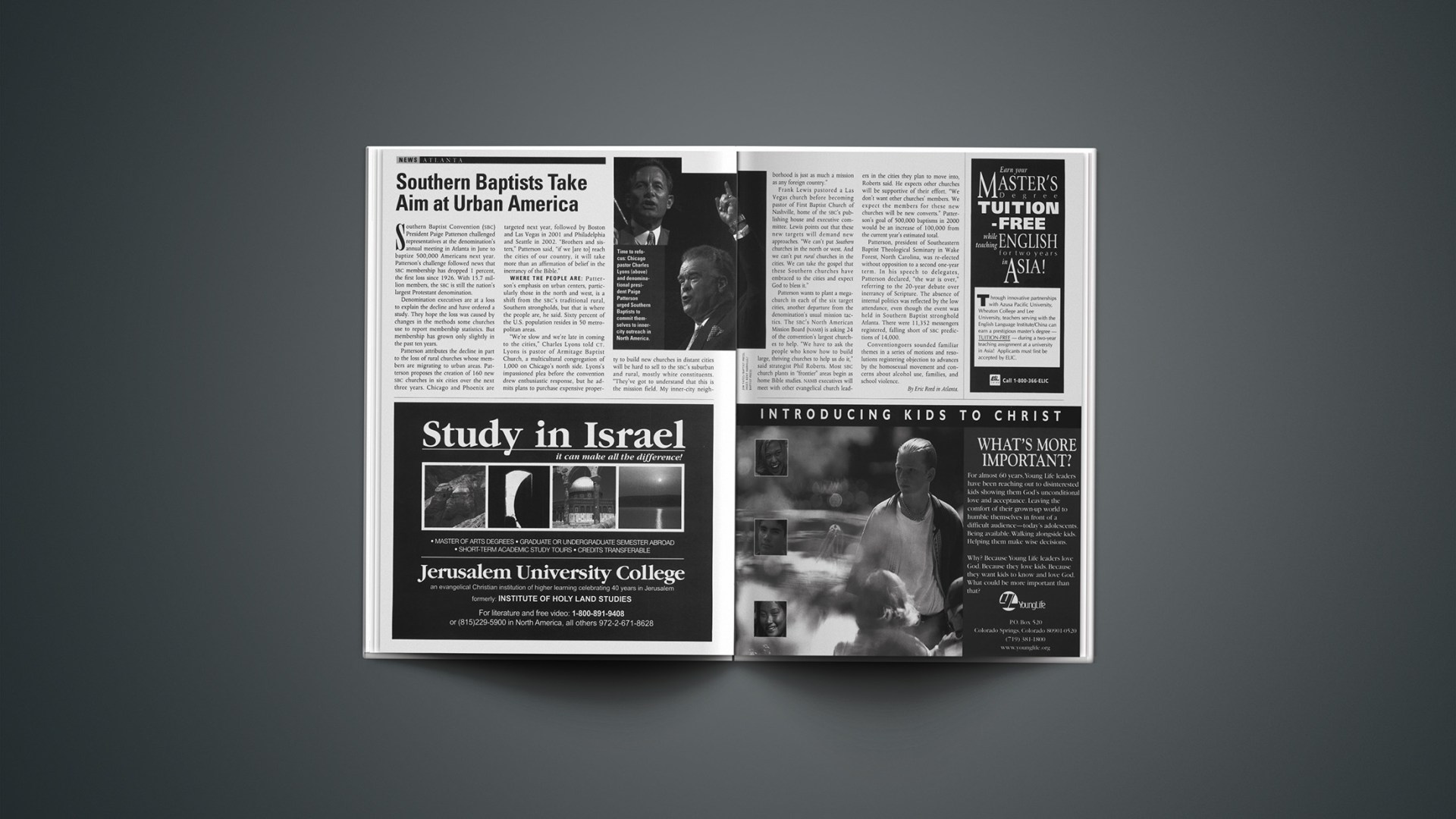

Southern Baptist Convention (SBC) President Paige Patterson challenged representatives at the denomination’s annual meeting in Atlanta in June to baptize 500,000 Americans next year. Patterson’s challenge followed news that SBC membership has dropped 1 percent, the first loss since 1926. With 15.7 million members, the SBC is still the nation’s largest Protestant denomination.
Denomination executives are at a loss to explain the decline and have ordered a study. They hope the loss was caused by changes in the methods some churches use to report membership statistics. But membership has grown only slightly in the past ten years.
Patterson attributes the decline in part to the loss of rural churches whose members are migrating to urban areas. Patterson proposes the creation of 160 new SBC churches in six cities over the next three years. Chicago and Phoenix are targeted next year, followed by Boston and Las Vegas in 2001 and Philadelphia and Seattle in 2002. “Brothers and sisters,” Patterson said, “if we [are to] reach the cities of our country, it will take more than an affirmation of belief in the inerrancy of the Bible.”
WHERE THE PEOPLE ARE: Patterson’s emphasis on urban centers, particularly those in the north and west, is a shift from the SBC’s traditional rural, Southern strongholds, but that is where the people are, he said. Sixty percent of the U.S. population resides in 50 metropolitan areas.
“We’re slow and we’re late in coming to the cities,” Charles Lyons told CT. Lyons is pastor of Armitage Baptist Church, a multicultural congregation of 1,000 on Chicago’s north side. Lyons’s impassioned plea before the convention drew enthusiastic response, but he admits plans to purchase expensive property to build new churches in distant cities will be hard to sell to the SBC’s suburban and rural, mostly white constituents. “They’ve got to understand that this is the mission field. My inner-city neighborhood is just as much a mission as any foreign country.”
Frank Lewis pastored a Las Vegas church before becoming pastor of First Baptist Church of Nashville, home of the SBC’s publishing house and executive committee. Lewis points out that these new targets will demand new approaches. “We can’t put Southern churches in the north or west. And we can’t put rural churches in the cities. We can take the gospel that these Southern churches have embraced to the cities and expect God to bless it.”
Patterson wants to plant a megachurch in each of the six target cities, another departure from the denomination’s usual mission tactics. The SBC’s North American Mission Board (NAMB) is asking 24 of the convention’s largest churches to help. “We have to ask the people who know how to build large, thriving churches to help us do it,” said strategist Phil Roberts. Most SBC church plants in “frontier” areas begin as home Bible studies. NAMB executives will meet with other evangelical church leaders in the cities they plan to move into, Roberts said. He expects other churches will be supportive of their effort. “We don’t want other churches’ members. We expect the members for these new churches will be new converts.” Patterson’s goal of 500,000 baptisms in 2000 would be an increase of 100,000 from the current year’s estimated total.
Patterson, president of Southeastern Baptist Theological Seminary in Wake Forest, North Carolina, was re-elected without opposition to a second one-year term. In his speech to delegates, Patterson declared, “the war is over,” referring to the 20-year debate over inerrancy of Scripture. The absence of internal politics was reflected by the low attendance, even though the event was held in Southern Baptist stronghold Atlanta. There were 11,352 messengers registered, falling short of SBC predictions of 14,000.
Conventiongoers sounded familiar themes in a series of motions and resolutions registering objection to advances by the homosexual movement and concerns about alcohol use, families, and school violence.
Copyright © 1999 Christianity Today. Click for reprint information.