Why? Two of the major news weeklies emblazoned that three-letter word across their covers the week following the massacre at Columbine High. Seven weeks later, we have been overwhelmed by simplistic explanations and quick-fix remedies, many of them ignoring a dark reality: evil always manages to thwart the best human programs and philosophies.
This is not to say that "simple" can't also be right and good. We heard some helpful ideas that can at least help us minimize the incidence of such evils.
Home alone. In the days following the tragedy, David Thomas, the district attorney investigating the case, seemed reluctant to discuss the circumstances surrounding the shootings or the current state of the investigation. Instead, he said, "We are not doing a very good job of communicating with our kids." And communication requires time spent with our kids. As Harvard's Deborah Prothow-Stith puts it: "Children figure out how to get adults' attention, time, and resources. We decide how we are going to give it to them."
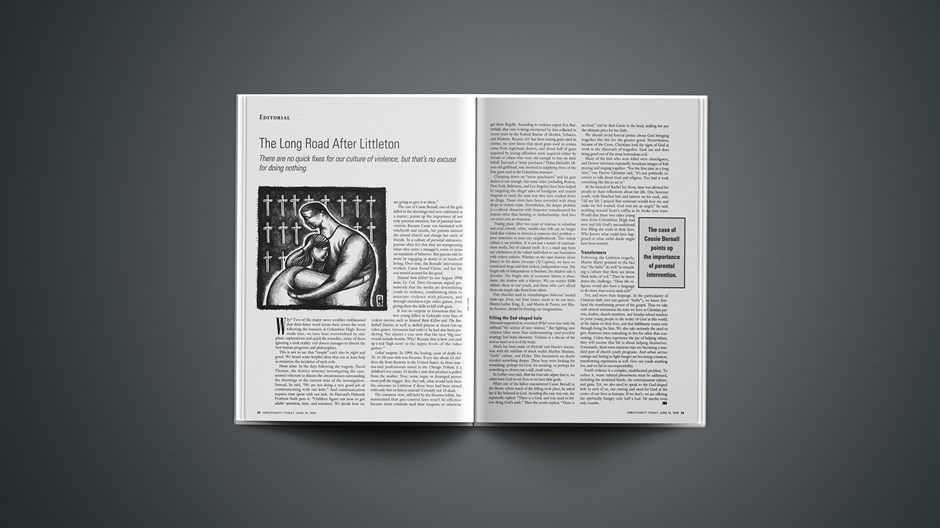
The case of Cassie Bernall, one of the girls killed in the shootings and now celebrated as a martyr, points up the importance of not only parental attention, but of parental intervention. Because Cassie was fascinated with witchcraft and suicide, her parents insisted she attend church and change her circle of friends. In a culture of personal autonomy, parents often feel that they are transgressing when they enter a teenager's room or insist on standards of behavior. But parents risk far more by engaging in denial or in hands-off loving. Over time, the Bernalls' intervention worked, Cassie found Christ, and her life was turned around for the good.
Natural born killers? In our August 1998 issue, Lt. Col. Dave Grossman argued persuasively that the media are desensitizing youth to violence, conditioning them to associate violence with pleasure, and through simulator-type video games, even giving them the skills to kill with guns.
It was no surprise to Grossman that the two young killers in Colorado were fans of violent movies such as Natural Born Killers and The Basketball Diaries, as well as skilled players at shoot-'em-up video games. Grossman had told CT he had also been predicting "for almost a year now that the next 'big one' would include bombs. Why? Because that is how you rack up a real 'high score' in the upper levels of the video games."
Lethal weapons. In 1995 the leading cause of death for 15- to 24-year-olds was firearms. Every day about 13 children die from firearms in the United States. As three trauma-unit professionals noted in the Chicago Tribune, if a children's toy causes 13 deaths a year, that product is pulled from the market. True, some angry or deranged person must pull the trigger. But, they ask, what would have been the outcome in Littleton if these boys had been armed with only fists or knives instead? Certainly not 15 dead.
The common view, still held by the firearms lobby, has maintained that gun-control laws won't be effective because most criminals steal their weapons or otherwise get them illegally. According to violence expert Fox Butterfield, that view is being overturned by data collected in recent years by the Federal Bureau of Alcohol, Tobacco, and Firearms. Because ATF has been tracing guns used in crimes, we now know that most guns used in crimes come from legitimate dealers, and about half of guns acquired by young offenders were acquired either by friends or others who were old enough to buy on their behalf. Just such a "straw purchaser," Dylan Klebold's 18-year-old girlfriend, was involved in supplying three of the four guns used in the Columbine massacre.
Clamping down on "straw purchasers" and lax gun dealers is not enough, but some cities (including Boston, New York, Baltimore, and Los Angeles) have been helped by targeting the illegal sales of handguns and assault weapons in much the same way they have cracked down on drugs. Those cities have been rewarded with sharp drops in violent crime. Nevertheless, the deeper problem is a cultural obsession with firepower manufactured for reasons other than hunting or marksmanship. And laws can never cure an obsession.
Trading places. After two years of violence in suburban and rural schools, white, middle-class folk can no longer think that violence in America is someone else's problem—poor minorities in inner-city neighborhoods. This violent culture is our problem. It is not just a matter of entertainment media, but of cultural myth: It is a small step from our celebration of the valiant individual to our fascination with violent outlaws. Whether on the open frontier (Jesse James) or the dense cityscape (Al Capone), we have romanticized thugs and their violent, independent ways. The bright side of independence is freedom; the shadow side is disorder. The bright side of economic liberty is abundance; the shadow side is thievery. We can market $100 athletic shoes to our youth, and those who can't afford them can simply take them from others.
Article continues below
Our churches need to remythologize believers' mental make-ups. Jesus, not Jesse James, needs to be our hero. Martin Luther King, Jr., and Martin de Porres, not Martin Scorsese, should be forming our imaginations.
Filling the God-shaped hole Newsweek supported its oversized Why? cover line with the subhead "the science of teen violence." But fighting teen violence takes more than understanding (and possibly treating) bad brain chemistry. Violence is a disease of the soul as much as it is of the brain.
Much has been made of Klebold and Harris's fascination with the nihilism of shock rocker Marilyn Manson, "Goth" culture, and Hitler. This fascination no doubt revealed something deeper. These boys were looking for something: perhaps for God, for meaning, or perhaps for something to drown out a still, small voice.
As Luther once said, Man hat Gott oder abgott, that is, we either have God in our lives or we have false gods.
When one of the killers encountered Cassie Bernall in the library where much of the killing took place, he asked her if she believed in God. Avoiding the easy way out, she reportedly replied: "There is a God, and you need to follow along God's path." Then the youth replied, "There is no God," and he shot Cassie in the head, making her pay the ultimate price for her faith.
We should avoid funeral pieties about God bringing tragedies like this for the greater good. Nevertheless, because of the Cross, Christians look for signs of God at work in the aftermath of tragedies. God can and does bring good out of the most horrendous evil.
Many of the kids who were killed were churchgoers, and Denver television repeatedly broadcast images of kids praying and singing together. "For the first time in a long time," one Denver Christian said, "it's not politically in correct to talk about God and religion. Too bad it took something like this to see it."
At the funeral of Rachel Joy Scott, time was allowed for people to share reflections about her life. One heavyset youth, with bleached hair and tattoos on his neck, said, "All my life I prayed that someone would love me and make me feel wanted. God sent me an angel," he said, nodding toward Scott's coffin as he broke into tears. Would that those two other young men from Columbine High had seen and felt God's unconditional love filling the voids in their lives. Who knows what could have happened or what awful deeds might have been averted.
Transformers
Following the Littleton tragedy, Martin Marty pointed to the fact that "the faiths" do well "at reteaching a culture that there are dense black holes of evil." Then he threw down the challenge: "Does the religious world also have a language to do more than notice such evil?"
Article continues below
The case of Cassie Bernall points up the importance of parental intervention.
Yes, and more than language. In the particularity of Christian faith (not just generic "faiths"), we know firsthand the transforming power of the gospel. Thus we take with utmost seriousness the roles we have as Christian parents, leaders, church members, and Sunday-school teachers to point young people to the reality of God in this world, of his claims on their lives, and that fulfillment comes only through living for him. We also take seriously the need to give American teens something to live for other than consuming. Unless they experience the joy of helping others, they will assume that life is about helping themselves. Fortunately, short-term missions trips are becoming a standard part of church youth programs. And urban service outings and fasting to fight hunger are becoming common, transforming experiences as well. Give our youth anything less, and we fail in our responsibility.
Youth violence is a complex, multifaceted problem. To reduce it, many cultural phenomena must be addressed, including the atomized family, the entertainment culture, and guns. Yet, we also need to speak to the God-shaped hole in each of us, our craving and need for God at the center of our lives as humans. If we don't, we are offering the spiritually hungry only half a loaf. Or maybe even only crumbs.
















 While we pray for peace, we need moral clarity about this war.
 We’ve got little information on Jesus’ appearance and personality. But that’s the way God designed it.españolFrançais
 The plan would organize UMC churches in four global regions, with each given more leeway around same-sex marriage and other theological issues.






