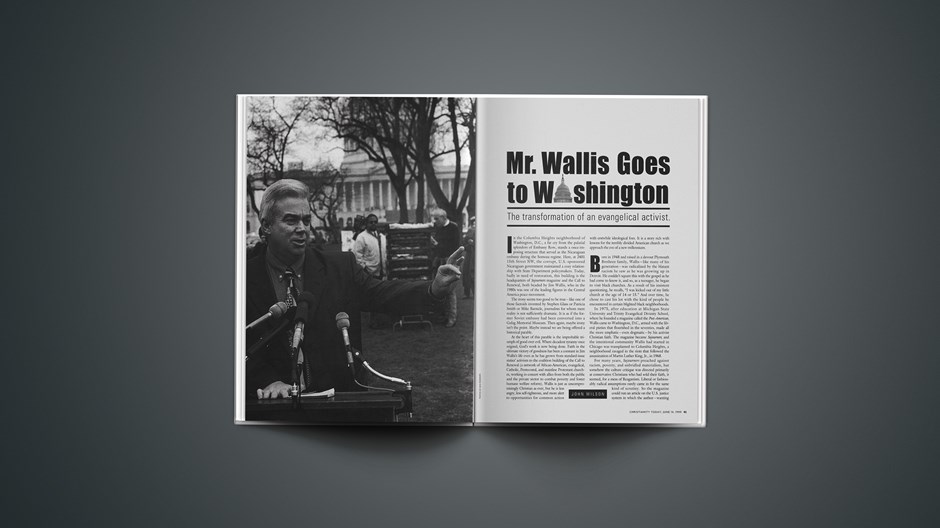
In the Columbia Heights neighborhood of Washington, D.C., a far cry from the palatial splendors of Embassy Row, stands a once-imposing structure that served as the Nicaraguan embassy during the Somoza regime. Here, at 2401 15th Street NW, the corrupt, U.S.-sponsored Nicaraguan government maintained a cozy relationship with State Department policymakers. Today, badly in need of restoration, this building is the headquarters of Sojourners magazine and the Call to Renewal, both headed by Jim Wallis, who in the 1980s was one of the leading figures in the Central America peace movement.
The irony seems too good to be true—like one of those factoids invented by Stephen Glass or Patricia Smith or Mike Barnicle, journalists for whom mere reality is not sufficiently dramatic. It is as if the former Soviet embassy had been converted into a Gulag Memorial Museum. Then again, maybe irony isn't the point. Maybe instead we are being offered a historical parable.
At the heart of this parable is the improbable triumph of good over evil. Where decadent tyranny once reigned, God's work is now being done. Faith in the ultimate victory of goodness has been a constant in Jim Wallis's life even as he has grown from standard-issue sixties' activism to the coalition building of the Call to Renewal (a network of African-American, evangelical, Catholic, Pentecostal, and mainline Protestant churches, working in concert with allies from both the public and the private sector to combat poverty and foster humane welfare reform). Wallis is just as uncompromisingly Christian as ever, but he is less angry, less self-righteous, and more alert to opportunities for common action with erstwhile ideological foes. It is a story rich with lessons for the terribly divided American church as we approach the eve of a new millennium.
Born in 1948 and raised in a devout Plymouth Brethren family, Wallis—like many of his generation—was radicalized by the blatant racism he saw as he was growing up in Detroit. He couldn't square this with the gospel as he had come to know it, and so, as a teenager, he began to visit black churches. As a result of his insistent questioning, he recalls, "I was kicked out of my little church at the age of 14 or 15." And over time, he chose to cast his lot with the kind of people he encountered in certain blighted black neighborhoods.
In 1975, after education at Michigan State University and Trinity Evangelical Divinity School, where he founded a magazine called the Post-American, Wallis came to Washington, D.C., armed with the liberal pieties that flourished in the seventies, made all the more emphatic—even dogmatic—by his activist Christian faith. The magazine became Sojourners, and the intentional community Wallis had started in Chicago was transplanted to Columbia Heights, a neighborhood ravaged in the riots that followed the assassination of Martin Luther King, Jr., in 1968.
For many years, Sojourners preached against racism, poverty, and unbridled materialism, but somehow the culture critique was directed primarily at conservative Christians who had sold their faith, it seemed, for a mess of Reaganism. Liberal or fashionably radical assumptions rarely came in for the same kind of scrutiny. So the magazine could run an article on the U.S. justice system in which the author—wanting to demonstrate his fair-mindedness—conceded that not all criminal trials in this country are in reality political trials.
But there were two significant differences even then between Wallis and many of his ideological allies. First, despite the predictable tilt of his positions on contested political issues, Wallis never compromised his basic Christian witness. In powerful pieces such as "The Economy of Christian Fellowship" (Sojourners, October 1978), he insisted that we cannot bracket off the "spiritual" from the rest of life. Purely political or economic "solutions" to our national dilemmas are bound to fail, just as a privatized faith is sure to rot. Second, while the typical liberal pundit went home to a neighborhood well removed from the ugly realities on which he or she so confidently and self-righteously pronounced, Wallis went home to one of the bleakest zones in our nation's capital.
That daily experience—easy to summarize in a glib sentence, but quite different in the living—has not changed his fundamental convictions, nor even altered his politics much, but it has tempered him. At 50, he became a father for the first time. His wife is Joy Carroll, one of the first women to be ordained as a priest in the Church of England. (They met on the speakers' platform at Britain's Greenbelt Festival in a panel on "What's the Point of Being an Evangelical?")
The first lesson for American Christians from Wallis's experience, then, is If you're going to talk the talk, you've got to walk the walk. That does not mean that all true Christians are called to move to an inner-city neighborhood. It does mean that we cannot in good conscience continue to call ourselves followers of Christ if we fail to acknowledge his demands on our lives.
Article continues below
This would not come as news to our evangelical ancestors. The closest thing we have to an evangelical family album may be The Blackwell Dictionary of Evangelical Biography, 1730-1860 (edited by Donald M. Lewis of Regent College in Vancouver, B.C., and published in two volumes in 1995). Here in condensed form are the lives of men and women from the founding generations of the modern evangelical movement. Again and again we read of conversions, of lives profoundly changed, of fervent preaching.
Some readers may be surprised to discover that these early evangelicals were social activists as well. The British evangelical crusade against slavery is well known, but that was only one of many such initiatives. Evangelicals founded hospitals, schools for the blind and for orphan girls, savings banks for working people, and homes for indigent sailors. They ministered to prostitutes, prisoners, and the mentally ill. Wherever they saw a problem, they attacked it. The gospel, they believed, demanded nothing less. Their Christian witness was a seamless whole in which the preaching of God's saving Word and the practice of Christ's love were woven together.
What happened to that resolve, that energy, that clear sense of a moral imperative? (Yes, sometimes blundering overconfidence—but those hospitals got built, and the homeless were given shelter.) Where among American evangelicals today do we find its like? How can we recover the Spirit-directed activism of our ancestors?
One place to look is the office of Sojourners/Call for Renewal. One of the evangelical traditions firmly maintained there is gratuitous ugliness. A handful of photos—Malcolm X, King, others of that vintage—adorn the walls, but in general I was reminded of the missionary offices I have frequented over the years. Another, more attractive tradition very much alive there is evangelical warmth of hospitality. When I visited, I was struck by the warmth of my hosts.
Also striking at the staff meetings was what the politically correct refer to as "diversity." The group led by Wallis resembled one of those obviously staged photos with which colleges seek to advertise their inclusiveness. But there was nothing staged about this gathering, which included men and women of several ethnic groups working unself-consciously together.
Their work is mostly mundane. Editor Karen Lattea Kline and the Sojourners staff talk and argue a bit about what stories should receive the most emphasis in coming issues. The Call for Renewal session (mostly the same cast, but with some changes) resembles any old political staff meeting. They celebrate the then-forthcoming Newsweek cover story on Eugene Rivers and church-based remedies for urban woes ("God vs. Gangs"). They compare notes on local media contacts; where can they get coverage?
Article continues below
And so it goes also at the Sojourners Neighborhood Center, where a Freedom School is open after school to neighborhood children grades K8; in the summer there is a six-week all-day program.
I asked him how churches in suburban communities could do more than hand wringing. He laughed.
"Three out of four kids in our neighborhood don't finish high school," Wallis says. "At the Freedom School we have 50 kids, all at-risk kids, virtually all of them living in the projects. All the kids in the program pass on to the next grade, and now the first batch is going to college. They're not doing drugs. They're not getting pregnant. They're not getting into trouble. These kids are having their lives changed."
The Neighborhood Center is an unpretentious ramshackle place, presided over during my visit by Jerilyn Upton, director of the Parent/Child program, a Biola alum who in the fall of 1998 began graduate studies in education at Harvard. She is representative of countless young people who have come to the Sojourners community as staff members or interns and then moved on to other work, informed by the conviction that active faith can make a difference.
Seen in the light of the visionary pronouncements Wallis frequently makes—he speaks, for instance, of "abolishing poverty"—the Neighborhood Center seems rather small potatoes. But credit Wallis and his coworkers (it is very much a team enterprise) for their willingness to do the hard work of changing lives—and changing America—one person at a time, one day at a time. And that is lesson number two for American Christians: Localize your vision.
It is in that spirit that Wallis has crisscrossed the country, holding "town meetings" under the umbrella of the Call to Renewal. And in April and October of 1997, Wallis convened two Christian roundtables in which leaders from all across the denominational and political spectrum came together to move from "common ground to common action."
What Wallis is trying to do, in fact, in partnership with many others, is to create the kind of spiritual momentum that sustained those early evangelicals in their extraordinarily various and vigorous Christian activism. In particular, he wants to arouse Christians to action against racism and poverty. When I spoke with him recently, he saw encouraging signs of change but also abundant evidence of the magnitude of the task.
Article continues below
"For all of the gains since the civil-rights movement," Wallis said, "there is still very little residential integration in this country, very little church integration in this country.
"And the black community in the inner city is in worse shape than before the civil-rights revolution, even though the black middle class is in much better shape. Part of the resentment on the street is against black people who have made it and left and emptied the ghetto of role models.
"In fact, I heard a very interesting comment on this when I was in South Africa for Nelson Mandela's inauguration. I stayed for a few days afterward to spend some time with friends in Soweto. And on the street I was talking to kids, young kids, asking them what they thought about the change and their hopes for the future. And several kids said to me, 'We don't want an American solution here.' These are 14-year-old South African kids!
"I said, 'What do you mean?'
" 'Well, when you had your civil-rights movement, the result was all the black leaders left the ghetto for the white suburbs, and so there were no leaders left behind, no role models. And now look what happened. Second, the gains that were made went only partway down; they included the leaders of that civil-rights movement, but they didn't include the people who were far below them. And we're afraid of that happening here.' "
Those fears, Wallis added, are all too justified. "They have a crime problem on the street now in South Africa that is far worse than I had thought. The random callousness of it is just incredible. And in part it's because what those kids in Soweto were afraid of is exactly what has happened. Black leaders have fled the townships. The ANC leadership has made tremendous gains, but the masses have yet to be touched."
Wallis didn't need to underline the parallel with our situation in the United States. I asked him how churches in suburban communities—like Wheaton, where my family and I live, in the western suburbs of Chicago—could do more than hand wringing. He laughed.
"Here's where I'm going to sound like a raving evangelical idealist. I would say that on the issues of poverty and the issues of racism it's very clear that the traditional political solutions and options have failed. We need a new kind of leadership, a spiritual leadership, really, that's directly addressed to those painful social crises. If there's ever been a moment to make the vital connection between faith and social action, this is the time."
Article continues below
Well, who would argue with that? Lots of people, it turns out. I've been surprised, while working on this story, at the vehement reactions provoked by the mere mention of Wallis's name. "Why would ct want to promote Jim Wallis?" one friend asked me, evidently exasperated. "He's such a tireless self-promoter; he doesn't need any help!"
Another friend wrote, "The thing that bothers me about Jim is his unrelenting bashing of Christian conservatives. It seems that that is what he's trying to be mainly known for—'I'm not a conservative, like those nasty people!' " One regular reader of CT, when told we were doing a story on Wallis, said, "I hope you nail him!" I could go on, but you get the idea.
For the record, in the five years I've known Jim Wallis, I have not found him to be any more (or less) "self-promoting" than the average Christian leader. If he is guilty of "unrelenting bashing of Christian conservatives," I haven't witnessed it. In our conversations, he has rarely focused on Christian conservatives. He and I have had a few arguments, but I have always found him to be fair-minded even when we strongly disagree.
In print, Wallis tends to be less nuanced and more predictable than he is in conversation. Thus in a Sojourners editorial (July/August 1998), he recycles the tired and increasingly unpersuasive arguments for affirmative action. But he has also shown much more flexibility than his critics allow. Above all, he is ready to set aside differences to work constructively with other Christians. "The cold war between religious groups over the poor is over," said Rich Cizik of the National Association of Evangelicals at the Christian Round table II in October 1997, and if that's true, Jim Wallis deserves part of the credit.
That is lesson number three: Don't let inessentials divide you. American Christians need this lesson more than ever today, in the face of a deep national moral crisis. It is the very depth of the crisis that is gaining church leaders like Eugene Rivers a hearing with policymakers—something unthinkable just a few years ago. Housing Secretary Andrew Cuomo, for example, said in a speech in February 1998 that "the social service networks developed by the nation's religious communities are a key element in plans to reverse a shortage of affordable housing" (New World, March 1, 1998).
Article continues below
Wallis himself is completing a year as a fellow at Harvard's new Center for the Study of Values in Public Life. There, with distinguished scholars such as urban sociologist William Julius Wilson and political theorist Theda Skopcol, Wallis tried to hammer out "new social policies to overcome poverty, motivated more by spiritual and biblical insights than by old political categories that have reached a dead end."
We may very well be inclined to hope with Wallis that "a new agenda, beyond both the Left and the Right, which combines personal responsibility and moral values with a frontal assault on racism and poverty, will be increasingly successful" ("A Time to Act," Sojourners, January/ February 1998). But if this is to happen, Wallis and other leaders must keep their rhetoric rooted in reality.
This does not mean acquiescing to the status quo, accepting the world's way of doing business, but it does mean that vision—however challenging, however countercultural—must always be translatable into practice. The emphasis in Wallis's title—"A Time to Act"—is just right, and when he says that this moment of historic opportunity "puts the ball in your court, you who are pastors and leaders of the local churches in your communities," we should recognize that his "you" includes us as well.

















 While we pray for peace, we need moral clarity about this war.
 But let’s not mistake it for calling.
 Amid the continued declines, Southern Baptists are celebrating back-to-back years of growth in worship attendance and baptism.