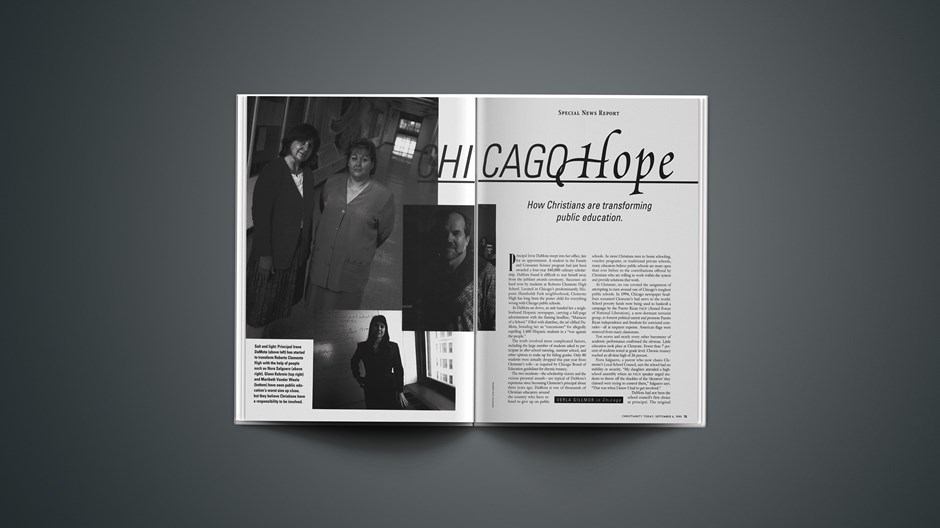
Principal Irene DaMota swept into her office, late for an appointment. A student in the Family and Consumer Science program had just been awarded a four-year $40,000 culinary scholarship. DaMota found it difficult to tear herself away from the jubilant awards ceremony. Successes are hard won by students at Roberto Clemente High School. Located in Chicago's predominantly His panic Humboldt Park neighborhood, Clemente High has long been the poster child for everything wrong with Chicago public schools.
As DaMota sat down, an aide handed her a neighborhood Hispanic newspaper, carrying a full-page advertisement with the flaming headline, "Massacre of a School." Filled with diatribes, the ad vilified Da Mota, branding her an "executioner" for allegedly expelling 1,400 Hispanic students in a "war against the people."
The truth involved more complicated factors, including the large number of students asked to participate in after-school tutoring, summer school, and other options to make up for failing grades. Only 80 students were actually dropped this past year from Clemente's rolls—as required by Chicago Board of Education guidelines for chronic truancy.
The two incidents—the scholarship victory and the vicious personal assault—are typical of DaMota's experience since be coming Clemente's principal about three years ago. DaMota is one of thousands of Christian educators around the country who have re fused to give up on public schools. As more Christians turn to home schooling, voucher programs, or traditional private schools, many educators believe public schools are more open than ever before to the contributions offered by Christians who are willing to work within the system and provide solutions that work.
At Clemente, no one coveted the assignment of attempting to turn around one of Chicago's toughest public schools. In 1994, Chicago newspaper headlines screamed Clemente's bad news to the world. School poverty funds were being used to bankroll a campaign by the Puerto Rican FALN (Armed Forces of National Liberation), a now-dormant terrorist group, to foment political unrest and promote Puerto Rican independence and freedom for convicted comrades—all at taxpayer expense. American flags were removed from many classrooms.
Test scores and nearly every other barometer of academic performance confirmed the obvious. Little education took place at Clemente. Fewer than 7 percent of students tested at grade level. Chronic truancy reached an all-time high of 26 percent.
Nora Salguero, a parent who now chairs Clemente's Local School Council, says the school had no stability or security. "My daughter attended a high-school assembly where an FALN speaker urged students to throw off the shackles of the 'dictators' they claimed were trying to control them," Salguero says. "That was when I knew I had to get involved."
DaMota had not been the school council's first choice as principal. The original candidate, a suburban educator, turned down the job after receiving a death threat by telephone. A second candidate did not pass muster with the city's board of education. When DaMota finally got the nod in February 1997, she sensed God's hand at work.
In the late 1980s, DaMota, weary of overregulation and burdensome rules, had reached a crucial turning point: whether to remain in public education. "I felt God gave me a calling to do this as a ministry—to work with and through the parents and with the kids," she says. "From that day forward, I saw no difference between ministering in the church and being a school administrator. God is working alongside me in ways I don't see, with students, parents, and colleagues."
Salguero knew DaMota would need help. She formed an alternative slate of mostly Christian candidates to run for positions on Clemente's local school council. After a year of battles left from the previous council, the new council formed committees that actually met and functioned. "I told Ms. DaMota: 'You are the Moses to this school,' " Salguero recalls. "'There are people who have been praying and interceding for 20 years to deliver this school. He has sent you to us. The school council and I are on one side of you, holding up one arm. God is holding up your other arm.'"
Today, Clemente's halls bear few lasting scars of its dark days. Students with book bags and baggy jeans exchange high fives and elaborate handshakes. The school is clean and brightly lit.
Instead of gang symbols, student artwork adorns hallway walls. Teens wear white T-shirts or blouses, and blue or black pants, eliminating the danger of wearing the wrong gang colors and inciting trouble.
More important, test scores are up and academic achievement is celebrated. In the most recent reporting period, standardized math scores catapulted a record 107 percent in one year. Reading scores have nearly doubled from five years ago.
Chronic truancy has dropped to 4 percent from 26 percent, due in large part to the efforts of Ana Rios, a committed Christian who is Clemente's attendance officer.
Article continues below
The Local School Council, churches, and community organizations are helping Clemente dig out, working collaboratively with school personnel in ways unthinkable just a few years ago. For the first time, parents, students, and teachers are all willing to say out loud: Maybe Clemente will make it.
REINVENTING PUBLIC EDUCATION: Although Clemente's problems may be more severe than those of the average school, overall public education in America is undergoing a historic transformation. While 90 percent of children still attend the nation's 87,000 public schools, the U.S. Department of Education reports that fewer than four in ten Americans have confidence in those schools. Those surveyed said that they believe public schools are not doing an adequate job of teaching reading, writing, and arithmetic. Even teachers are losing heart. A recent government study found that only one in five public-school teachers felt well qualified to teach in a modern classroom.
The growing disenchantment has led to the demise of public education's monopoly and the rise of a smorgasbord of new options, including:
Home schooling. There are 1.2 million children educated in their homes, and the number continues to increase.
Vouchers. Privately financed voucher programs exist in nearly every state, but Wisconsin and Ohio are the only states so far with established public voucher programs (in Milwaukee and Cleveland). Voucher programs using public dollars allow students to apply their per-pupil public education dollars toward tuition at the private school of their choice.
In Illinois, the idea of some form of voucher has drawn the interest of such high-profile advocates as Chicago's Cardinal Francis George. The Roman Catholic leader told the Illinois legislature that if parochial schools were not allowed to share some of the taxpayer dollars earmarked for education, 131,000 parochial students could end up on the doorstep of the public school system, costing the system $1 billion a year to absorb.
Vouchers—once seen as a way to help low-income families leave poorly performing schools—are now being positioned as an option that should be available to everyone.
Charter schools. The recent surge of charter schools—now operating in 34 states—has created public schools freed from many of the regulations that traditionally govern education. Teachers can be hired without traditional credentials, the curriculum can be changed, and the length of the school year can be altered—as long as academic results are evident.
Article continues below
THE CASE FOR CHICAGO REFORM: Public schools are scrambling to respond to the new wave of competition and using it to leverage reform within public education.
In some cases, reform has been mandated. Some 23 state legislatures have passed laws giving control of troubled school systems to mayors and local government bodies. Nowhere was reform needed more than in Chicago, the nation's third-largest school district with 437,000 students. Test scores in the early 1990s plummeted to historic lows. For many years, September signaled teacher strikes instead of the start of classes. The system tottered repeatedly on the edge of financial ruin, often counting on last-minute state bailouts. A staggering 36 percent of the system's high-school graduates were reading at the sixth-grade level or below.
In 1995, Illinois lawmakers gave Mayor Richard M. Daley sweeping managerial control over Chicago public schools. Daley wasted no time installing the city's former budget director, Paul Vallas, as the school system's new chief executive officer.
Vallas eliminated a $1.3 billion deficit, balanced the budget, cut the central administrative staff by 13 percent, arranged an uneasy truce with the teachers union, and privatized school repairs formerly handled by 17 different unions.
Principals and administrators no longer had tenure. Teachers —while still enjoying more job protection than administrators—began to be more closely evaluated and held accountable for delivering academic results.
By far the biggest challenge was correcting long-standing student academic deficiencies. Chicago became the first major urban school system to end social promotion, the practice of sending students to the next grade whether or not they performed at grade level. Summer school and after-school programs expanded to handle the mounting number of pupils who failed under the new standards and needed extra help. Schools received more latitude in selecting curriculum, within the framework of a strong back-to-basics emphasis. During her first year at Clemente, DaMota began systematically to visit every classroom. She told one student who asked about her presence in the room, "I'm here to observe your teacher and write down positive notes so he can see how well he is doing." At the end of that class, DaMota handed the teacher a blank sheet of paper. "We began to implement the kind of measures that build a high-performing educational institution," DaMota says. At the end of that school year, 20 out of 132 teachers were not retained.
Article continues below
TOO LITTLE, TOO LATE? For many Christians, in Chicago and elsewhere, education reform is happening too slowly and too late. In the 1980s and early 1990s, organizations such as Citizens for Excellence in Education, with 1,700 chapters nationwide, urged Christians to get elected to local school boards in order to provide a biblical perspective from within the system on such issues as homosexuality and creationism. However, a year ago the organization urged parents to abandon public education, calling school reform hopeless. It created Rescue 2010 to achieve that separation within the next dozen years.
Other organizations such as Exodus 2000, the Exodus Project, and the Separation of School and State Alliance echo the perspective, with varying levels of stridency. Some go so far as to insist that abandonment of public schools is necessary to usher in a spiritual awakening.
Perry L. Glanzer, education and religious liberty analyst with Focus on the Family, takes a more moderate approach. He says much of society is antagonistic to the Christian world-view and says turning back the clock is a naive notion.
Nevertheless, Glanzer and others have identified fairness and neutrality toward religion in public education as worthy goals. "We're not saying we want the Christian dominance and power back, but public education should at least be fair to different world-views," Glanzer says.
"It's an unjust system that penalizes you for choosing a religious school," he says. "If you really want social justice, school choice will do it. Competition will not solve all public education's problems, but it does help."
MINISTRY AND MISSION: The debate is painful for Christians working within public education, who say abandonment is wrong. "Christians belong in public education because that's where the most people are and that's where the poor are," says Maribeth Vander Weele, inspector general for the Chicago public school system. Vander Weele, author of Reclaiming Our Schools: The Struggle for Chicago School Reform, investigates waste, fraud, and mismanagement and recommends legislative initiatives to improve the system.
"If we are going to be judged at the end of our lives for how we helped the poor and the fatherless, then we should go to where the poor and the fatherless are," says Vander Weele, a Wheaton College graduate and an award-winning reporter on public education in the early 1990s for the Chicago Sun-Times. "The neediest people in our society are in our public schools. They need exposure to Christians."
Article continues below
Charles W. Lyons, senior pastor of Armitage Baptist Church in Chicago's Logan Square neighborhood, has worked with local public schools for more than 25 years. He finds talk of exiting public education utterly unacceptable. "There are half a million people in the Chicago public school system—bigger than the population of many cities," Lyons says. "When you consider the influence of a system that big, how can we possibly justify abandoning it? Jesus called us to be salt and light in the world. This is a mission field."
On the west side of Chicago in the tough Austin neighborhood, Circle Urban Ministries lives on both sides of the public-private education controversy. For 25 years, the organization has sponsored youth programs, supplemental education classes, tutoring courses, and after-school activities—all serving public education students. However, five years ago the ministry thoroughly examined the results.
"The greatest need in our community is indigenous leaders," says executive director Glenn Kehrein. "We asked ourselves, 'How many leaders have we developed over all these years from all these programs, and what is the prospect for the future as far as developing the next generation of leaders?' The demonstrated results were more anecdotal than real."
Because the ministry has the children an average of only ten hours a week, Kehrein says Circle decided to take a comprehensive approach to investing in the children—realizing they faced problems ranging from poverty to gangs.
Four years ago, Circle Urban Min is tries, in partnership with Rock of Our Salvation Church, opened Circle Rock Preparatory School. This fall, 150 children will attend kindergarten through fourth grade, with additional grades to be added annually.
Kehrein is quick to point out that starting the school does not mean he has given up on public schools. "We will continue to serve about 300 public school kids and their families," he says. "However, public education needs to have some level of competition to justify the resources they spend."
OUTSIDE SUPPORT CRUCIAL: As Christians line up on both sides of the question, DaMota stays focused on the challenges at hand, leaning heavily on the support of other Christians who share her passion for saving public education.
When DaMota arrived as principal, three churches invited her to visit so members could pray for her. Clemente staff student advocate Delia Pantojo and her church, the Noah's Ark Church of God, host both after-school and summer tutoring programs for 40 to 80 students. And every two weeks about 50 people attend a prayer meeting to pray for the school and the pupils.
Article continues below
The Sword of the Spirit Christian Center, Iglesia Bethel Church, and DaMota's own church, Reba Mennonite Church of Rogers Park, also actively support her and the school. "Every time I have critical decisions to make, I have people I can go to who will pray for me and for Clemente until the answers come."
DaMota says it has taught her how much Christians need each other. "The Lord reigns beyond my biases," she says. "Some of these individuals I find so precious. Those whom God has ministered through to me do not necessarily fit the Christian eyepiece that I culturally developed as I grew up."
Church support of local public schools is not confined to Clemente. In Logan Square, Lyons says that his church mentors and tutors kids year-round. In addition, every September the church holds a back-to-school rally on the main stage at the outdoor Taste of Logan Square neighborhood festival. At Christmas, the church sends candy gift packages and notes of appreciation to local teachers and administrators.
CEO Vallas has advocated collaboration among schools, local churches, and community resources. A year into the job he called a summit of 200 Chicago-area religious leaders to discuss ways to partner with public schools.
Out of that meeting came the Interfaith Community Partnership (IFCP). A steering committee of 90 religious leaders developed an action plan to coordinate public and private resources to impact the academic performance of students, especially those racially isolated or economically impoverished.
Strategies included crisis intervention teams trained and deployed to help families, students, and school officials cope with the long-term impact of school-related violence and tragedy.
When neighborhood violence makes it unsafe for students to walk to school, IFCP activates the Walking Men Pro gram. For example, when gang crossfire escalated near the Robert Taylor Homes public-housing project, IFCP executive director Janette C. Wilson says the group sent out a team of 200 men from local churches to escort children to and from school. Attendance jumped from 70 to 95 percent a week after the program started.
At one point, Progressive Community Church, situated in the heart of the danger zone, had 75 men a day taking part.
Article continues below
"Several of the men became mentors to the kids," Wilson says. "The kids would look up at these big, tall men and say, 'Are you going to come back tomorrow?' That kept the men coming back." The men, the churches, and IFCP partners have gone on to provide meals, adult supervision, help with homework, and wholesome relationships—all geared to keep the kids in school and out of gangs.
Wilson, a lawyer and ordained Baptist minister, formerly served as executive director of Operation PUSH (People United to Save Humanity).
"I attended 33 funerals of children while at push, and I noticed the growing level of nonresponsiveness and hostility from the kids who attended these funerals," Wilson says. "They calmly discussed violence as a fact of life."
The last straw for Wilson was the 1994 death of 11-year-old Robert "Yummy" Sandifer, who murdered an other child and then, in turn, was killed by gang members.
While the child's story shook the conscience of a nation, classmates who attended his funeral missed the point.
"The kids were counting the limousines of the politicians who came," Wilson says. "They were admiring the fact that Yummy made the cover of Time, even though all he'd done was kill somebody and be killed."
Christians cannot ignore such attitudes, Wilson believes. "We can't sit back in our churches, praising God and praying for each other and never interact with the real forces of evil that are on our streets attacking our kids," she says.
One of her first projects with IFCP involved helping the school system develop a character/values curriculum that is now taught at every grade level, covering topics such as courtesy, honesty, responsibility, respect, and a work ethic. "We have a generation of parents and students who have no respect for life, respect for others, respect for work, or our differences," Wilson says. "We have to plant those values back into them."
KNOWING THE LIMITS? Forrest Turpen, executive director of Christian Educators Association International (CEAI), says there are about 600,000 Christian educators in public schools, but most do not understand what they can legally do in the classroom to be salt and light.
"The Supreme Court has made it very clear that public schools are to be neutral and are not to show hostility toward people of faith," Turpen says. "Schools are generally hostile because they don't know the law, don't understand it, or don't care."
CEAI is working with the Christian Legal Society on a booklet that will explain teachers' rights regarding religious expression and related issues.
Article continues below
"Administrators and the general public should not accept the lie that God has been ruled out of the public-school setting," Turpen says. "Parents who want to pull their kids out of public schools think the schools are failing. The failure is that the church has pulled out and left public schools to rot."
Turpen, whose organization includes educators in both public and private education, supports the parents' right to choose the education option that is best for their children.
However, Turpen says parents have to ask themselves honestly whether they are sending their kids to a Christian school so they do not have to worry about their parental responsibility to "train a child in the way he should go" (Prov. 22:6).
"The [public school] environment won't taint them if parents are doing what they ought to do at home," Turpen says. "I don't care what school you put them in, they are going to survive, thrive, lead, and show God's truth to boys and girls who don't know the truth."
Kathleen Ogundipe agrees that having Christian students in the classroom makes a huge difference. She chairs the English department at Austin Community Academy High School on Chicago's west side, where she has taught for 13 years. "When the Christian kids are in the school with their good attitudes and their high achievement standards, a lot of that rubs off on the other students," she says. "We need Christian kids in the school."
Ogundipe says she is also grateful for Christian colleagues. "It's not easy being a teacher in today's climate of reform, even when you're a good teacher." As is the case with Clemente, Austin is a troubled school. It has been "reconstituted" four times under the Vallas reform ad ministration.
Reconstituting is a procedure used at the poorest-performing schools or those on academic probation whereby the school is officially "closed" and then essentially reopens as a new school. All teacher and staff contracts are automatically terminated, forcing teachers to reapply for their jobs. The policy is seen as a legal way of weeding out bad teachers, who are given two years to find a job elsewhere in the system or be released.
Ogundipe says such policies leave Christian teachers feeling unaffirmed for their deep commitment to one of the toughest schools in the city. Badmouthing from Christians toward public schools is not helpful either, she says.
"You can't compare public and private schools," Ogundipe says. "There are laws that bind public schools that don't bind private schools." For example, she notes that laws limit the number of times a student can be suspended for bad behavior or chronic tardiness. "We aren't allowed to discipline profanity," Ogundipe continues. "Many times, our hands are tied."
Article continues below
She points out what teachers believe is another drawback of some reform policies: running education like a corporation. "In a business you have control over the raw materials," Ogundipe says.
Still, Ogundipe says, the opportunity to make an impact is enormous. For instance, when a student curses at her, Ogundipe does not respond in kind. "The way they talk to me is their choice, but the way I answer is my choice," she says. "I live by a set of principles that shows me how to treat people. I can communicate biblical truth without calling it that. And I can model forgiveness and nurture and commitment to them and other positive behaviors."
At Countee Cullen Elementary School on Chicago's far south side, sixth-grade teacher Pat Daley says the opportunities are even greater at the primary level. "I can't teach religion, but I have all kinds of opportunities to teach morals and values," Daley says. "I can do it when I'm helping children who are in a fighting mood work out their anger or jealousy or disrespect. Or a child may come in and tell me their 16-year-old sister is going to have a baby. That can open a discussion about how we make choices."
Daley says students are coming into her classroom with more desperate needs than she has seen in three decades of teaching. "Many come from families with multiple mothers or fathers, some who are in prison or on drugs," Daley says. "Children often wonder if any adult trusts them or really loves them." Daley gives them her home phone number and invites them to call anytime—and they do.
"They come in at the beginning of the year frightened, beaten down, insecure, sure that they're stupid, sure you won't like them," she says. "When little miracles happen and children are turned around, I realize God put me here to do this work. He allows me to make a difference as long as I remember it's not me doing it."
Myrna Garcia looks at the big picture of what is happening within Chicago's 583 schools. Garcia has been director of Student Health Services for the past two years, though she has worked in the system for 22 years.
The battles Garcia fights have to do with political hot potatoes such as sex education and family life curriculum. Contrary to popular opinion, Garcia says schools do not promote birth control or routinely distribute condoms or encourage abortions.
Article continues below
"Our curriculum is abstinence-based," Garcia says. "In fact, we are aggressively moving in the direction where every chapter in the curriculum will touch on abstinence and a policy of abstinence first."
Furthermore, Garcia says people might be surprised to know school board policy is actually more conservative than required by Illinois law.
"Illinois state law says that if a child is sexually active by the age of 12, they don't need permission from their parents to get birth control pills, condoms, or counseling about sexual options," Garcia says. "But we require parental consent for every transaction we have with kids."
THE CHALLENGE AHEAD: From whatever vantage point Chicago public schools are viewed, there is reason for cautious optimism. The personal success stories, improved test scores, safer schools, and church/community involvement are all unprecedented. But Chicago schools have a lot of catching up to do. Despite academic gains every year for the past four years, student test scores still remain well below national averages.
At Roberto Clemente High School, only 13 percent of the students are reading at their grade level. Higher academic standards and the end of social promotion meant nearly 800 Clemente students attended summer school, due to failing grades, in an effort to avoid being held back a year. Students are climbing out of the hole, but it is a very deep hole.
Inspector general Vander Weele is determined to keep the momentum going. "The first wave of reform was about sending a clear message and tearing down what was bad in the system," Vander Weele says. "Now there's a critical need to re build and institutionalize positive changes for the long term."
Christians who work in and with Chicago schools admit there is still enough bureaucracy to sink good intentions. The rules and red tape never go away, they say, and people still resist change.
On the bright side, they express gratitude for the spontaneous holy network of Christian colleagues who are also at work in the same culture, encouraging and comforting each other when things are going badly. Yet they wish other Christians understood how much they are urgently needed in public education.
Teacher Daley believes the nation's future depends on Christians staying in public schools. "Can we go off in a little corner and be Christians and not be involved in the whole of society?" she asks. "If we throw away this part of society, what's left?"















 While we pray for peace, we need moral clarity about this war.
 As my doubts about his teachings grew, so did a secret fascination with Jesus.
 How groups like Hillsong learned to let go of the literal in favor of creative collaboration.españolPortuguês






