Thomas is gaunt, his face stark and raw-edged like a Palestinian landscape. Sharpness of bone, hollowness of flesh. And there's something else, something in the eyes: a shrewdness, a wariness, a caginess. He is sparing with words. He watches. He listens. He can unnerve you with his silence, with the depths and layers of it. What is he thinking? His silence is more inflected than Cantonese.
Thomas is a doubter, the doubter—the doubter's patron saint. His name comes conjoined, hip to bone, feather to wing, with that unshakable epithet: Doubting Thomas.
The Bible never describes Thomas this way. It describes his moment of doubt. But it is one moment, only one, and he moves quickly beyond it. His identity, despite our perception and description of him, is not rooted in that moment. There is much that is praiseworthy in him. When Jesus, hearing of his friend Lazarus's sickness in Bethany, tells the disciples that they are returning there, some of them protest: people want to kill you there, Jesus. But Thomas speaks up. "Let us also go," he says, "that we may die with him" (John 11:8,16). These are hardly the words of a chronic doubter.
Yet, Thomas's moment of doubt has comforted and troubled us so much for so long—it reflects back to us our own stubborn and fragile faith, our heart's own waywardness and waverings and yet tenacity—that our remembrance of that moment has for most of us eclipsed everything else about the man. It is a truth about Thomas that, dwelt upon obsessively, has become a myth about him, a character lapse that has become his all-defining character trait.
This is unfortunate, but not entirely. After all, Thomas's doubt itself is pithy, earthy, real. His is a doubt that often taunts us. It is a doubt that stands between the world's believing and doubting. Because his doubt is this: is Jesus really risen from the dead? Has he really conquered death, with all that such conquest means? Or is the claim that he is risen just the deluded wish-fulfillment of a few men and women made unstable by grief, needing to fabricate a resurrection to console themselves, to vindicate their naïve faith?
Is this not our doubt, too? Is this not the doubt? To second-guess and explain away Christ's resurrection is, of course, the vogue of academia, a virtual growth industry. It has been for a long time. That's neither particularly surprising nor particularly interesting. But this is: even dear Mrs. Smith, a tithing laywoman so reverent and faithful and faith-filled—so abounding in good works and unshakable in her convictions—even she feels, from time to time, the chill of this doubt's shadow.
As a pastor I deal often with death. Believers do respond to death—their own approaching death, the death of loved ones—differently from non-Christians. They don't grieve as those without hope. But neither do they grieve as those without doubt—they do grieve. Now I don't think God intended us ever to meet death devoid of grief. Even Jesus wept over Lazarus's tomb mere moments after calling himself the Resurrection and the Life—just before resurrecting Lazarus back to life. Still, it's disconcerting. The truth is, if we believed without doubt in the resurrection of Jesus, our living and dying would look dramatically different from the way they generally do.
Thomas's doubt is ours, too, our nemesis and companion, our secret haunting. Unless I see it with my own eyes, touch it with my own hands, I will not believe. This is the heart of the matter. This is what stands between Thomas's believing and his doubting: unless I. I know what he means. I can have all the personal testimony and logical airtightness and empirical verification in the world, but unless I see it, touch it, have an experience of it, a shade of doubt exists. Nothing—not the witness box, not the lab report, not the field dispatch—substitutes for the power to convince that my own seeing and touching can deliver. Unless I is the doubter's mantra.
I read in the Bible of miracles. I hear of miracles today. Some of them I've read about in the pages of this magazine. Not long ago, a close friend of mine was in a church where a woman got up during testimony time. Tearful and joyful, she praised God: only moments before, the Lord had healed her completely of an eye problem that had plagued her most her life.
I want to believe these accounts. And yet. And yet, unless I. … There is something holding back in me. There is some mental reservation, a twinge of hesitancy. There is belief, and there is doubt. Unless I see, unless I touch, I will not believe. Not entirely.
And who can fault Thomas for his own refusal? After all, though Jesus had foretold his resurrection, look who attests to it: "the other disciples." That means the likes of Peter, James, John. Thomas has seen too much fickleness in those men. Peter? He's an unstable mix of headlong rashness and fleet-footed cowardice. He dashes into things, then thrashes his way out of them. He's the one who says yes and means no. James, John? They're filled with hot-tempered brashness—wanting to call down fire on hapless Samaritan villages—and petty rivalry, spatting over who gets to sit next to Jesus in heaven. Here are Peter, James, John, words tumbling out, jumbled up, in a breathless welter of half-baked testimony: Jesus is alive! Alive! We've seen him ourselves!
Article continues below
Oh, really?
We live in an age of credulity, not skepticism. The cult of scientism, which itself was a sign of the age's credulity, is waning, giving way to ever new and extravagant forms of mysticism, irrationalism, fideism—just believe, anything. This is widespread in culture. And it's widespread in the church. Recently, I have heard numerous reports of people in church worship services having silver teeth turned to gold, or of gold dust sifting down, ex nihilo, onto their skin, then disappearing. (Hard to verify that.) These events are touted as miracles, a touch of God. What am I to make of them?
I question them. I doubt them. I take the position, Unless I see. Sometimes doubting is not a lack of faith but rather an expression of it. Sometimes to doubt is merely to insist that God be taken seriously, not frivolously—to insist that our faith is placed in and upheld by something other than seeming conjuring tricks. In these accounts of gold teeth and gold dust, nostalgia is at work, a longing for the old God-of-the-gaps, God as magician. Thomas stands as a bulwark against that. These things might be true occurrences. But they need to be sifted, probed, tested. We need to bite them, and see if they're fool's gold or the real thing.
Even if they are genuine occurrences, they need to unfold theologically and biblically. Most miracles in the Bible—maybe all—have a discernible social function. Even ax heads floating and water turned to wine, though not as humanly beneficial as the blind seeing and the lame walking, serve clear enough social purposes. But gold teeth, evaporating gold dust?
Biblical faith is not sentimental, not sloppy, not vague. It excludes more than it embraces. In the recent publication of "The Gospel of Jesus Christ: An Evangelical Celebration" (CT, June 14, 1999, p. 51), the authors chose a format that equally affirms some things and denies others. In other words, biblical faith progresses by an alternating rhythm of yes and no, a taking hold and a letting go, a believing and a doubting. Peter represents that part of our heritage that says "I will believe though I have not yet seen." But Thomas represents the other, equally needed part of our heritage: "Unless I see, I will not believe." More than ever, the strength of evangelical faith must draw from both sides of the heritage.
Article continues below
Skepticism has an interesting etymology. It means to look at a matter closely, to scrutinize, to study with great care and in minute detail. On this definition, what the church needs is not less but more skepticism.
I met a man who told me he didn't believe the Bible because he was a skeptic. I asked him if he had read the Bible. "No, not really," he said. "I told you, I'm a skeptic. I don't believe it." This is not skepticism. This is its opposite: a refusal to investigate, to scrutinize, to ponder deeply.
Skepticism is not an excuse for evasion, an alibi for laziness. Any skeptic worthy of the name is both hunter and detective, stalking the evidence, laying ambush, rummaging for clues, dredging the river bottom, wiretapping phone lines, setting traps. Skeptics are passionate about finding truth out. True skeptics want to believe, but safeguard against the hypnotic power of that wanting. So they test.
Thomas was a true skeptic. He doubted, not to excuse his unbelief, but to establish robust belief. He doubted so that his belief might be based on something more than rumor and wishful thinking.Doubt has its limits. It can be faith's tonic, a cleansing and invigorating force. But doubt can quickly turn corrosive or cancerous, burning or mutating healthy tissue. It can become a way of holding God for ransom. Our lives can degenerate into a fruitless and futile round of "Unless I see, unless I touch, unless I have the experience, I will not believe." Indulged too long, doubt becomes just a parlor game.
And for what? Most people can attest—and the Bible confirms—that even spectacular displays of divine power don't always or forever secure faith and faithfulness on the part of those who witness them. The raising of Lazarus is, again, a prime example. Many witnessed it, and believed. But the Pharisees and chief priests had a much different reaction: though they apparently never questioned the reality of the miracle, they saw Jesus' ability to perform such miracles as a threat to their power, and so they launched plans to kill him (John 11:45-49).
Philip Yancey makes the observation that miracles, especially in the Old Testament, almost always created distance rather than intimacy between people and God. And those who saw Jesus' miracles and believed hardly come off as unshakable and unswerving in their decision to follow him.
Article continues below
In Michael O'Brien's potent novel Father Elijah: An Apocalypse (Ignatius Press, 1996), the central character repeatedly ponders the mystery of his own believing and doubting. His faith has led him to radical acts of self-denial and risky acts of self-sacrifice. His faith has been bolstered over and over by miracles.
And yet, just as sturdy and solid as his faith is, he is also subject to violent storms of despair and doubt. His doubts are as big and dark and menacing as his faith is bright and vast and promising. Perhaps that's a general principle: the depth of our doubt is roughly proportionate to the depth of our faith. Those with strong faith have equally strong doubts. That principle bears out in the other direction as well: people with a trivial and shallow faith usually have trivial and shallow doubts. For Father Elijah, this man of deep faith and deep doubt, his doubting is haunted by a realization—what he calls the fundamental problem of his soul. He had been given everything and it did not suffice. The reflection continues:
He had been graced to see the actions of God as few men had seen them. The consolations poured out upon him were extraordinary. And yet—and yet, the ancient scar of Adam dragged him inexorably back, again and again, to his desire for certainty. He longed for a trace of explanation.
He knew full well that if it were given he would soon need a larger one after that, until in the end no explanation would fill the yawning abyss of his doubt.
Here lies the basic flaw of all doubt: it really can never be satisfied. No evidence is ever fully, finally enough. Doubt wants always to consume, never to consummate. It clamors endlessly for an answer, and so drowns out any answer that might be given. It demands proof, but will doubt the proof proffered. Doubt, then, can become an appetite gone wrong; its craving increases the more we try to fill it. Christ's concluding words to Thomas are not so much an endorsement of "mere belief" as a warning that the quest for "proof" is not the path of blessedness. "Because you have seen me, you have believed; blessed are those who have not seen and yet have believed."
Just what is the connection between seeing and believing? Jesus tells Thomas after he sees him to stop doubting and believe. Belief is still called for, still demanded. Seeing does not remove the necessity of belief: seeing is not believing.
We walk by faith, not by sight.
In Roger's Version (Knopf, 1986) by John Updike, Roger Lambert is a jaded, debauched theology professor who argues with Dale Kohler, a gangling, earnest young evangelical bent on proving the existence of God mathematically. Dale argues that we need some logically airtight demonstration for the existence of God to counter the bravado of scientism. If we could prove God's existence, he contends, we could rout the Devil.
Article continues below
Roger asks Dale who he thinks the Devil is. "The Devil," Dale replies, "is doubt."
Roger's response to this is both ingenious and disturbing:
I would have said, looking at recent history and, for that matter, at some of our present-day ayatollahs and Führers, the opposite. The Devil is the absence of doubt. He's what pushes people into suicide bombing, into setting up extermination camps. Doubt may give your dinner a funny taste, but it's faith that goes out and kills.
As the story progresses, it becomes clear that the Devil is both doubt and its absence. Roger the Doubter, Dale the Assured, both commit terrible, godless acts: adulteries, incest, abortion. And both have a dauntless, swaggering pride.
Doubt and faith: mix either with pride, and the concoction is toxic. Those proud in their faith, those proud in their doubts—both are terrors. But Thomas, he is the patron saint of real doubt: because with him, his believing and his doubting are marked by humility.
All this makes more poignant the nature of Thomas's doubt and Christ's answer. What, after all, does Thomas want to see and touch? What does Christ show him? What is the evidence sought and then offered for the resurrection?
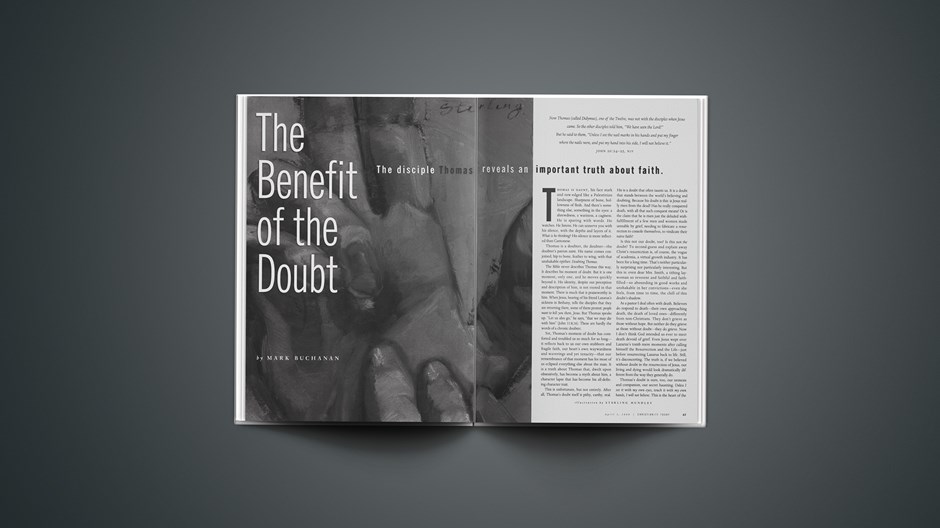
Wounds. "Unless I see the nail marks in his hands and put my fingers where the nails were, and put my hand into his side, I will not believe." And Jesus says to Thomas, "Put your finger here; see my hands. Reach out your hand and put it into my side. Stop doubting and believe."
Christ demonstrates his victory over death, not by feats of strength, not by more and more spectacular miracles, but by wounds: nail holes, spear marks. Behold, the lamb who was slain.
It is no accident that the more squeamish our culture becomes about wounds—denying death, cloaking sickness, hiding away the old and the decrepit—the more we are plagued with doubt about the resurrection. We shun wounds, and our doubts breed. And the opposite is true. To see wounds, to touch wounds, often displaces doubt. Mother Teresa, with her vocation of touching wounds—real flesh-and-blood wounds—and seeing them as Jesus' wounds, never seemed to doubt the resurrection. Maybe that should be a prerequisite for all participants in the Jesus Seminar: spend at least one year in a slum or refugee camp or soup kitchen before they get to cast their votes on the historical veracity of the gospels. Put your finger here. See my hands. Stop doubting and believe.
Article continues below
Doubt, when honest, should set us on a quest for that which is true, real, that for which we can give not only our intellectual assent but, even more, that to which we can entrust our very lives. Thomas's doubt led to this place. Jesus shows his wounds to Thomas, tells Thomas to see, to touch. He sees, but he doesn't touch. He knows when enough is enough. And here is the real sign that Thomas is not some poseur, some mere academic trend-chaser: his seeing gives way, not just to belief, but to worship: "My Lord and my God!"
Between beginning this article and finishing it, I had lunch with Dr. Philip Wiebe, a professor of philosophy at Trinity Western University. Wiebe, among his many distinctions, is also a Shroud of Turin scholar. He is convinced—and convincing—that the shroud is the genuine burial cloth of Jesus, and that it is intrinsic evidence of his resurrection. He argues the point in a minutely detailed, scientifically sophisticated manner, and can answer even the most stubborn objections without any logic-twisting or special pleading. His case seems without crack or warp.
This poses its own set of problems. What if the much-contested shroud is no hoax? What if it can be demonstrated that this, indeed, is the burial cloth of Jesus, that it bears the imprint of Christ's gaunt image scorched, by the unique event of his rising from the dead, into the delicate fibers of its linen? Again, is this all faith is—seeing the evidence? To reduce faith, as modernist theologians have often done, to free-floating sentiment, lacking root in historical events, is mistaken. To tell a dying man that the resurrection is only a "symbol" of new life is like giving a starving man a picture of food and bidding him be full. But to reduce faith to mere empiricism, a verification procedure, is mistaken too.
In Jesus' parable about Lazarus and the rich man, the rich man dies and goes to hell. From there, he pleads in his torment with Abraham to resurrect Lazarus from the dead and send him to warn his five brothers. "If someone from the dead goes to them," the rich man reasons, "they will repent." And Abraham replies, "If they do not listen to Moses and the Prophets, they will not be convinced even if someone rises from the dead" (Luke 16:30-31).
Article continues below
Wiebe told me about another scholar, who has written an article which calls into question the resurrection of Jesus, claiming that those who encountered the risen Christ were in altered states of consciousness, and so were, in effect, only seeing things. Wiebe has begun an exchange with this scholar. The battle is joined.
I asked Wiebe: "Do you envision this man ever being so convinced by the evidence that he believes—and, more, that he worships, that he cries out in wonder, shame, joy, 'My Lord and my God'?"
Wiebe laughed a sad, wry laugh. "No," he said. "No, I don't."
That's not honest doubt. That's something very different—intellectual dogma, doctrinaire agnosticism, hidebound ideology, scholarly Trivial Pursuit. That's the refusal to be convinced even if someone rises from the dead.
Over that, I'll take Thomas and his doubt any day.
Mark Buchanan is pastor of New Life Community Baptist Church in Duncan, British Columbia. Illustration by Sterling Hundley
Related Elsewhere
For more meditations on these verses and Thomas's doubt, see classic writings and sermons from:
John Chrysostom (c.347-407)
Augustine of Hippo (354-430)
Origen (c.185-254)
Matthew Henry (1662-1714)
Charles Haddon Spurgeon (1834-92)
Alexander Balmain Bruce (1831-1899)
More links to meditations are available at Textweek.org
Past articles by Mark Buchanan include:
Running with Jonah | Do we really want to be closer to God? (Nov. 3, 1999)

















 While we pray for peace, we need moral clarity about this war.
 As my doubts about his teachings grew, so did a secret fascination with Jesus.
 Beyoncé’s right. Whether listening to Cowboy Carter or reading theology, diversity is a good thing.






