



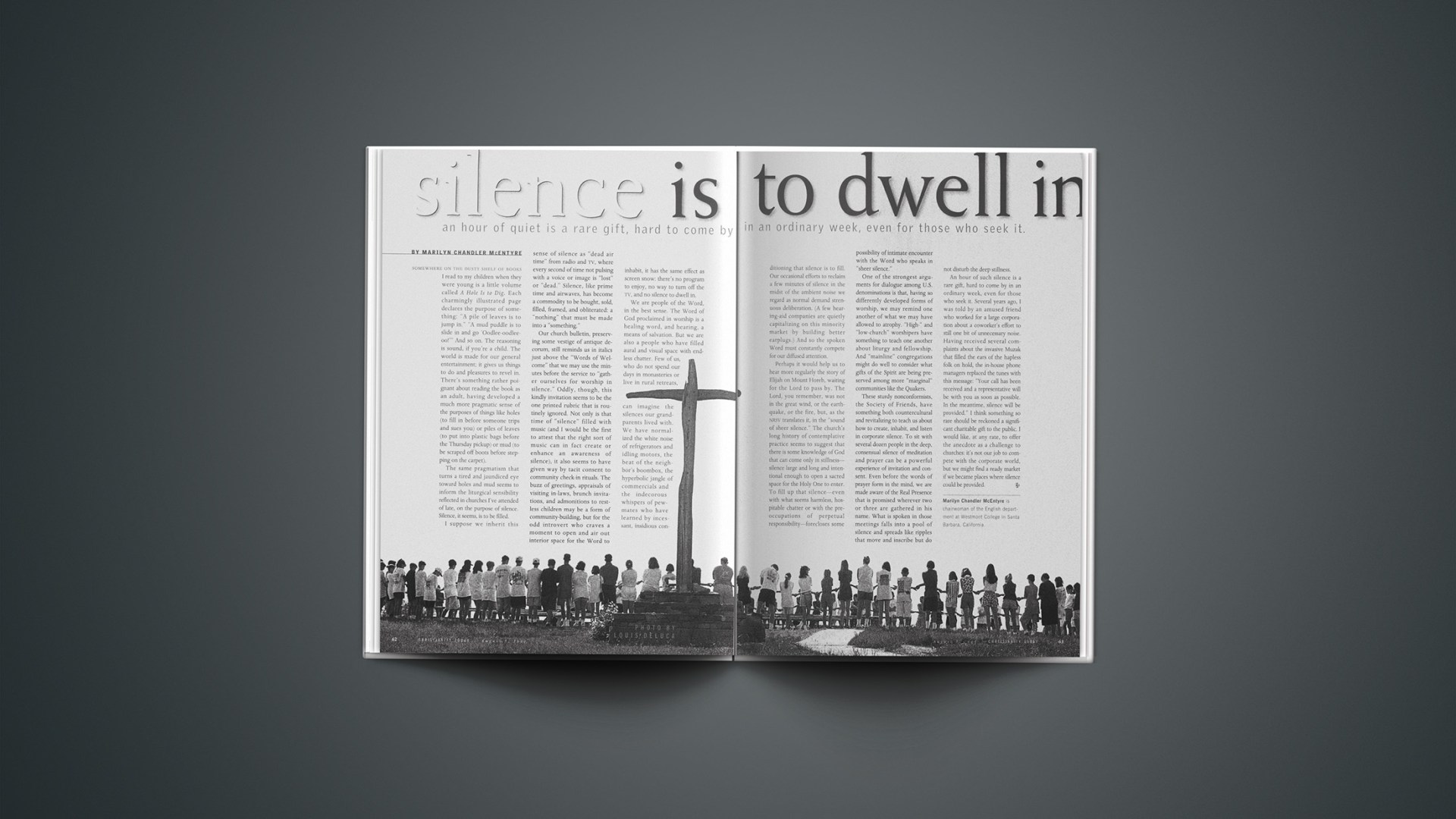

Somewhere on the dusty shelf of books I read to my children when they were young is a little volume called A Hole Is to Dig. Each charmingly illustrated page declares the purpose of something: “A pile of leaves is to jump in.” “A mud puddle is to slide in and go ‘Oodlee-oodlee-oo!'” And so on. The reasoning is sound, if you’re a child. The world is made for our general entertainment; it gives us things to do and pleasures to revel in. There’s something rather poignant about reading the book as an adult, having developed a much more pragmatic sense of the purposes of things like holes (to fill in before someone trips and sues you) or piles of leaves (to put into plastic bags before the Thursday pickup) or mud (to be scraped off boots before stepping on the carpet). The same pragmatism that turns a tired and jaundiced eye toward holes and mud seems to inform the liturgical sensibility reflected in churches I’ve attended of late, on the purpose of silence. Silence, it seems, is to be filled. I suppose we inherit this sense of silence as “dead air time” from radio and TV, where every second of time not pulsing with a voice or image is “lost” or “dead.” Silence, like prime time and airwaves, has become a commodity to be bought, sold, filled, framed, and obliterated: a “nothing” that must be made into a “something.” Our church bulletin, preserving some vestige of antique decorum, still reminds us in italics just above the “Words of Welcome” that we may use the minutes before the service to “gather ourselves for worship in silence.” Oddly, though, this kindly invitation seems to be the one printed rubric that is routinely ignored. Not only is that time of “silence” filled with music (and I would be the first to attest that the right sort of music can in fact create or enhance an awareness of silence), it also seems to have given way by tacit consent to community check-in rituals. The buzz of greetings, appraisals of visiting in-laws, brunch invitations, and admonitions to restless children may be a form of community-building, but for the odd introvert who craves a moment to open and air out interior space for the Word to inhabit, it has the same effect as screen snow: there’s no program to enjoy, no way to turn off the TV, and no silence to dwell in.We are people of the Word, in the best sense. The Word of God proclaimed in worship is a healing word, and hearing, a means of salvation. But we are also a people who have filled aural and visual space with endless chatter. Few of us, who do not spend our days in monasteries or live in rural retreats, can imagine the silences our grandparents lived with. We have normalized the white noise of refrigerators and idling motors, the beat of the neighbor’s boom box, the hyperbolic jangle of commercials and the indecorous whispers of pewmates who have learned by incessant, insidious conditioning that silence is to fill. Our occasional efforts to reclaim a few minutes of silence in the midst of the ambient noise we regard as normal demand strenuous deliberation. (A few hearing-aid companies are quietly capitalizing on this minority market by building better earplugs.) And so the spoken Word must constantly compete for our diffused attention.Perhaps it would help us to hear more regularly the story of Elijah on Mount Horeb, waiting for the Lord to pass by. The Lord, you remember, was not in the great wind, or the earthquake, or the fire, but, as the NRSV translates it, in the “sound of sheer silence.” The church’s long history of contemplative practice seems to suggest that there is some knowledge of God that can come only in stillness—silence large and long and intentional enough to open a sacred space for the Holy One to enter. To fill up that silence—even with what seems harmless, hospitable chatter or with the preoccupations of perpetual responsibility—forecloses some possibility of intimate encounter with the Word who speaks in “sheer silence.”One of the strongest arguments for dialogue among U.S. denominations is that, having so differently developed forms of worship, we may remind one another of what we may have allowed to atrophy. “High-” and “low-church” worshipers have something to teach one another about liturgy and fellowship. And “mainline” congregations might do well to consider what gifts of the Spirit are being preserved among more “marginal” communities like the Quakers.These sturdy nonconformists, the Society of Friends, have something both countercultural and revitalizing to teach us about how to create, inhabit, and listen in corporate silence. To sit with several dozen people in the deep, consensual silence of meditation and prayer can be a powerful experience of invitation and consent. Even before the words of prayer form in the mind, we are made aware of the Real Presence that is promised wherever two or three are gathered in his name. What is spoken in those meetings falls into a pool of silence and spreads like ripples that move and inscribe but do not disturb the deep stillness.An hour of such silence is a rare gift, hard to come by in an ordinary week, even for those who seek it. Several years ago, I was told by an amused friend who worked for a large corporation about a coworker’s effort to still one bit of unnecessary noise. Having received several complaints about the invasive Muzak that filled the ears of the hapless folk on hold, the in-house phone managers replaced the tunes with this message: “Your call has been received and a representative will be with you as soon as possible. In the meantime, silence will be provided.” I think something so rare should be reckoned a significant charitable gift to the public. I would like, at any rate, to offer the anecdote as a challenge to churches: it’s not our job to compete with the corporate world, but we might find a ready market if we became places where silence could be provided.
Marilyn Chandler McEntyreis chairwoman of the English department at Westmont College in Santa Barbara, California.
Related Elsewhere
To meditate on the concept of silence, read through Arthur O. Robert’s week-long Bible study on holy silence .Augustine’s exposition of the Psalms includes his thoughts on sacred silences. McEntyre’s credentials are available at the Westmont College site, including a list of all her books and articles. In Quiet Light: Poems on Vermeer’s Women , McEntyre’s latest book, will be available in October.
Copyright © 2000 Christianity Today. Click for reprint information.