"Free creativeness is the creature's answer to the great call of its Creator. Man's creative work is the fulfillment of the Creator's secret will." Nikolai Berdyaev, The Destiny of Man
A Wednesday-night class at church about Hollywood movies was too intriguing to pass up. Settling into the same seat where on Sunday I studied how Acts reiterated Jesus' resurrection, I now readied to critique The Shawshank Redemption. What an odd confluence of worlds. After all, these were church friends, people with whom my husband and I had attended Bible studies, fellowship dinners, and prayer meetings. Whenever the topic of movies, television, or current books came up among Christian friends, awkward silences often fell over some corner of the room.
This night the awkwardness fell right into my lap. The instructor began with a casual reference to the recent comedy hit There's Something About Mary. I leaned to my right, preparing to confess to a friend, someone who knew the Bible very well, that we had rented that movie but turned it off when its raunchiness went over the top. But before I could say anything, he whispered to me, "That was the funniest movie I've ever seen." I just nodded. As cool as I try to be, I thought this, of all movies, should repulse any Christian.
Later in the class, the teacher used Chariots of Fire as a prime example of a "breakthrough" film. It ranks among our all-time favorites. We named our second child, Eric, in part after the lead character. So when a woman, a frequent worship leader, tapped my arm and with a little shrug of her shoulder whispered, "I just never got what people saw in that movie," I could not muster any response. But inside I was shrieking, Didn't get it? How could anyone, especially a Christian, not get it?
In just 20 minutes, I got two reminders that a common faith in no way implies a common aesthetic. But even though belief in Christ does not come with an approved reading list, a PG rating, or a highlighted TV Guide, it certainly appears to. The adjective Christian is bandied about so often, describing everything from financial strategies to education to the arts and even political lobbies, that it seems a line has been drawn in the cultural sand. And it is a very straight line indeed.
I suppose each person makes such cultural choices in private, according to conscience. But the issue is complicated for those, like me, who want to express themselves creatively in a public way. The age-old dilemma between our relationship with God and our relationship to the times in which we live has hit home.
Part of the blame must be placed on the aggressive marketing and proliferation of a Christian subculture which, despite some good, has erected a higher wall between Christ and modern culture. I am realizing that this arrangement has distorted and inhibited my creative urges and given me a bit of an identity crisis.
Christians as adjectives
Over the years, the more I heard something described as "Christian" the more schizophrenic my inner life became. I have long been active in Christian fellowship but did not always agree with "Christian" tastes or opinions. Then in nonreligious circles, I often shared cultural tastes but was hesitant, or even ashamed, to mention my faith. I tried to face that shame, first with God, then by determining its origin. Searching for resolution, I looked up Christian in a concordance and was astounded that it is only mentioned four times. In each case it is a noun, a person. It is never an adjective. The use of Christian to modify a noun is supposed to summon some descriptive image. It will distinguish what we are describing from other categories, such as bohemian or Elizabethan or classic. The adjective Christian is highly subjective.
The term had come to mean so many things to me, among them "very nice," "safe for kids," "conservative, right-leaning," and "spiritual, with frequent mention of God and Jesus." My faith had become chock full of adjectives, but missing a couple of nouns: me and the Lord.
Writing with adjectives is easy but not very powerful. Living an easily described lifestyle has the same effect. The description came with a secret code that I allowed to be inscribed across my heart, instructing me how to both act and create in order to stay on God's good side. It wasn't too much longer that a voice whispered in my ear with a pretty simple explanation: "You, Miss Lee, are a Pharisee." This was a sad state of affairs for someone who, as a child, felt unlimited freedom.
As a little girl, I had an insatiable desire to make things. It brought me unrivaled joy to manipulate and control anything, from crayons to my little brother. At age 6, I used to run to a nearby hill that was full of rocks, bring some home in my shirttail, and glue them into the shapes of people.
The next year, during my Blue Crayon Period, a drawing of a castle with an onion dome came out so perfectly that I kept it in the dresser on top of my socks. Every time I opened the drawer, it took my breath away. I wondered how and if I had really done something so good. It had a sense of otherness.
Article continues below
But by the time I was 15, the uncontrollable, unseen aspects of life grew out of compositional balance in my head. A passion to know the origin and destination, the purpose and meaning of life, particularly mine, sent me into a yearlong depression. I now know that these are the great existential questions of history. But at the time, as I lay on the family-room couch after school every day, the questions were paralyzing. As if coming from grotesque figures in a funhouse mirror, voices asked, "Why are you here? What is the point? Why bother to live at all when you are just going to die?" I could not reignite my passion.
Then, in the same way that I used to billow my bed sheets to feel them drape slowly across my body when I was a little girl, God's love fell over me one summer night. My mother had asked a friend to meet with me and three of my friends for an informal Bible study. During the fourth week, as we sat around a little table in my bedroom, she stopped to ask if any of us had ever prayed to receive God's love through the gift of his Son, Jesus Christ. I had not. As I did, though, a slight physical sensation began in my legs and moved up through the top of my head. The burden to know it all had been lifted, and the voices went away.
The rest of high school was the most integrated and honest time of my life. Through my involvement in Young Life, the seed of faith took hold. But at the same time, my friends and I argued all night long about Watergate and Vietnam, sharpened our self-proclaimed rapier wits in the back of class, and sat around an art table experimenting with paint, pencil, and clay. Typical of that idealistic age, we railed against hypocrisy and judgmental attitudes and swore we would never become like that. But by senior year, as more and more of my classmates fell from my prudish moral standards, the more nervous—and high-minded—I got about maintaining them.
Sinking into religion
In college, my roommates introduced me to a new church attended by students and young married couples, a place where the worship was exciting and "God was moving," as they reminded us often. The lawyer-pastor, I'll call him Joe, had attracted over 600 people with a great sense of humor, brilliant Bible-based sermons, and frequent comparisons of us to all the dead churches in America. The elders—a mixture of more lawyers, biology majors, and golf pros in their late 20s and early 30s—"shepherded" their flock in a devoted, police-state fashion, we would discover later.
Article continues below
Once well-intentioned but increasingly paranoiac, Joe preached often about "ruling your spirit" and admonished us to "watch our witness" in order to become more like Christ. Still nursing my moralistic and perfectionist tendencies, I thought he made sense. If I could wrap my mind around my sinful flesh and squeeze it to death, then other kids on campus would see a saintly glow, walk up, and ask, "Hey, there's something different about you." With what seemed like genuine motives, I worked at being spiritual.
After marriage and motherhood, the stakes got even higher. Yet the more I tried to "go deeper with the Lord," the more I disappointed myself. Although I prayed, it was not for Pastor Joe's recommended two to four hours beginning at 4 a.m. I read the Bible but was unable to memorize long passages that I would need when persecution came and we were all in prison. Upon close examination, I think I was striving not necessarily to be just a Christian but to actually be Christ, only a snobby version. Something had to give.
On one side of my heart lay my "Christian" persona who knew how to pick apart Bible verses and spiritualize everything. But the other half was throbbing with criticism over a church culture that would have scared or, as we said in the late '70s, "weirded out" people we deemed to be unbelievers. For six years I sat in the rented high-school auditorium every Sunday, unable to whip up any more religious emotion. I beat myself up for daydreaming about lunch during Joe's two-hour sermons, which by the later years had degenerated into political diatribes.
It wasn't enough that we all talked alike. Now we had to hush while Joe ushered us down the aisles of a political movement. This was the formative stage of the Religious Right, and Pastor Joe knew all the generals well. There was less talk about the Jesus of the Gospels and more discussion of godly elected officials and biblical principles guiding our nation. When I listened to Joe on stage or the generals on talk shows and at political conventions, they painted pictures of God with either a mean or worried look on his face. Either way, persecution was coming. Man the battle stations.
I had regained just enough self-awareness to know I wasn't a particularly cause-oriented person. So when Joe said about an upcoming conference, "If you are not going this year, then I seriously doubt whether you know Christ at all," I gave up the fight. Like Huck Finn when he helps Jim escape from slavery, I thought, "All right then, I'll go to hell."
Article continues below
It was, of all things, a movie that gave me a little hope for regaining grace in my relationship with God and myself. It was the early '80s, and Chariots of Fire had recently come out. Eric Liddell's famous line, "When I run I feel his pleasure," did not square with what I had learned about knowing God. What a radical notion. A person could actually feel God's joy through a natural activity like running? How could running be spiritual? I knew this was just a movie script, but those words sent both hope and sadness through me. I longed to feel God's pleasure too, not through more manufactured emotions, but in my real life.
Beautiful again
The church would soon unravel, but not before I, a history major, got a real education about power, intimidation, and the preservation of institutions. After I offered a tiny constructive criticism to an elder, Pastor Joe accused me of having the spirit of Jezebel and interrogated me for names of other dissenters.
Joe was no longer a charismatic visionary. He was an autocrat of the worst order, one who used God and manipulated people to amass personal power. It wasn't long until we also discovered that Joe was an adulterer and a man who needed help. It took a year or so for the church to dwindle from 600 to about 50 hangers-on who still believed God had given them a special revelation.
The disillusionment was devastating. While nothing I had been taught was in any way contrary to Scripture, the church culture, one in which I rarely felt like my self, applied layer upon layer of conformity. Being insulated in such a culture either took away an honest estimation of sin, as people became spiritually proud, or it made them preoccupied with their sin in trying to eliminate it. I won lots of morality points and spiritual status this way, but in the end I lost my humanity.
The spiritual healing I needed started with a bag of clay. I felt so much like myself as I kneaded and pinched those early doodads into existence. The little girl with rocks in her shirttail was back. It was pure fun but did not connect to my spiritual life yet. After turning the clay hobby into a small home business, I turned my creative urge to a long-dormant desire to write and signed up for a course with a local author.
When the teacher explained that she had begun to write simply as a way to make something of beauty, I was dumbstruck. I hadn't heard that word in a very long time. Beauty, the weak cousin of truth, had been lost as I strained along the Christianized path of self-improvement. It showed too. My writing had been either overly didactic, aimed at winning arguments and manipulating thought, or sappy and sentimentalized. I was just learning how to put some flesh and blood—mine—on my words.
Article continues below
A big help in that effort was Anne Lamott's book Bird by Bird. She offered great writing advice and not a little of herself in the process. I noticed she dedicated the book to her church, but judging by some of her earthy language, she obviously had no legalism hang-ups. Now a Lamott fan, I read Traveling Mercies, her autobiographical essays. One late night, after finishing her painfully honest account of the mess she'd made of her life and how God came to her, just as she was, I closed the book and burst into tears. That was the same unconditional, powerful love I had received so many years ago. I was jealous of her. Lamott's close encounter with such a real Jesus underscored my distance from him and myself.
Suddenly the layers of religious clothing started slipping off, a frightening yet freeing experience. A good look at the Gospel of Matthew helped me see Jesus again as a radical, apolitical, loving Savior who came to judge those who created stumbling blocks to his free grace. As though standing amid the crowd in first-century Palestine, I was able to see Christ as a person, a noun, not a description. Like the dry bones coming together in Ezekiel's desert, with tendons and flesh re forming, God be came real—sinewy real. Overly familiar verses meant something again: The Word became flesh and dwelt among us; For God so loved the world, he gave his Son; All the fullness of God dwells in Christ. This was flesh that embodied God, not symbolized evil; a world that God loved, not one to be feared or conquered.
Coming to myself
Perhaps the old gnostic habits of over-spiritualizing and under-humanizing God are alive and well. As backward as it sounds, Jesus' resurrection has been more comprehensible to me than his incarnation. Yet Dorothy L. Sayers's classic book The Mind of the Maker warns the Christian and the artist about dismissing any of the three parts of the Creator's nature: the Creative Idea (the Father image), which imagines the whole work complete; the Creative Energy (the Son), begotten from the Idea, which works itself out into "the bonds of matter," becoming flesh; and the Creative Power (the Spirit), which gives meaning to the Incarnation within a soul. Sayers believed that when artists are "hampered by a lopsided doctrine, they create wrongly because they do not 'rightly believe.' " Good art, or a good life, results when the three parts of a creation are in sync.
Article continues below
I became a Pharisee as I strove for moralistic ideals, even though they were based on a great Idea. My work lacked heart. On the other end, when I tried to whip up spiritual emotion, elongating the Creative Power side of the triangle, the result was sentimentality and an overly "ghost-ridden" piety. Both cases—the overly pious self-centered religion, or a legalistic theology—have disastrous effects on a culture.
What Sayers called the "cultivation of religious emotion without philosophic basis" encourages the sense that religion is anti-intellectual and estranges genuine artists. She felt this imbalance helped lead Britain into a post-Christian culture as intellectuals and common people alike gained the "prevalent impression that the Christian religion is unreal, depressing, and fit only for very stupid people."
In my local paper recently, a letter to the editor summed up the writer's reaction to Christians this way: "Such people are weak, easily manipulated and corrupted, afraid to confront and deal with reality, have low self-esteem, are unimaginative, and serve as obstacles to human progress." The writer's caustic words highlight an important point for believers: Without thoroughly incarnating Christ, Christianity is stripped of its power and credibility. It becomes identified with what Sayers called, three generations ago, "artistic frivolity and intellectual dishonesty."
But incarnation is hard. Letting God make me into an original brings the same anxiety as making a thoroughly original piece of art. There is always a fear that someone will reject it. But with the same awe and sense of otherness I had toward the drawings in my sock drawer, God's breath is taken away by us. Whether we are fans of Shakespeare in Love or Dumb and Dumber, as we cultivate and express our unique combinations of experience, talents, and intelligence, in traditional art or other life-giving endeavors, we will be used, most of the time unwittingly, for his purposes.
This is good news. But Oswald Chambers, in My Utmost for His Highest, puts us on alert—every September 18th—when he writes, "By regeneration the Son of God is formed in us, and in our physical life he has the same setting that he had on earth. Satan does not tempt us to do wrong things; he tempts us in order to make us lose what God has put into us by regeneration—the possibility of being of value to God."
Article continues below
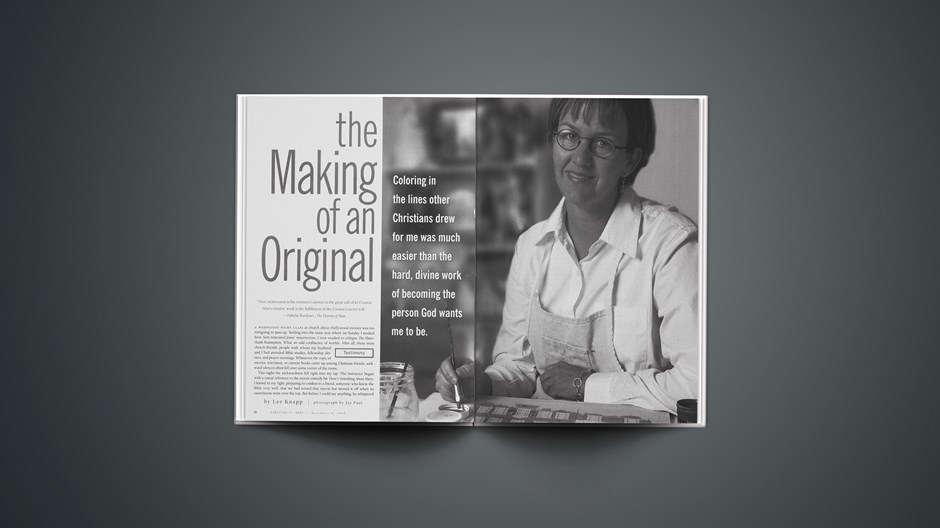
God wants me to be true to my own nature. Sayers wrote that if "work is not true to itself it cannot be true to God or anything else." It is so much easier just to color in the lines that someone else has drawn for me, or to write in another "successful" author's style, than to go through all the hard work of bringing something honest and original into being. It's easier but joyless.
When I was trying to restructure, tame, and even ignore parts of my personality, not to please God but to feel a part of some hard-to-define Christian culture, it was like copying other people's ideas and selling them as my own. It cheated everyone.
Lee Knapp is a writer and artist from Richmond, Virginia.
Related Elsewhere
Read Lee Knapp's article about parenting,"Lunch Happens."















 While we pray for peace, we need moral clarity about this war.
 As my doubts about his teachings grew, so did a secret fascination with Jesus.
 The rage of the mob is a poor substitute for real community.






