Truly I tell you, whoever does not receive the kingdom of God as a little child will never enter it. Luke 18:17 (NRSV)"It's not only more blessed to give than to receive," says Frederick Buechner, "it's also a whole lot easier."It's easier to give, because we then work from our strength. We work from the human resource center that God has opened in each of us. We offer somebody a willing hand or an encouraging word, and we know we've been on holy ground. We've gone into union with God. Even our tears can bless a suffering person with the knowledge—the irreplaceable knowledge—that he matters to us, that his suffering makes us suffer. Because of the bounteous way we've been created, we have value to confer on others, and we've got freedom to decide how much value to confer, and when to do it, and to whom.Of course we make bad decisions all the time. We give full attention to people who don't need it and we ignore people who do. We give a lot to people who are already full, and we scrimp with people who hunger—maybe people who hunger for no more than a word of praise. We try to give something to someone, but we go about it in a patronizing way that makes the recipient wish we hadn't bothered. We mess up our giving all the time. Still, to have something to give is to be like God.So what if you didn't have anything to give? What if you had to be on the receiving end all the time? You'd feel passive. You'd feel dependent. You'd feel as if your balance of trade was way out of whack. Many people worry about this. They think, What if I get so sick that strangers have to give me a bath? What if I get paralyzed? What if I get caught in some disastrous sin and need help just to get out of bed and face the wreckage?One of the terrible realities we saw in the news last year was the way Kosovar children inevitably saw their parents. The parents were forced out of their family house before the eyes of their children. The children would see a paramilitary goon roust their mother, plant his foot in her back, and shove. It's terrible to see one's parents humiliated by threats and blows and curses. And then the long, weary march to refugee camps. Kosovars often arrived at refugee camps that were already jammed. In these camps everybody is thirsty and bone-tired, and everybody stinks. Part of the degradation is that under these conditions parents had nothing left to give—not even to their own sons and daughters. Children who were accustomed to seeing their parents as providers had to watch their parents get in line and wait for help just like their children.Dependency can feel like a sorrowful thing. We don't like to be dependent. In one of his books Scott Hoezee points out that all the forms of dependency we hear about have a stigma attached. Who wants to be welfare de pen dent or codependent? How many Christians relish a chance to depend on help from deacons, to need aid from their congregation's Agape Fund? What nation would issue a Declaration of Dependence and hope it would stir the blood of patriots? I think we understand very well that it's more blessed to give than to receive. We understand that it's easier too. A giver has power. A giver has options. A giver may choose to dispense grace or withhold it, almost like God.And so we find ourselves surprised that Jesus is so impressed by children. In Luke 18 Jesus blesses some babies, and then he says to his disciples, Look here. You ought to be like this. The kingdom of God belongs to people like this. And you're never going to "get it" unless you learn to receive the kingdom as these children do.Like a child. Here, of course, is where centuries of preachers have gotten sentimental. Here is where we hear all of the virtues of children, including imaginary ones. But Jesus wasn't sentimental about children. As James Breech writes, Jesus knew they could be perverse, and he says so when he describes children who get themselves in a snit. Their playmates complain about them: "We played the flute for you, and you did not dance"
We wailed, and you did not weep. (Luke 7:32)So in Luke 18 Jesus doesn't say how sweet children are. He doesn't tell us they're special. Not a word about the trusting look in a child's eye. When Jesus Christ blesses an infant—and Luke does use the word for infant here—what he sees is a bundle of need. Infants are needy people. Likewise, in first-century Pales tine they are lowly people. They don't count for anything.Children are like the tax collector in the parable of the Pharisee and the tax collector, which comes just before this text in chapter 18. Jesus tells the parable of the lofty Pharisee who got humbled and the lowly tax collector who got exalted by God.Then he says, Look. While we're in the lowliness department, look at these babies.Jesus was talking to first-century people. Nobody had designer children in those days. Nobody wanted a child-centered family. A child was another mouth to feed, after all, and you had to feed a child for years before the child was old enough to milk a goat or prune a vine.Jesus looks at an infant and he sees a person on the bottom rung of society. As Joel B. Green writes, first-century children were lowly because they had nothing to give. They didn't produce anything. They didn't contribute anything to village life. Infants can't build a barn or dig a well. They just lie around all day. All they produce is an occasional pants-full, and the village can't do much with that.There's just one thing infants are really good at, one thing they can do better than all the rest of us, one lesson they can teach us all. Jesus Christ points to infants because they are perfectly wonderful receivers. They don't produce very much, but are they ever great at receiving! Nudge an infant with a nipple or a fingertip or almost anything else, and her mouth opens. A healthy infant knows how to take nourishment from food, and she knows how to take nourishment from love. And it's a good thing, because without them she will die. I'm telling you the truth, says Jesus. You have to receive the kingdom of God like an infant, like a child. Jesus says this to disciples, including all of us, who have a large problem in this area. We're not good at receiving. We don't like to be dependent. We don't like to be obliged.We also get cynical over the years, forgetting how to receive a gift with simple enthusiasm. The theologian Hans Urs von Balthasar once wrote about this. Somebody gives us a gift and we rebuke them. "Oh, you shouldn't have," we say. Somebody praises us for the way we played the piano—or whatever it is that we play—and we run ourselves down. "Oh," we say, "I played ugly today." We don't receive the gift of praise. We block the gift, and then we make the giver look ignorant. In effect, we say to her, "When you praised the way I played, you didn't know what you were talking about."
Article continues below
ONCE UPON A TIME WE KNEW HOW TO RECEIVE SOMETHING UNCRITICALLY AND THEN LIVE OFF IT.
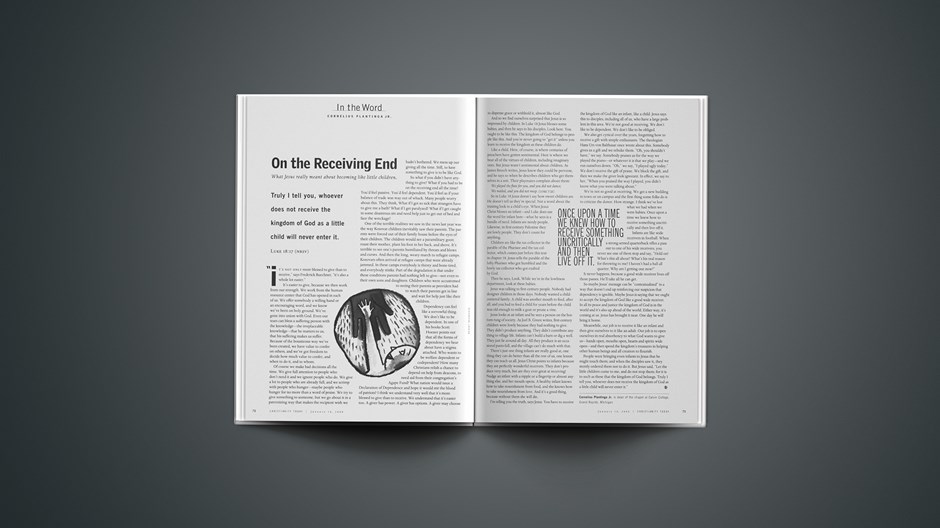
We're not so good at receiving. We get a new building in town or on campus and the first thing some folks do is to criticize the donor. How strange. I think we've lost what we had when we were babies. Once upon a time we knew how to receive something uncritically and then live off it.Infants are like wide receivers in football. When a strong-armed quarterback rifles a pass out to one of his wide receivers, you never see one of them stop and say, "Hold on! What's this all about? What's his real reason for throwing to me? I haven't had a ball all quarter. Why am I getting one now?"It never happens, because a good wide receiver lives off those passes. He'll take all he can get.So maybe Jesus' message can be "contextualized" in a way that doesn't end up reinforcing our suspicion that dependency is ignoble. Maybe Jesus is saying that we ought to accept the kingdom of God like a good wide receiver. In all its peace and justice the kingdom of God is in the world and it's also up ahead of the world. Either way, it's coming at us. Jesus has brought it near. One day he will bring it home.Meanwhile, our job is to receive it like an infant and then give ourselves to it like an adult. Our job is to open ourselves in real absorbency to what God wants to give us—hands open, mouths open, hearts and spirits wide open—and then spend the kingdom's treasures in helping other human beings and all creation to flourish.People were bringing even infants to Jesus that he might touch them; and when the disciples saw it, they sternly ordered them not to do it. But Jesus said, "Let the little children come to me, and do not stop them; for it is to such as these that the kingdom of God belongs. Truly I tell you, whoever does not receive the kingdom of God as a little child will never enter it."Cornelius Plantinga Jr. is dean of the chapel at Calvin College, Grand Rapids, Michigan.Illustration by Robert Neubecker.
Article continues below
Related Elsewhere
Earlier "In the Word" columns include:
Running with Jonah, November 15, 1999
Stuck on the Road to Emmaus, July 12, 1999
Surprised by Death, May 24, 1999
Trying Patience on for Size, February 8, 1999
It's Hard to Hug a Bully, January 11, 1999
Pray the Lord My Mind to Keep, August 10, 1998
What's Wrong with Spirituality?, July 13, 1998
Can God Be Trusted?, June 15, 1998
The Day We Were Left Behind, May 18, 1998
Why We Love This Deadly Sin, February 9, 1998
See other articles by Cornelius Plantinga Jr. in both Christianity Todayand our sister publication Books & Culture.January 10, 2000, Vol. 44, No. 1, Page 72















 While we pray for peace, we need moral clarity about this war.
 Alcoholism among women is rising. Can the church help?
 A first cohort of scholars consider whether God is calling them to executive leadership.