The publication of Cal Thomas's and Ed Dobson's Blinded by Might: Can the Religious Right Save America? (Zondervan, 1999) caused a stir in both national and evangelical circles. CHRISTIANITY TODAY devoted a number of pages to the book's theses (Sept. 6, 1999). And pundits ever since have been announcing the withdrawal of evangelicals from active public life. Richard Cizik, the National Association of Evangelicals' liaison in Washington, D.C., begs to differ.
"Presidential candidates may be more open, even boastful, about their faith, but Christian activists are retreating from national politics," National Journal concluded recently.
Admittedly, some activists have become disillusioned with politics as usual and have dropped out. But does this a trend make? Maybe. And maybe not.
Perhaps the real role of evangelicals in national politics is more complex. Four realities not only suggest this but also might encourage us to persevere in our political efforts:
1. Real evangelical influence inside the beltway is not tied to the success of the "religious right."
The role of religion in turning out the vote is scrutinized every election year. Success, or failure, of the Christian Coalition (and other religious-right groups) to elect politicians (mostly Republicans) is the lens through which our movement's influence is evaluated. This is misguided. The Christian Coalition was never the Goliath opponents made it out to be.
"The decline of the Christian Coalition and some similar religious-right organizations does not necessarily indicate a fall in either the participation or influence of evangelicals in national politics," said James Reichley of the Public Policy Institute at Georgetown University during a recent conference. In fact, he added, "The role of the less partisan and more moderate National Association of Evangelicals seems actually to have increased."
Reichley, a Presbyterian layman, further believes that as evangelicals become more pragmatic, "they increase the possibility that a broad Republican coalition, in which they play a significant part, may win enduring political success.
"
It's also more than "being willing to compromise with others to advance common interests," as he put it. We see our work as a civil endeavor in which we work with all Americans of good faith, whatever their religion, to achieve proper civic goals (religious freedom, restraint of violence, protection of life, justice for all).
Can this civil, pragmatic approach be politically effective? Even the leaders of the Christian right, in private if not in public, admit as much. One of the most significant political accomplishments on Capitol Hill in decades& amp;mdash;passage of the International Religious Freedom Act& amp;mdash;did not depend upon electing or defeating anyone. But it did take enormous work to convince the political and diplomatic establishment that our arguments were sound.
Working for 20 years inside Washington has taught me at least one thing: evangelical success in this town does not depend on the outcome of any election.
2. Evangelical leaders oppose political withdrawal.
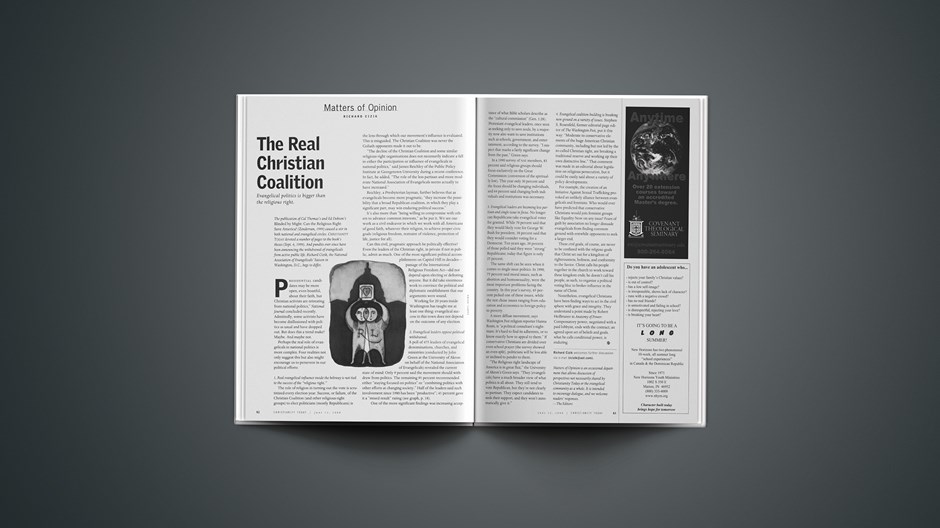
A poll of 475 leaders of evangelical denominations, churches, and ministries (conducted by John Green at the University of Akron on behalf of the National Association of Evangelicals) revealed the current state of mind: Only 9 percent said the movement should withdraw from politics. The remaining 91 percent recommended either "staying focused on politics"
or "combining politics with other efforts at changing society." Half of the leaders said such involvement since 1980 has been "productive"; 41 percent gave it a "mixed result" rating (see graph).
One of the more significant findings was increasing acceptance of what Bible scholars describe as the "cultural commission" (Genesis 1:28). Protestant evangelical leaders, once seen as seeking only to save souls, by a majority now also want to save institutions such as schools, government, and entertainment, according to the survey. "I suspect that marks a fairly significant change from the past," Green says.
In a 1990 survey of NAE members, 83 percent said religious groups should focus exclusively on the Great Commission (conversion of the spiritually lost). This year only 30 percent said the focus should be changing individuals, and 64 percent said changing both individuals and institutions was necessary.
3. Evangelical leaders are becoming less partisan and single-issue in focus. No longer can Republicans take evangelical votes for granted. While 70 percent said that they would likely vote for George W. Bush for president, 38 percent said that they would consider voting for a Democrat. Ten years ago, 38 percent of those polled said they were "strong" Republicans; today that figure is only 25 percent.
The same shift can be seen when it comes to single-issue politics. In 1990, 75 percent said moral issues, such as abortion and homosexuality, were the most important problems facing the country. In this year's survey, 65 percent picked one of these issues, while the rest chose issues ranging from education and economics to foreign policy to poverty.
Article continues below
A more diffuse movement, says Washington Post religion reporter Hanna Rosin, is "a political consultant's nightmare. It's hard to find its adherents, or to know exactly how to appeal to them." If conservative Christians are divided over even school prayer (the survey showed an even split), politicians will be less able or inclined to pander to them.
"The Religious right landscape of America is in great flux," the University of Akron's Green says. "They [evangelicals] have a much broader view of what politics is all about. They still tend to vote Republican, but they're not clearly so partisan. They expect candidates to seek their support, and they won't automatically give it."
4. Evangelical coalition-building is breaking new ground on a variety of issues. Stephen S. Rosenfeld, former editorial page editor of The Washington Post, put it this way: "Moderate to conservative elements of the huge American Christian community, including but not led by the so-called Christian right, are breaking a traditional reserve and working up their own distinctive line." That comment was made in an editorial about legislation on religious persecution, but it could be easily said about a variety of policy developments.
For example, the creation of an Initiative Against Sexual Trafficking provoked an unlikely alliance between evangelicals and feminists. Who would ever have predicted that conservative Christians would join feminist groups like Equality Now on any issue? Fears of guilt by association no longer dissuade evangelicals from finding common ground with erstwhile opponents to seek a larger end.
These civil goals, of course, are never to be confused with the religious goals that Christ set out for a kingdom of righteousness, holiness, and conformity to the Savior. Christ calls his people together in the church to work toward these kingdom ends; he doesn't call his people, as such, to organize a political voting bloc to broker influence in the name of Christ.
Nonetheless, evangelical Christians have been finding ways to act in the civil sphere with grace and integrity. They understand a point made by Robert Heilbruner in Anatomy of Power: Compensatory power, negotiated with a paid lobbyist, ends with the contract; an agreed upon set of beliefs and goals, what he calls conditional power, is enduring.
Richard Cizikwelcomes further discussion via e-mail (rcizik@aol.com).Matters of Opinion is an occasional department that allows discussion of perspectives not necessarily shared by Christianity Today or the evangelical community as a whole. It is intended to encourage dialogue, and we welcome readers' responses. --The Editors















 While we pray for peace, we need moral clarity about this war.
 As my doubts about his teachings grew, so did a secret fascination with Jesus.
 Beyoncé’s right. Whether listening to Cowboy Carter or reading theology, diversity is a good thing.






