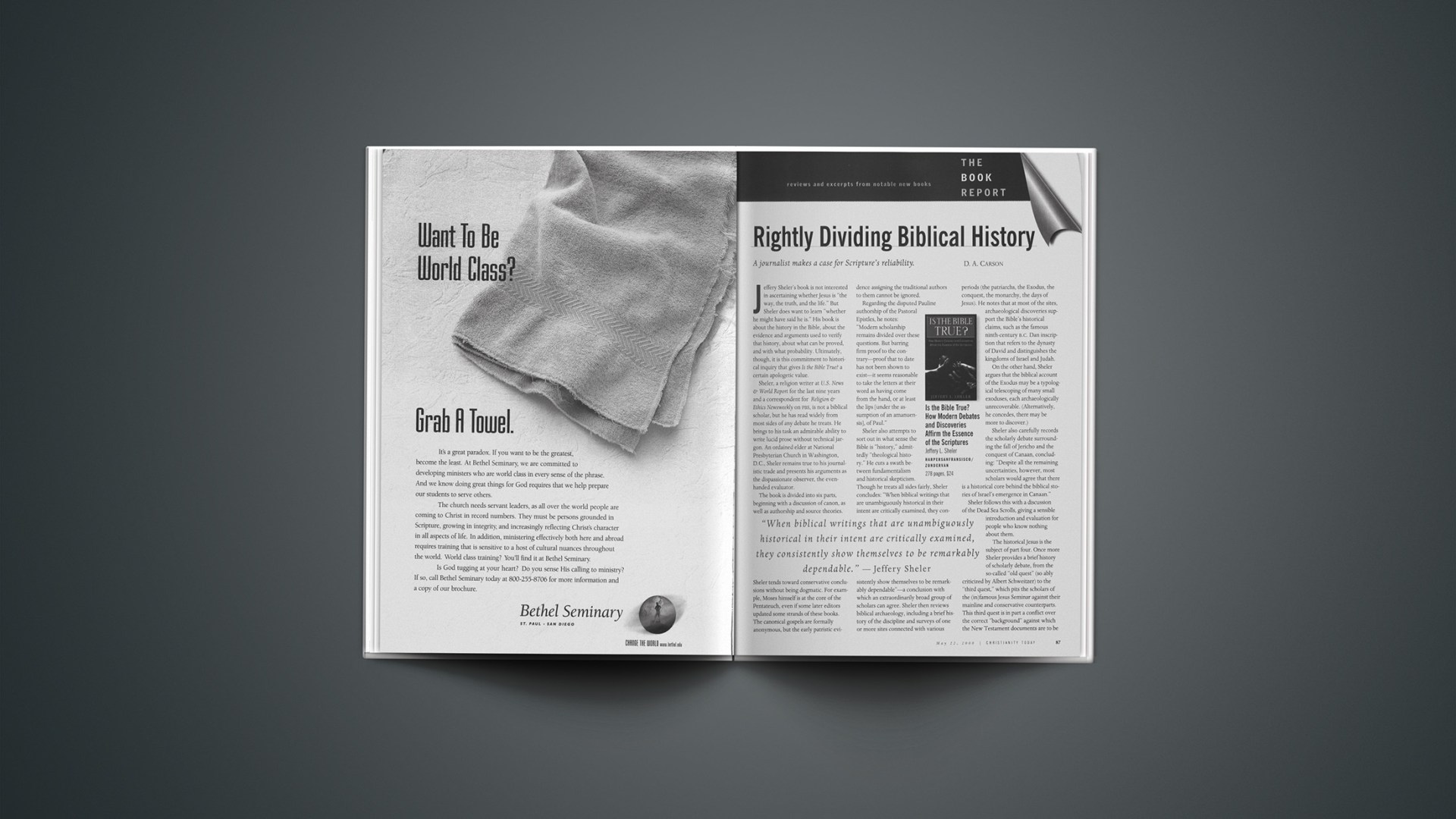

Jeffery Sheler’s book is not interested in ascertaining whether Jesus is “the way, the truth, and the life.” But Sheler does want to learn “whether he might have said he is.” His book is about the history in the Bible, about the evidence and arguments used to verify that history, about what can be proved, and with what probability. Ultimately, though, it is this commitment to historical inquiry that gives Is the Bible True? a certain apologetic value.
Sheler, a religion writer at U.S. News & World Report for the last nine years and a correspondent for Religion & Ethics Newsweekly on PBS, is not a biblical scholar, but he has read widely from most sides of any debate he treats. He brings to his task an admirable ability to write lucid prose without technical jargon. An ordained elder at National Presbyterian Church in Washington, D.C., Sheler remains true to his journalistic trade and presents his arguments as the dispassionate observer, the even-handed evaluator.
The book is divided into six parts, beginning with a discussion of canon, as well as authorship and source theories. Sheler tends toward conservative conclusions without being dogmatic. For example, Moses himself is at the core of the Pentateuch, even if some later editors updated some strands of these books. The canonical gospels are formally anonymous, but the early patristic evidence assigning the traditional authors to them cannot be ignored.
Regarding the disputed Pauline authorship of the Pastoral Epistles, he notes: “Modern scholarship remains divided over these questions. But barring firm proof to the contrary—proof that to date has not been shown to exist—it seems reasonable to take the letters at their word as having come from the hand, or at least the lips [under the assumption of an amanuensis], of Paul.”
Sheler also attempts to sort out in what sense the Bible is “history,” admittedly “theological history.” He cuts a swath between fundamentalism and historical skepticism. Though he treats all sides fairly, Sheler concludes: “When biblical writings that are unambiguously historical in their intent are critically examined, they consistently show themselves to be remarkably dependable”–a conclusion with which an extraordinarily broad group of scholars can agree. Sheler then reviews biblical archaeology, including a brief history of the discipline and surveys of one or more sites connected with various periods (the patriarchs, the Exodus, the conquest, the monarchy, the days of Jesus). He notes that at most of the sites, archaeological discoveries support the Bible’s historical claims, such as the famous ninth-century b.c. Dan inscription that refers to the dynasty of David and distinguishes the kingdoms of Israel and Judah.
On the other hand, Sheler argues that the biblical account of the Exodus may be a typological telescoping of many small exoduses, each archaeologically unrecoverable. (Alternatively, he concedes, there may be more to discover.)
Sheler also carefully records the scholarly debate surrounding the fall of Jericho and the conquest of Canaan, concluding: “Despite all the remaining uncertainties, however, most scholars would agree that there is a historical core behind the biblical stories of Israel’s emergence in Canaan.”
Sheler follows this with a discussion of the Dead Sea Scrolls, giving a sensible introduction and evaluation for people who know nothing about them.
The historical Jesus is the subject of part four. Once more Sheler provides a brief history of scholarly debate, from the so-called “old quest” (so ably criticized by Albert Schweitzer) to the “third quest,” which pits the scholars of the (in)famous Jesus Seminar against their mainline and conservative counterparts. This third quest is in part a conflict over the correct “background” against which the New Testament documents are to be read. This survey is probably the best in the book. Sheler gives brief biographies of the Jesus Seminar’s three leading lights (Robert Funk, Marcus Borg, and John Dominic Crossan), and two of their most influential opponents (John Meier and N. T. Wright). After laying out the conflicting arguments, Sheler concludes,
[T]he gospel portrait of Jesus of Nazareth appears far clearer, more consistent, and more credible than contentious scholarly discourse often makes it out to be. The Jesus of the gospels emerges as a bearer of hope, a doer and sayer of the unexpected. His message and miracle [sic] correspond. And the unknown man from Galilee becomes less of a stranger to our times. & amp;#hellip; The New Testament & amp;#hellip; bears strong and credible witness to two important pieces of historical data: an empty tomb and reports of post-resurrection appearances of the risen Christ. That, of course, falls far short of proving as incontestable objective fact the gospel claim that Jesus of Nazareth was raised from the dead. But it is no small thing. It establishes a credible historical foundation—a basis beyond mere fantasy or wishful thinking—upon which a resurrection faith can stand.
Unfortunately, Sheler then looks at the dubious “Bible Code” theory of Michael Drosnin and others, a part of the book that should have been omitted—though one can understand why a journalist would want to tackle it, for the theory has attracted a lot of attention. Certainly Sheler is to be thanked for his popular-level debunking of this nonsense.
For his concluding chapter, Sheler tries to answer the question, “Is the Bible true?” The last paragraphs break the tone of detached coolness that characterizes much of the book. He reminds his readers that something deeper still is going on in the Bible: “It is not merely to ancient history that the Bible directs our attention. It is to the God who is active in history, redeeming it and infusing it with meaning, that the Scriptures ultimately point.”
For Christians, there are better light introductions to almost all of the topics Sheler discusses. On particular points, Sheler’s volume can appear thin next to more rigorous treatments: on the Jesus Seminar, for instance, one might read Jesus Under Fire: Modern Scholarship Reinvents the Historical Jesus (1995), edited by Michael J. Wilkens and J. P. Moreland. Nor will this book satisfy the new wave of students whose view of history has been heavily influenced by postmodern epistemology: Sheler’s book is an eminently “modern” approach.
Still, I would happily recommend this book—indeed, give it away as part of responsible Christian witness—to the substantial numbers of people who know virtually nothing about Christianity or the Bible except for the esoteric and way out things they have picked up from the more skeptical media. Wilkens and Moreland are far too technical for them, and standard New Testament introduction would put them to sleep. This book might help them question the dogmatic agnosticism they have imbibed and leave them open for more serious conversations.
D. A. Carson is research professor of New Testament at Trinity Evangelical Divinity School in Deerfield, Illinois.
Related Elsewhere
Jeff Sheler’s book was excerpted in U.S. News & World Report, and appeared as the cover story of the magazine’s October 25, 1999 issue.
HarperCollins‘s page merely provides several happy blurbs promoting the book. Zondervan‘s has even less information.
An interview with Sheler where he discusses his book is also online (requires RealAudio). Last month, author Ian Wilson published The Bible Is History, where he discusses some of the same evidence as Sheler, although sometimes drawing different conclusions.
Sheler’s book was recently selected as the top apologetics/evangelism title of 1999 by Christianity Today. It also receives a brief, but positive comment from historian Mark Noll in a recent article in Books & Culturethat discusses books on the history of the Bible. The Biblical Archaeology Society has published a slightly more critical review of the book.
Is the Bible True? can be purchased at the Christianity Online bookstore and other book retailers.
In addition to Christianity Today‘s September 7, 1998 cover story, “Did the Exodus Never Happen? | How two Egyptologists are countering scholars who want to turn the Old Testament into myth,” our past coverage of archaeology includes:
Ancient Church Discovered in Gaza (May 24, 1999)
Signs of Canaanite Jerusalem Found (Oct. 5, 1998)
Temple Mount on Shaky Ground? (April 6, 1998)
Pottery Shard Points to Temple (Jan. 12, 1998)
Do Photos Evidence Lost Edenic River? (Oct. 7, 1996)
Time has also covered the topic of the Bible’s historical reliability. U.S. News reported in 1998 on how the Bible is being taught as history in public schools, while People for the American Way criticizes the way the Bible is taught in Florida schools.
Biblical Archaeology Review has selected articles from its current issue available online. Bible History Online has a massive amount of links to Web sites relating to Bible history.
D.A. Carson recently answered whether Christians are required to tithe in an article for Christianity Today, defended expository preaching for Leadership, and recounted how he learned to pray for Christian Reader.
Copyright © 2000 Christianity Today. Click for reprint information.