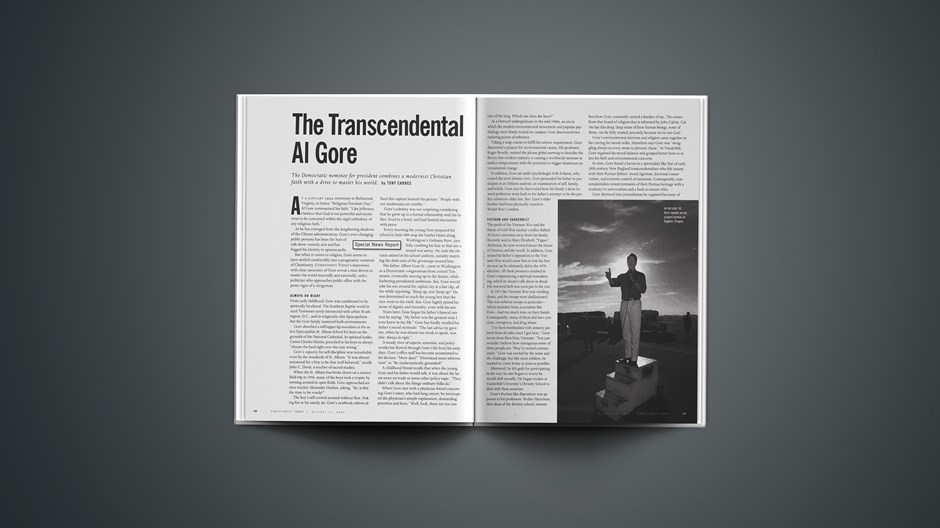
At a January 1994 ceremony in Richmond, Virginia, to honor "Religious Freedom Day," Al Gore summarized his faith: "Like Jefferson, I believe that God is too powerful and mysterious to be contained within the rigid orthodoxy of any religious faith." As he has emerged from the lengthening shadows of the Clinton administration, Gore's ever-changing public persona has been the butt of talk-show comedy acts and has fogged his identity in opinion polls. But when it comes to religion, Gore seems to have settled comfortably into a progressive variation of Christianity. Christianity Today's interviews with close associates of Gore reveal a man driven to master his world internally and externally, and a politician who approaches public office with the pious vigor of a clergyman.
Always do right
From early childhood, Gore was conditioned to be spiritually bicultural. The Southern Baptist world in rural Tennessee rarely intersected with urban Washington, D.C., and its religiously elite Episcopalians. But the Gore family mastered both environments. Gore absorbed a stiff-upper-lip moralism at the select Episcopalian St. Albans School for boys on the grounds of the National Cathedral. Its spiritual leader, Canon Charles Martin, preached to his boys to always "choose the hard right over the easy wrong."Gore's capacity for self-discipline was remarkable even by the standards of St. Albans. "It was almost unnatural for a boy to be that well-behaved," recalls John C. Davis, a sacred-studies teacher. When the St. Albans bus broke down on a science field trip in 1958, many of the boys took a respite by running around in open fields. Gore approached science teacher Alexander Haslam, asking, "Sir, is this the time to be rowdy?" The boy's self-control seemed without flaw. Poking fun at his saintly air, Gore's yearbook editors affixed this caption beneath his picture: "People without weaknesses are terrible."Gore's sobriety was not surprising considering that he grew up in a formal relationship with his father, lived in a hotel, and had limited interaction with peers. Every morning the young Gore prepared for school in Suite 809 atop the Fairfax Hotel along Washington's Embassy Row, carefully combing his hair so that not a strand was astray. He rode the elevator attired in his school uniform, suitably matching the dark suits of the grownups around him. His father, Albert Gore Sr., came to Washington as a Democratic congressman from central Tennessee, eventually moving up to the Senate, while harboring presidential ambitions. Sen. Gore would take his son around the capital city at a fast clip, all the while enjoining, "Keep up son! Keep up!" He was determined to teach the young boy that the race went to the swift. Sen. Gore highly prized his sense of dignity and formality, even with his son. Years later, Gore began his father's funeral oration by saying, "My father was the greatest man I ever knew in my life." Gore has fondly recalled his father's moral rectitude: "The last advice he gave me, when he was almost too weak to speak, was this: Always do right."A steady river of experts, scientists, and policy wonks has always moved through Gore's life from his early days. Gore's office staff has become accustomed to his decrees: "More data!" "Download more information!" or "Be mathematically grounded!"A childhood friend recalls that when the young Gore and his father would talk, it was about the latest news on trade or some other policy topic. "They didn't talk about the things ordinary folks do."When Gore met with a physician friend concerning Gore's sister, who had lung cancer, he interrupted the physician's simple explanation, demanding precision and facts: "Well, look, there are ten cancers of the lung. Which one does she have?"
As a Harvard undergraduate in the mid-1960s, an era in which the modern environmental movement and popular psychology were firmly rooted on campus, Gore discovered two enduring points of reference. Taking a snap course to fulfill his science requirement, Gore discovered a passion for environmental causes. His professor, Roger Revelle, minted the phrase "global warming" to describe the theory that modern industry is causing a worldwide increase in surface temperatures with the potential to trigger disastrous environmental change. In addition, Gore sat under pop psychologist Erik Erickson, who coined the term "identity crisis." Gore persuaded his father to participate in an Erickson analysis, an examination of self, family, and beliefs. Gore says he discovered how his family's drive toward perfection went back to his father's attempt to be the perfect substitute older son. Sen. Gore's older brother had been physically ruined in World War I combat. The perils of the Vietnam War and the threat of Cold War nuclear conflict shifted Al Gore's attention away from his family. Recently wed to Mary Elizabeth "Tipper" Aitcheson, he now worried about the future of America and the world. In addition, Gore sensed his father's opposition to the Vietnam War would cause him to lose his Senate seat (as he ultimately did in the 1970 election). All these pressures resulted in Gore's experiencing a spiritual reawakening, which he doesn't talk about in much detail. His newly renewed faith was soon put to test."I've been bombarded with sensory patterns from all sides since I got here," Gore wrote to his family from Bien Hoa, Vietnam. "You just wouldn't believe how outrageous some of these people are. They're stoned continuously."In 1971 the Vietnam War was winding down, not very successfully, and the troops were disillusioned. The rear-echelon troops in particular—which included Army journalists like Gore—had too much time on their hands. Consequently, many of them slid into cynicism, corruption, and drug abuse.Gore was excited by the noise and the challenge, but like most soldiers, he wanted to come home as soon as possible. Afterward, he felt guilt for participating in the war; he also began to worry he would drift morally. He began studies as Vanderbilt University's Divinity School to deal with these anxieties.Gore's Puritan-like disposition was apparent to his professors. Walter Harrelson, then dean of the divinity school, remembers how Gore constantly carried a burden of sin. "He comes from that brand of religion that is informed by John Calvin. Calvin has this deep, deep sense of how human beings, none of them, can be fully trusted, precisely because we're not God."Gore's environmental interests and religion came together in his craving for moral order. Harrelson says Gore was "struggling always in every sense to prevent chaos." At Vanderbilt, Gore regained his moral balance and grasped better how to relate his faith and environmental concerns.In time, Gore found a haven in the spirituality of early 19th-century New England transcendentalists who felt uneasy with their Puritan fathers' moral rigorism, doctrinal conservatism, and extreme control of emotions. Consequently, transcendentalists mixed remnants of their Puritan heritage with a tendency to universalism and a back-to-nature ethic.
Article continues below
A rising star falters
As Gore regained his sense of self, he detoured into journalism. In 1976 he was elected as a congressman from Tennessee. Eight years later, he won election to the Senate and was seen as a rising star in the beleaguered Democratic Party during the Reagan-Bush years. Gore quickly set his sights on the 1988 presidential primaries. His string of political victories, however, slowed to a halt as his presidential campaign failed to catch fire. The following year brought another catastrophe. Gore, Tipper, and Al III (then age 6) had gone to watch the Baltimore Orioles defeat fireball-hurler Roger Clemens of the Boston Red Sox. As the twosome walked out of the stadium, Al III son slipped his father's grasp and ran headlong into an incoming car, bouncing 20 feet, losing two feet of skin and crushing his internal organs. "We prayed, the two of us, there in the gutter, with only my voice," Gore says. He fell to his knees and grasped his son, nearly overwhelmed with shock. Two passing nurses started to give CPR. Tipper hovered nearby, praying aloud."For a dozen or more days, the doctors told the Gores, 'One of you needs to be here when he wakes up.' They were there, always one of them," says James Dunne, a Southern Baptist theologian who has counseled the Gores. Gore's beloved sister had died two years earlier. His campaign was stalled, and he was secretly borrowing money to make ends meet. He and Tipper were fighting furiously over his overbooked schedule. Now he was threatened with losing his namesake. It was too much, even for "stiff-as-a-board Al," as some opponents and even some friends called him. Dunne says that the near-death of Gore's son was "no doubt a turning point." Gore says he "changed in a fundamental way."In the depths of this period, Gore wrote Earth in Balance, to date his best attempt to articulate his concern for creating a better world. But the book has attracted a great deal of criticism for being a compendium of New-Age Christianity, buttressed by universalism and pantheism.In the book, Gore blasts Western civilization as "deeply dysfunctional." In his prescription for change, Gore draws on Islamic, Hindu, Sikh, and Baha'i texts, along with Native American prayers to the Great Spirit. He waxes nostalgic about "a single earth goddess" who benevolently reigned in the hearts of prehistoric humans. Just before the book's publication in 1992, Gore gave a sermon at the Episcopal Cathedral of St. John the Divine in New York City. His pronouncement that "God is not separate from the earth" brought a storm of protest. Southern Baptist leader Richard Land sharply responded, "We make it very clear we do not worship creation, we worship the God of creation."Gore's defenders say that he is very careful to distinguish between his Christian convictions and other doctrines. "The foundation of all my work on the environment is my faith in Jesus Christ," Gore told CT after publishing Earth in the Balance.Joan Brown Campbell, former head of the National Council of Churches and a longtime Gore friend, says Gore is "not confused about who God is. The earth is not God. He is not a New Ager."Others say that Gore employs insights from other religions to build a bridge of understanding. They point out that Gore's primary text is the Bible. Indeed, Gore's chapter "Environmentalism of the Spirit" could have been written by the late evangelical scholar Francis Schaeffer, says Ron Sider of Eastern Baptist Theological Seminary in Philadelphia.While Gore may not be a New Age pantheist, he seems comfortable with New Age psychology. From getting in touch with "the inner child" to bonding through emotional confessions, Gore seeks to unlock his Puritan shell to get in touch with his emotions and "the nature that throbs around us," as 19th-century Transcendentalist Ralph Waldo Emerson put it.After the 1996 election, Gore put together a Cabinet-level retreat. The assembled leaders of the Clinton administration were put through a New Age therapy session by consultants described by former White House communications director George Stephanopolous as "two sensible looking middle-aged ladies with Romper Room smiles on their faces and jumbo Magic Markers in their hands." Stephanopolous said it was "excruciating."
Article continues below
Article continues below
Spiritual sweet spot
Gore has an uncanny ability to find the spiritual sweet spot of an audience. With Campbell and the late Cornell University astronomer Carl Sagan, he accented the things religion and science have in common. At his father's funeral in Possum Hollow in central Tennessee, he started with the Bible and ended with a Billy Graham quote.Gore's diverse religious rhetoric and practice do not seem rooted in attempts to manipulate the electorate. Indeed, Gore has put his Christian spirituality on the line in environmental policy, welfare reform, and strengthening families. He claims that his support of faith-based initiatives for social services more than matches that of Bush.His critics, however, say his faith-based rhetoric is an election-year ploy. Interviews with Gore campaign staffers reveal a telling lack of detail to Gore's plans for bringing faith-based ministries into new partnerships with government."Vice President Gore believes that the solutions of faith-based organizations should be part of our national strategy," says Gore campaign spokesman Dagoberto Vega. Yet Vega was unable to cite any specific policy proposal: "When [Gore] becomes president, then we will do most of our research on how to do this."Gore's mosaic of rational spirituality has given him the profile of an inclusive modernist who maintains a commitment to Christian belief and the institutional church. At the same time, says Campbell, a Presbyterian, "Gore is open to the faith of others."
Article continues below
Related Elsewhere
Visit
Gore's campaign homepage.
The Washington Post ran a comprehensive series that dealt with every aspect of Gore's life from his marriage and schooling, to his time in Vietnam.Read a
candidate profile of Gore and his runningmate, Joseph Leiberman, at U.S. News Online.See our previous coverage of Gore's opponent
George W. Bush.Previous Christianity Today articles about Gore include:Pencils Down, the Election's Over | According to political scientists, Al Gore has already won. (Sept. 11, 2000)
Bush and Gore Size Up Prolife Running Mates | Will abortion stances play an influential role in Vice Presidential selection? (July 13, 2000)
A Jew for Vice-President? | Joseph Lieberman's Torah observance could renew America's moral debate. (Aug. 9, 2000)















 While we pray for peace, we need moral clarity about this war.
 Alcoholism among women is rising. Can the church help?
 Christian urban designers and developers explain how their faith affects their work—and how their work affects your faith.