Today on American college and high school campuses, the name most associated with the word Christian—other than Jesus—is not the Pope or Mother Teresa or even Billy Graham. Instead, it's a goofy-looking guy named Ned Flanders on the animated sitcom known as The Simpsons. The mustache, thick glasses, green sweater, and irrepressibly cheerful demeanor of Ned Flanders, Homer Simpson's next-door neighbor, have made him an indelible figure, the evangelical known most intimately to nonevangelicals.
A 1999 survey conducted by Roper Starch Worldwide found that 91 percent of American children between the ages of 10 and 17 could identify members of the Simpson family; 84 percent of adults could identify them. In each case, this was a greater percentage of children and adults than could identify then-Vice President Al Gore. Many evangelicals would have no difficulty in recognizing Ned and his family as their own. Gerry Bowler, professor of philosophy at Canadian Nazarene College in Calgary and chairman of the Center for the Study of Christianity and Contemporary Values, calls Flanders "television's most effective exponent of a Christian life well-lived."
Like many of the series' characters, Flanders is the frequent object of satire. An Oral Roberts University graduate who is never without a Bible and a large piece of the True Cross (which saved his life in one episode when he was shot), Ned believes that an essential element of a good life is "a daily dose of vitamin church." Nevertheless, Flanders is a complex and nuanced character who often raises serious issues.
Consider his journey of faith. The root of his turn toward a structured religious framework is a traumatic childhood. When Ned suffers a breakdown and is institutionalized, he experiences flashbacks of his child psychiatrist employing eight months of sustained, "therapeutic" spanking to control the obstreperous little boy. His parents were "freaky beatniks'' who raised their son with no rules at all. Ned's reaction to this chaotic environment mirrors many studies of those who came of age in the 1960s and 1970s and, finding the freewheeling lifestyle unsatisfying or repugnant, gravitated to religion.
Ned's daily obedience
Religion informs nearly every aspect of Ned's life, from the doorbell that chimes "A Mighty Fortress is Our God" to his air horn that blares the Hallelujah chorus. Together with his family, he prays at meals and before bed. He attends church three times a week and tithes, contributing to seven other congregations, just to be on the safe side. He belongs to a Bible-study group and keeps notes stuck on his refrigerator with a sign of the fish magnet. Like many believers, he thanks God often for his blessings, for things as small as a beautiful day.
Ned believes in salvation through grace, and he expects Jesus' return to Earth at any moment. Yet Ned is also deeply immersed in the good works of the social gospel, beginning with the random (and typically improbable) donation of one kidney and one lung. His elderly grandmother lived with the family for a time. Ned volunteers at a foster home, hospitals, soup kitchens, and a homeless shelter.
Ned's Christianity plays a major part in the way he and his wife, Maude, raise their sons, Rod and Todd. Ned does not allow the kids to use dice when playing board games because dice are wicked. He is hesitant to buy the children Red Hots candies because there is a lascivious caricature of the devil on the package. The kids' favorite games are Good Samaritan and Clothe the Leper. The young Flanders boys are total innocents; they believe they are getting closer to God when they jump on the Simpsons' trampoline, and they complain that they only get to attend church three times a week. Ned is not immune to the familiar conflict between parental instruction on morality and the exigencies of modern life, especially when it comes to lying. Todd overhears Ned tell Homer that he can't come over to their house because they are visiting relatives. The boy knows it's untrue—though told to spare Homer's feelings. "Lies make Baby Jesus cry," Todd reminds his father.
Even Ned's various sideline businesses, some part of Flancrest Industries, reflect his faith. He sells religious hooked rugs on the Internet and Bible trading cards at the swap meet. Flanders is honorable in his business, sometimes to his detriment. His major plunge into the entrepreneurial world occurs when he gives up his job in pharmaceuticals to open the Leftorium, a boutique in the mall for all things left-handed. His morality and good nature nearly do him in. He spends the day ignoring shoplifters and chasing down a customer he inadvertently short-changed, and becomes known for validating parking even for passersby.
Ned admits that most of the time he is "about as exciting as a baked potato." Yet for all his sweetness, he does have an unpredictable side. A part of him yearns to fit in with his worldly friends, even when his efforts are outlandish. Given his muscular physique, Flanders is selected to play the role of Stanley Kowalski in the community production of A Streetcar Named Desire, a musical version called Oh! Streetcar! The director instructs him to play it as if he were "pulsating with animal lust." In another episode, Flanders sins on a grand scale, going with Homer to Las Vegas for a wild weekend, during which he goes on an all-night bender and (apparently) marries a cocktail waitress.
Article continues below
Ned grapples with other temptations of popular culture in various incarnations and, on those rare occasions when he succumbs to temptation, is quick to see divine retribution. He angrily runs off a shady cable installer who offers an illegal hookup. Instead, he turns to satellite television, which enables him to view more than 200 channels, almost all of which he then locks out for offensive content. Straying from his usual screen fare, like reruns of The Jim Nabors Show, he once watched Married. … With Children (on the same network that produces The Simpsons). He insists he is afflicted with the flu for this lapse: "Oh, the network slogan is true! Watch Fox and be damned for all eternity!"
Ned's dark side
For all his admirable qualities, Flanders occasionally exhibits the zealous proselytizing that for many represents the unpleasant side of evangelical Christianity: an unwillingness to take no for an answer. After a typical misadventure, Homer and Marge lose custody of their children—Bart, Lisa, and Maggie. The state moves the Simpson children next door into the temporary care of the Flanders family. A family parlor game, Bible Bombardment, first reveals that Bart and Lisa have no grasp of the scriptural arcana that is common knowledge to the Flanders boys. The Simpson offspring then let slip that they have never been baptized. Rather than consulting Homer and Marge, who are taking court-ordered parenting classes, Ned dresses the Simpson children—who have voiced neither interest nor acquiescence—in white robes for baptism. At the Springfield River, he prepares to immerse them and asks if they reject Satan. Homer interrupts the involuntary rite before any water lands on Bart's head, saving Bart from being saved.
This situation is not as far-fetched as it may appear. As often happens in The Simpsons, the scenario illustrates a serious and historic theological issue, in this case involving religious commitment and free will. Forced conversions have been an all-too-familiar event in Christian history and even today. In a case that became a world controversy, a 6-year-old Jewish boy named Edgardo Mortara was taken from his parents in Rome in 1858 and raised as a Catholic after a serving girl claimed to have secretly baptized the boy when he was an infant. Closer to home and the present, parents in central Florida in the late 1990s sued a Christian daycare center for baptizing their children without their consent.
Article continues below
But above all, Ned is the good neighbor, his basic role in the series. "Affordable tract housing made us neighbors," he tells Homer, "but you made us friends." In fact, the opposite is true. Homer does everything short of mayhem to abuse Flanders. It is only by repeatedly turning to Mathew (19:19), Jesus' admonition to "love your neighbor as yourself," that Ned is able to survive the relationship, returning unconditional love for sustained abuse. Well, maybe not unconditional love. Ned is human, and so has limits, traits that reinforce his believability.
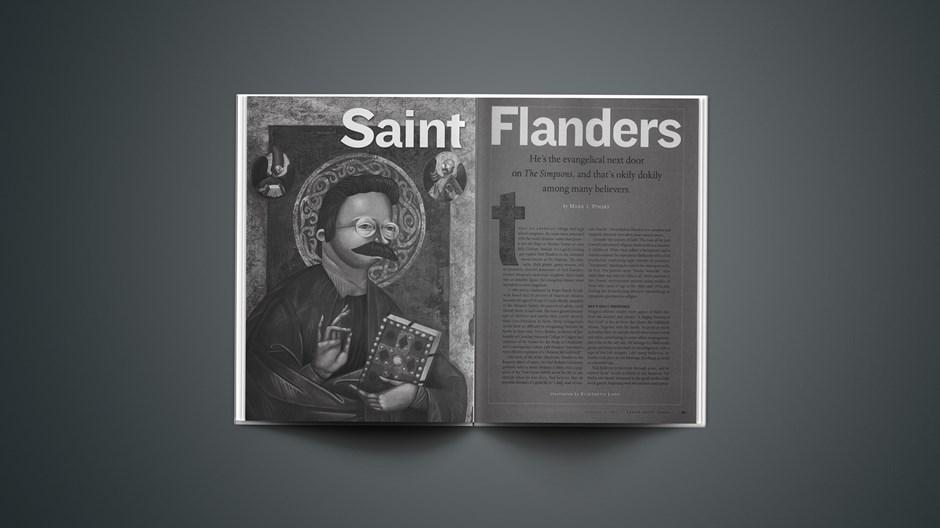
While Ned never suffers martyrdom for his faith, he endures Homer's scorn. Homer considers him "a big, four-eyed lame-o" who wears the same sweater every day, except to attend church. Homer tells Ned to shut up, calls him a liar and a square, nearly runs him over, and dumps garbage on his head. He refers to Ned by a variety of derisive terms like "Saint Flanders," "Charlie Church," and "Churchy La Femme." Flanders is actually the physical embodiment of "muscular Christianity," a man who would be right at home at a Promise Keepers rally. Ned works out to a buff build that belies his age, which he insists is 60. The secret of his youthful appearance, he explains to Homer, is that he "resists all major urges." Yet early in the series, he would take a drink, a beer, or a cocktail—he claims a degree in mixology—and he smokes a pipe. Ned has many of the accoutrements of the last decade's middle-class prosperity, like a boat (Thanks for the Boat, Lord II) and a summer beach house. On the other hand, he drives an uninspiring Geo station wagon, with a license plate reading jhn 143 (John 1:43, in which Jesus tells the disciples, "Follow me").
Ned takes literally Jesus words' in John 15:13: "Greater love hath no man than this, that a man lay down his life for his friends." A volunteer firefighter, Ned says a prayer as he risks his life to save Homer from a house fire and, in the process of rescuing his neighbor twice, almost loses his own life. Homer assumes the fire is God's will, a notion Ned instantly rejects. As the fire spreads, the instantly ungrateful Homer observes that God is not sparing Ned's roof from fire, despite his piety and churchgoing. Suddenly, a small wisp floating above Ned's home becomes a rain cloud and douses the blaze. Then a rainbow frames the home.
Article continues below
Ned's tests of faith
In one episode, too much gratitude from Homer turns out to be a deadly thing. Again, prayer plays a central role as a plot device. Just after Homer prays for a ticket to a sold-out local football game, Flanders knocks on the door with an offer to take him. Homer decides he has been unfair to his neighbor, and determines to show his love. But the love is of the oppressive, smothering variety, and before long it is Ned who is praying—for the strength to survive Homer's friendship.
Feeling trapped, Ned dreams of climbing the church tower, singing "Bringing in the Sheaves" while assembling an assault rifle and picking off people below—all with Homer's face. He wakes, distraught, telling his startled wife that he thinks he hates his neighbor, something he knows is wrong and unchristian. Still, the next day Ned makes an excuse to avoid Homer and drives off with his family. In his haste to shake Homer, Ned is stopped for speeding by Springfield Police Chief Wiggum, who loudly (and erroneously) accuses him of driving under the influence of drugs, just as a bus full of horrified church members rolls past the scene. "Where's your Messiah now?" the chief asks in his best Edward G. Robinson accent. It's a good question for Flanders, who has rejected Homer's sincere, if irritating, efforts to be a good neighbor. For a man who puts his faith at the center of his life, where is Jesus now?
On Sunday, Flanders gets his answer. In the car driving to church, he is anxious about appearing at the one place, outside his home, where he feels most welcome and part of society. Maude assures him that the church is "a house of love and forgiveness." But as Flanders enters the sanctuary, people in the pews whisper that he is evil and "the fallen one." The church's pastor, Reverend Lovejoy, announces that the sermon topic is "What Ned Did." Ned compounds his sin by cursing Homer for whistling through his nose during silent prayer, further inflaming the congregation against him.
The role reversal is nearly complete as Homer defends Flanders, describing him—correctly—as a kind, wonderful, caring man who has "turned every cheek on his body" in the face of Homer's insults. "If everyone here were like Ned Flanders, there'd be no need for heaven. We'd already be there." Reverend Lovejoy is convinced, acknowledging that Ned deserves an apology. Flanders has clearly learned his lesson and later thanks Homer for being a true friend. Homer reverts to type, telling him to get lost, and all is right again in the world.
Article continues below
Ned the widower
In early 2000, after a nasty fight over money with the actress who provided the voice for Maude, the series writers killed the character in a freak accident. Al though Homer is accidentally responsible, Ned blames himself and is crushed. But Ned wouldn't be Ned if he didn't turn to God in his time of greatest need. Months later, still desolate, he prays, "Lord, I never question your will, but I'm wondering whether your decision to take Maude was, well, wrong—unless this is part of your divine plan. Could you please just give me some sign, anything?" Instead, there is only silence.
The next morning, Sunday, Flanders sleeps late, and tells Rod and Todd to attend church with the Simpsons—an act so out of character that the boys back out of their father's bedroom, gasping. Flanders vows not to attend church that day, and says he might not go the next day as well. In the very next scene, Flanders is speeding to church, repeating apologies for his momentary lapse of faith. He walks into the sanctuary and hears a Christian rock group. The beautiful lead singer seems to be speaking directly to him: "If you think God isn't there, or doesn't care, it's not too late to look to him for salvation." Ned, still standing in the aisle, is transfixed. This is the sign he prayed for. Outside the church after the service, he introduces himself to the singer, saying, "My name is Ned Flanders and I'm here every week—rain or shine!"
According to usually reliable sources at the fan-run Simpsons Archive, this season Ned will build a Bible-themed amusement park, called "Praise Land,'' in Maude's memory.
Maude's death prompted Frederica Mathewes-Green to write a paean called "Ned Flanders, My Hero" on Beliefnet.com. "Ned is endlessly cheerful because he is pure in heart. He treats everyone around him with generosity and kindness, and can't imagine they wouldn't treat him the same way. He is incapable of cynicism or contempt," unlike most residents of Springfield. While he may be a fool, she observes, he is the kind of fool who makes the world a better place.
Some observers see Flanders rather differently. Flanders is the show's "cheap shot at fundamentalists—which is why I like it," says David Landry, professor of theology and New Testament at the University of St. Thomas, a Catholic school in St. Paul, Minnesota. Still, Landry said in a newspaper interview, Flanders illustrates "the virtues of hard work and honesty. Flanders is very successful, with well-behaved children, an excellent marriage. He's not portrayed as a real nut. I mean, he's got a beer keg in his basement."
Article continues below
Ned in real time?
In February of 2000, The New York Times featured a family named Scheibner on the cover of its Sunday magazine. Author Margaret Talbot described a family of nine fundamentalist Baptists ensconced in Pennsylvania's Lehigh Valley. On the surface, the Scheibners are similar to the Flanders family. There is no sports gear in the home because parents Stephen and Megan believe athletic competition would not be Christlike. There are Christian board games that Rod and Todd Flanders might enjoy. Stephen Scheibner is a pilot for American Airlines and a commander in the Naval Reserve who, like his wife, found his Christian faith in his teens. But, apart from voting and paying taxes, he and his family have consciously opted out of the surrounding culture.
Yet the Scheibners may be more of a caricature than the Flanders family, who are fully engaged in the world. "We will exaggerate some of Ned's beliefs as a form of comic relief," said The Simpsons' Mike Scully. "I think everybody knows a family like the Flanders[es]." Stripped of their comedic excess and hyperbole, how fairly do Ned and his family represent evangelical Christianity to the world? As an observant Jew raised in a Northeastern suburb, I may not be the best judge. Or maybe I am. For the past five years, I have reported on the evangelical movement—locally and nationally—for The Orlando Sentinel newspaper. More to the point, fate and my central Florida suburb have put me into close contact with a family I see as the Flanders family in real life. Until I raised the issue with them, they had no basis for comparison; they didn't watch the show or allow their children to watch it.
Dan and Lorraine Hardaway are an attractive, college-educated couple in their late 30s. Each experienced some degree of dysfunction in their early lives before turning to Jesus. Dan, who has reddish blond hair and blue eyes, works full time for a Christian outreach organization based in Orlando. Lorraine, whose auburn hair frames a face brightened by a toothy grin, is a stay-at-home mom. Their four children, who range in age from 6 to 14, are as good-natured as Rod and Todd Flanders but considerably more worldly. The Hardaways belong to a nondenominational, evangelical megachurch and a small Bible-study group. They sing in the choir and listen to a contemporary Christian radio station in their cars and at home, and hold conservative beliefs on social issues, although they disagree with some aspects of the Christian Right. For the most part, they grapple with the same things our family does: balancing their stretched budget and busy schedules, deciding what television show or computer game is appropriate for the kids. Like their neighbors, they made an accommodation with Beanie Babies, PokÉmon, and, after much soul-searching and consultation with Christian friends, the Harry Potter books. With their agreement, I use the family as a source, a sounding board, and a pipeline to ground-level believers for my newspaper reporting.
Article continues below
Are the Hardaways typical of evangelical Christians, as typical as the Flanders family? It's hard to say. We have come to know them pretty well in recent years. Our children attend the same public elementary school and the same scout troops at the school, and often attend the same birthday parties, which means we are often in and out of each other's houses. They are sophisticated and generally open-minded, and never press their religious or political views on us or on our children. It is apparent, though, that they draw strength from their Christian faith, which they try to apply to every aspect of their lives. I met them before I started watching The Simpsons, but I cannot watch the Flanders family without thinking of the Hardaways.
I showed them an early draft of this essay, loaned them some tapes from the series and asked them what they thought. "All in all, it would be flattering to be associated with Ned Flanders, based on what I know about the person and how he lives out his faith," Dan says. "There's an element of unconditional love in his life that accurately portrays Christianity." Some Christians might be put off by some of the idiosyncrasies associated with the character, like "nerdy behavior," he added.
Lorraine agreed that, as a family of believers, they are much closer to the Flanders family than to the Scheibners. "How else are people going to see Jesus' teachings lived out unless they see them in our lives?" she says. "It's very important that we're part of the world, that others can see the difference he's made and the truth we believe he taught and shared."
Article continues below
Mark I. Pinsky is a senior reporter who covers religion for The Orlando Sentinel. This essay is adapted from his book, The Gospel According to the Simpsons: The Spiritual Life of America's Most Animated Family, which Westminster/John Knox Press will publish in November.
Harry Shearer is the voice of Flanders (as well as Montgomery Burns, God, the Devil, and Principal Skinner) on The Simpsons. His web site features Simpson soundbytes, as well as other comedy.
If you get our print issue, you may notice that there's not many images of The Simpsons characters. Fact is the Fox network refused to give them to us. And look what happened to The Door when they used the images without permission.
Shoot the Messenger, an Australian Christian site, also looked at the religious themes in the show.
Have something to add about this? See something we missed? Share your feedback here.
Our digital archives are a work in progress. Let us know if corrections need to be made.















 While we pray for peace, we need moral clarity about this war.
 As my doubts about his teachings grew, so did a secret fascination with Jesus.
 How groups like Hillsong learned to let go of the literal in favor of creative collaboration.españolPortuguês






