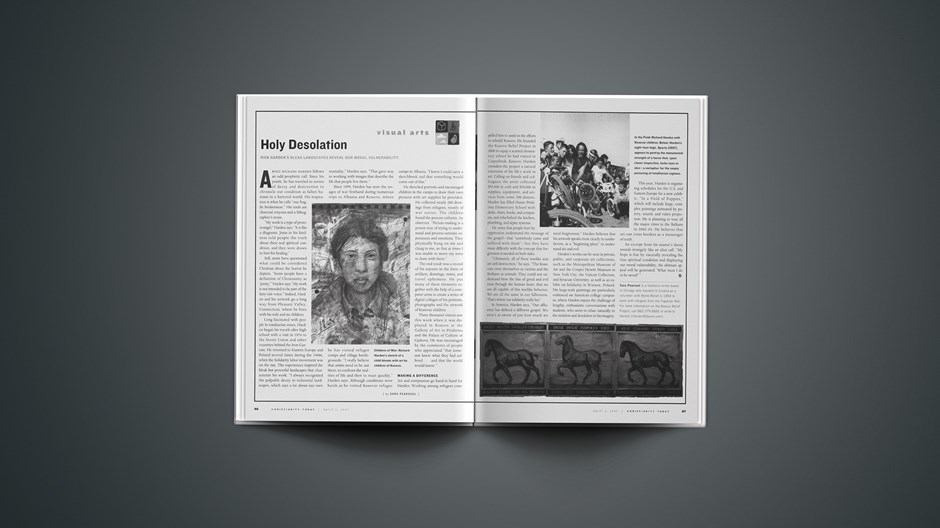
Artist richard harden follows an odd prophetic call. Since his youth, he has traveled to scenes of decay and destruction to chronicle our condition as fallen humans in a battered world. His inspiration is what he calls "our fragile brokenness." His tools are charcoal crayons and a lithographer's stone.
"My work is a type of proto- evangel," Harden says. "It is like a diagnosis. Jesus in his kindness told people the truth about their real spiritual condition, and they were drawn to him for healing."
Still, some have questioned what could be considered Christian about the horror he depicts. "Some people have a definition of Christianity as 'pretty,' " Harden says. "My work is not intended to be part of the fairy-tale voice." Indeed, Harden and his artwork go a long way from Pleasant Valley, Connecticut, where he lives with his wife and six children.
Long fascinated with people in totalitarian states, Harden began his travels after high school with a visit in 1974 to the Soviet Union and other countries behind the Iron Curtain. He returned to Eastern Europe and Poland several times during the 1980s, when the Solidarity labor movement was on the rise. The experiences inspired the bleak but powerful landscapes that characterize his work. "I always recognized the palpable decay in industrial landscapes, which says a lot about our own mortality," Harden says. "That gave way to working with images that describe the life that people live there."
Since 1999, Harden has seen the ravages of war firsthand during numerous trips to Albania and Kosovo, where he has visited refugee camps and village battlegrounds. "I really believe that artists need to be out there, to confront the realities of life and then to react quickly," Harden says. Although conditions were harsh as he visited Kosovar refugee camps in Albania, "I knew I could carry a sketchbook and that something would come out of this."
He sketched portraits and encouraged children in the camps to draw their own pictures with art supplies he provided. He collected nearly 200 drawings from refugees, mostly of war scenes. The children found the process cathartic, he observes. "Picture-making is a potent way of trying to understand and process extreme experiences and emotions. They physically hung on me and clung to me, so that at times I was unable to move my arms to draw with them."
The end result was a record of his sojourn in the form of artifacts, drawings, notes, and travel ephemera. He put many of these elements together with the help of a computer artist to create a series of digital collages of his portraits, photographs and the artwork of Kosovar children.
Three thousand visitors saw this work when it was displayed in Kosovo at the Gallery of Art in Prishtina and the Palace of Culture in Gjakova. He was encouraged by the comments of people who appreciated "that someone knew what they had suffered. … and that the world would know."
Making a Difference
Art and compassion go hand in hand for Harden. Working among refugees compelled him to assist in the efforts to rebuild Kosovo. He founded the Kosovo Relief Project in 2000 to equip a scarred elementary school he had visited in Llapushnik, Kosovo. Harden considers the project a natural extension of his life's work in art. Calling on friends and colleagues, the artist collected $95,000 in cash and $30,000 in supplies, equipment, and services from some 300 donors. Harden has filled Hasan Prishtina Elementary School with desks, chairs, books, and computers, and refurbished the kitchen, plumbing, and septic systems.
He notes that people hurt by oppression understand the message of the gospel—that "somebody came and suffered with them"—but they have more difficulty with the concept that forgiveness is needed on both sides.
"Ultimately, all of these warlike acts are self-destruction," he says. "The Kosovars view themselves as victims and the Serbians as animals. They could not understand how the line of good and evil runs through the human heart, that we are all capable of this warlike behavior. We are all the same in our fallenness. That's where our solidarity really lies."
In America, Harden says, "Our affluence has defined a different gospel. We aren't as aware of just how much we need forgiveness." Harden believes that his artwork speaks most clearly to nonbelievers, as a "beginning place" to understand sin and evil.
Harden's works can be seen in private, public, and corporate art collections, such as the Metropolitan Museum of Art and the Cooper Hewitt Museum in New York City, the Vatican Collection, and Syracuse University, as well as an exhibit on Solidarity in Warsaw, Poland. His large-scale paintings are particularly embraced on American college campuses, where Harden enjoys the challenge of lengthy, enthusiastic conversations with students, who seem to relate naturally to the isolation and desolation in his imagery.
This year, Harden is organizing schedules for the U.S. and Eastern Europe for a new exhibit, "In a Field of Poppies," which will include large, complex paintings animated by poetry, sound, and video projection. He is planning to tour all the major cities in the Balkans in 2002-03. He believes that art can cross borders as a messenger of truth.
Article continues below
An excerpt from his master's thesis sounds strangely like an altar call. "My hope is that by viscerally revealing the true spiritual condition and displaying our moral vulnerability, the ultimate appeal will be generated: 'What must I do to be saved?' "
Sara Pearsaul is a freelance writer based in Chicago who traveled to Croatia as a volunteer with World Relief in 1994 to work with refugees from the Yugoslav War. For more information on the Kosovo Relief Project, call 860.379.6665 or write to Harden (rharden8@juno.com).















 While we pray for peace, we need moral clarity about this war.
 We’ve got little information on Jesus’ appearance and personality. But that’s the way God designed it.españolFrançais
 Beyoncé’s right. Whether listening to Cowboy Carter or reading theology, diversity is a good thing.






