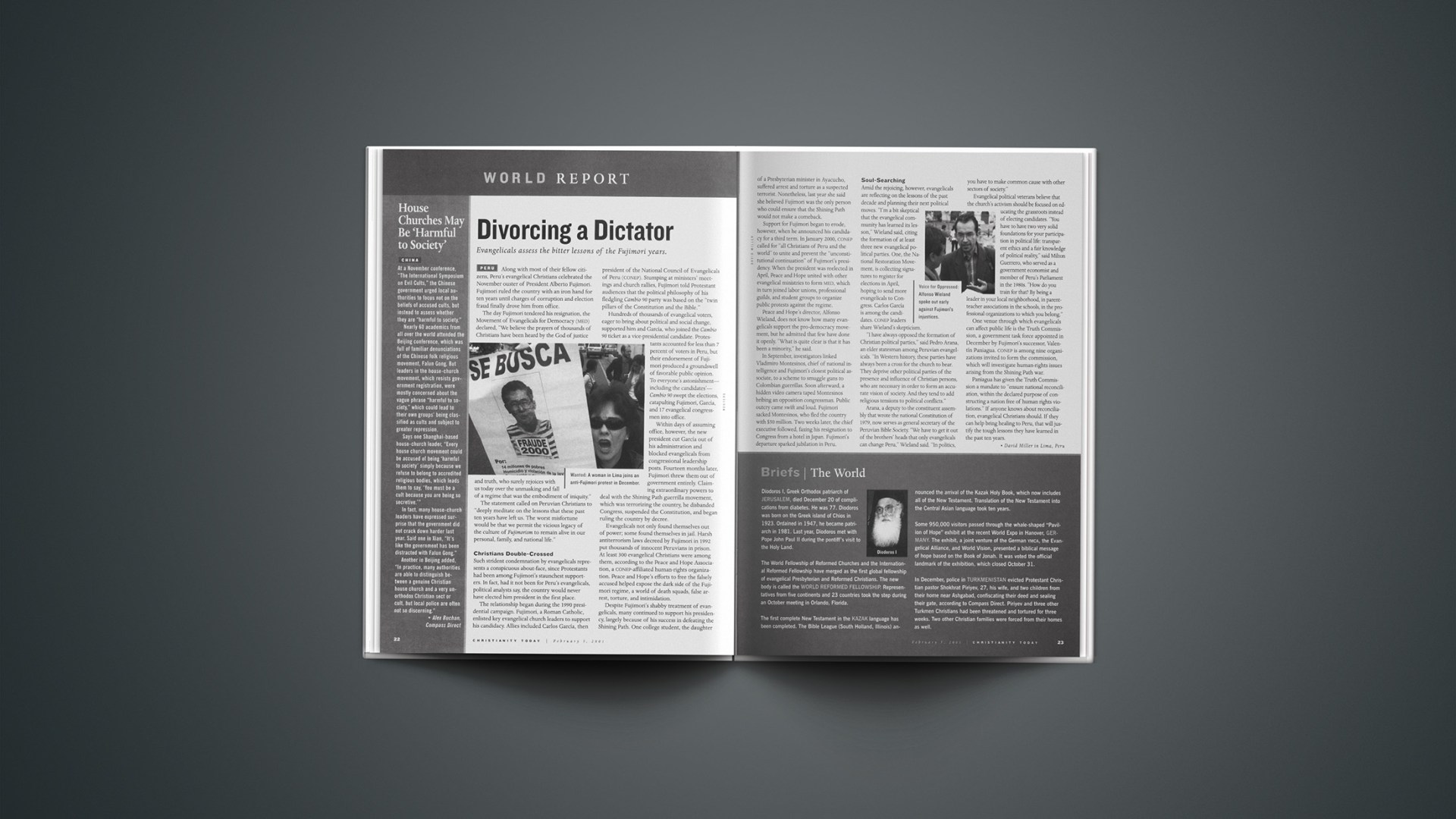

The day Fujimori tendered his resignation, the Movement of Evangelicals for Democracy (MED) declared, “We believe the prayers of thousands of Christians have been heard by the God of justice and truth, who surely rejoices with us today over the unmasking and fall of a regime that was the embodiment of iniquity.”
The statement called on Peruvian Christians to “deeply meditate on the lessons that these past ten years have left us. The worst misfortune would be that we permit the vicious legacy of the culture of Fujimorism to remain alive in our personal, family, and national life.”
Christians Double-Crossed
Such strident condemnation by evangelicals represents a conspicuous about-face, since Protestants had been among Fujimori’s staunchest supporters. In fact, had it not been for Peru’s evangelicals, political analysts say, the country would never have elected him president in the first place.The relationship began during the 1990 presidential campaign. Fujimori, a Roman Catholic, enlisted key evangelical church leaders to support his candidacy. Allies included Carlos GarcÍa, then president of the National Council of Evangelicals of Peru (CONEP). Stumping at ministers’ meetings and church rallies, Fujimori told Protestant audiences that the political philosophy of his fledgling Cambio 90 party was based on the “twin pillars of the Constitution and the Bible.”
Hundreds of thousands of evangelical voters, eager to bring about political and social change, supported him and GarcÍa, who joined the Cambio 90 ticket as a vice-presidential candidate. Protestants accounted for less than 7 percent of voters in Peru, but their endorsement of Fujimori produced a groundswell of favorable public opinion. To everyone’s astonishment—including the candidates’—Cambio 90 swept the elections, catapulting Fujimori, GarcÍa, and 17 evangelical congressmen into office.
Within days of assuming office, however, the new president cut GarcÍa out of his administration and blocked evangelicals from congressional leadership posts. Fourteen months later, Fujimori threw them out of government entirely. Claiming extraordinary powers to deal with the Shining Path guerrilla movement, which was terrorizing the country, he disbanded Congress, suspended the Constitution, and began ruling the country by decree.
Evangelicals not only found themselves out of power; some found themselves in jail. Harsh antiterrorism laws decreed by Fujimori in 1992 put thousands of innocent Peruvians in prison. At least 300 evangelical Christians were among them, according to the Peace and Hope Association, a CONEP-affiliated human-rights organization. Peace and Hope’s efforts to free the falsely accused helped expose the dark side of the Fujimori regime, a world of death squads, false arrest, torture, and intimidation.
Despite Fujimori’s shabby treatment of evangelicals, many continued to support his presidency, largely because of his success in defeating the Shining Path. One college student, the daughter of a Presbyterian minister in Ayacucho, suffered arrest and torture as a suspected terrorist. Nonetheless, last year she said she believed Fujimori was the only person who could ensure that the Shining Path would not make a comeback.
Support for Fujimori began to erode, however, when he announced his candidacy for a third term. In January 2000, CONEP called for “all Christians of Peru and the world” to unite and prevent the “unconstitutional continuation” of Fujimori’s presidency. When the president was reelected in April, Peace and Hope united with other evangelical ministries to form MED, which in turn joined labor unions, professional guilds, and student groups to organize public protests against the regime.
Peace and Hope’s director, Alfonso Wieland, does not know how many evangelicals support the pro-democracy movement, but he admitted that few have done it openly. “What is quite clear is that it has been a minority,” he said.
In September, investigators linked Vladimiro Montesinos, chief of national intelligence and Fujimori’s closest political associate, to a scheme to smuggle guns to Colombian guerrillas. Soon afterward, a hidden video camera taped Montesinos bribing an opposition congressman. Public outcry came swift and loud. Fujimori sacked Montesinos, who fled the country with $50 million. Two weeks later, the chief executive followed, faxing his resignation to Congress from a hotel in Japan. Fujimori’s departure sparked jubilation in Peru.
Soul-Searching
Amid the rejoicing, however, evangelicals are reflecting on the lessons of the past decade and planning their next political moves. “I’m a bit skeptical that the evangelical community has learned its lesson,” Wieland said, citing the formation of at least three new evangelical political parties. One, the National Restoration Movement, is collecting signatures to register for elections in April, hoping to send more evangelicals to Congress. Carlos GarcÍa is among the candidates. CONEP leaders share Wieland’s skepticism.“I have always opposed the formation of Christian political parties,” said Pedro Arana, an elder statesman among Peruvian evangelicals. “In Western history, these parties have always been a cross for the church to bear. They deprive other political parties of the presence and influence of Christian persons, who are necessary in order to form an accurate vision of society. And they tend to add religious tensions to political conflicts.”
Arana, a deputy to the constituent assembly that wrote the national Constitution of 1979, now serves as general secretary of the Peruvian Bible Society. “We have to get it out of the brothers’ heads that only evangelicals can change Peru,” Wieland said. “In politics, you have to make common cause with other sectors of society.”
Evangelical political veterans believe that the church’s activism should be focused on educating the grassroots instead of electing candidates. “You have to have two very solid foundations for your participation in political life: transparent ethics and a fair knowledge of political reality,” said Milton Guerrero, who served as a government economist and member of Peru’s Parliament in the 1980s. “How do you train for that? By being a leader in your local neighborhood, in parent-teacher associations in the schools, in the professional organizations to which you belong.”
One venue through which evangelicals can affect public life is the Truth Commission, a government task force appointed in December by Fujimori’s successor, ValentÍn Paniagua. CONEP is among nine organizations invited to form the commission, which will investigate human-rights issues arising from the Shining Path war.
Paniagua has given the Truth Commission a mandate to “ensure national reconciliation, within the declared purpose of constructing a nation free of human rights violations.” If anyone knows about reconciliation, evangelical Christians should. If they can help bring healing to Peru, that will justify the tough lessons they have learned in the past ten years.
Copyright © 2001 Christianity Today. Click for reprint information.
Related Elsewhere
Previous Christianity Today stories about Peru include:Peru’s Shining Path Still Taking Prisoners | As government shifts in turmoil, thousands of forced “accomplices” are still unfairly imprisoned. (Nov. 27, 2000)
Christian Human Rights Agency Burglarized in Peru | Stolen files contained information on more than 5,000 forced disappearances. (Nov. 15, 2000)
Peru’s Churches Welcome Fujimori’s Decision to Call New Election | After riots and videotapes of bribes, Peru pushes its current president for the opportunity to vote again. (Sept. 28, 2000)
Imprisoned Peruvian Army Colonel Denied Parole | Evangelical convicted of drug trafficking continues fight for justice as hope fades. (Sept. 1, 2000)
Peru’s Christians Oppose Presidential Vow to End Pardons | More than 300 unjustly accused of terrorist involvement will remain in jail, say critics. (Dec. 16, 1999)
Imprisoned Evangelicals Dispute Accusations of Terrorism (Feb. 9, 1998)