A lengthy document outlining the mission of the church in Latin America during the new millennium has been withdrawn by leaders of a regional consultation on mission after several groups—including women, indigenous people, and blacks—strongly objected to its content.
"The original document was exclusive and racist," Norman Bent, a Moravian pastor from Nicaragua, told ENI. "It was written by white Latin Americans, people with no awareness of indigenous people or people of African origin. They consider their white power structure to represent the Evangelical movement in Latin America."
The document, Theology on the Road, was prepared over the past two years by the Theology Commission of the Latin American Council of Churches (CLAI). It was distributed late last year to participants in this month's regional Mission Consultation and CLAI general assembly that is being held in the Colombian port city of Barranquilla.
After three days of argument about the text, CLAI's president, Walter Altmann, announced on January 15 that the Theology Commission was retracting the document. Using written commentaries from the critics, the commission will now spend two months rewriting the text. Altmann made the announcement at the end of the Mission Consultation, which overlapped with the five-day general assembly..
Margarita de la Torre, a Quichua indigenous woman who teaches theology at an Evangelical seminary in Ecuador, said she was shocked by the original document. "We're entering a new millennium, and I'm surprised there are people who still write this way. They are obviously not involved with people at the grassroots. The document shows their distance from people at the grassroots, and it's a big distance," she told ENI.
Beatriz Ferrari, a Methodist leader from Uruguay, told ENI that the document "had lots of errors, and displayed little sensitivity to women, indigenous, blacks, and youth. And children weren't even discussed at all."
Ferrari was part of a big group of women who discussed the document before issuing a 14-page rebuttal of its contents.
Other critical reactions were issued by a youth group and another group including indigenous and black church leaders. The treatment of homosexuality in the text also prompted many complaints.
"The original was written as if Latin America had just one culture," Ferrari said, "when in fact we're a region made up of many cultures. The writers chose the dominant culture as if that's all there is. The document illustrated that much of our church leadership sadly continues to see the world from the perspective of whites and mestizos [mixed race]. They have a very masculine concept of mission that's largely oriented toward the interior of the church."
Ferrari added that discrimination against women was not limited to CLAI's written documents. Whereas at CLAI's last general assembly, held in Concepcion, Chile, in 1995, women had made up about 20 percent of delegates, at the current assembly the proportion of women had dropped to about 12 percent.
"I hope God illuminates the people doing the rewriting of this document," Ferrari said. "Because our churches are anxiously waiting for it. If we take it to our churches the way it is, then once again we're going to get involved in mission the wrong way."
Gloria Winters, a Presbyterian pastor from Colombia who worked on the committee that drafted the original document, denied the writers were insensitive. Winters, a professor of biblical studies at a Reformed Church seminary here, said technological errors and a lack of time had contributed to the report's shortcomings. "The section on sexuality was written by one person and the comments that others sent via e-mail were lost by mistake," Winters told ENI.
"I don't believe there are irreconcilable differences. We're entering into territory that's new for many people. We have to sit down and understand what's at play and try to understand the other's positions."
The six-page critique prepared by indigenous and black participants complained that the mission document followed a missiology that "denigrates indigenous peoples and blacks, conceiving of them as an object of mission, refusing to recognize mission as a space for encountering the other where a relationship of reciprocity is established between equals, where all who participate in the relationship are mutually evangelized. It's time to let ourselves be evangelized by indigenous peoples and blacks."
The critique accused the church's mindset of negating the region's cultural pluralism and "attempting to culturally homogenize our diverse peoples ... [and] failing to respect their specific values and traditions". The indigenous and black group demanded "a wider understanding of ecumenism that includes a frank and sincere dialogue with other religious and spiritual expressions."
Bent said the rejected document resulted from the "Pentecostalization" of CLAI, which is made up of a mix of Evangelical and mainstream Protestant churches. Bent told ENI he doubted whether Pentecostals genuinely wanted to participate in ecumenical activities.
Article continues below
"CLAI should quit struggling to get new members and challenge those interested in ecumenism to work together," said Bent. "It will do no good to have more members if you lose your prophetic vision. Are Pentecostals really interested in ecumenism? I think that rather than wanting to work together they're only interested in the money they can get from the ecumenical movement."
Bent's stance is the opposite of the opinions expressed by Professor Arturo Piedra of the Latin American Biblical Seminary in San Jose, Costa Rica in a keynote address to CLAI at the general assembly on January 14.
Professor Piedra said that CLAI's relationship to the region's churches was not helped by the impression that the ecumenical council "had assumed, at times uncritically, all of the agenda of the political left, in which the utility of faith was measured in terms of social change. It lost sight of the fact that the preaching of the Gospel affects individuals as well as societies, families as well as political institutions."












 While we pray for peace, we need moral clarity about this war.
 As my doubts about his teachings grew, so did a secret fascination with Jesus.
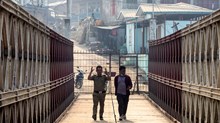 The government plans to close its porous border with Myanmar to boost security, separating ethnic groups that straddle the boundary.





