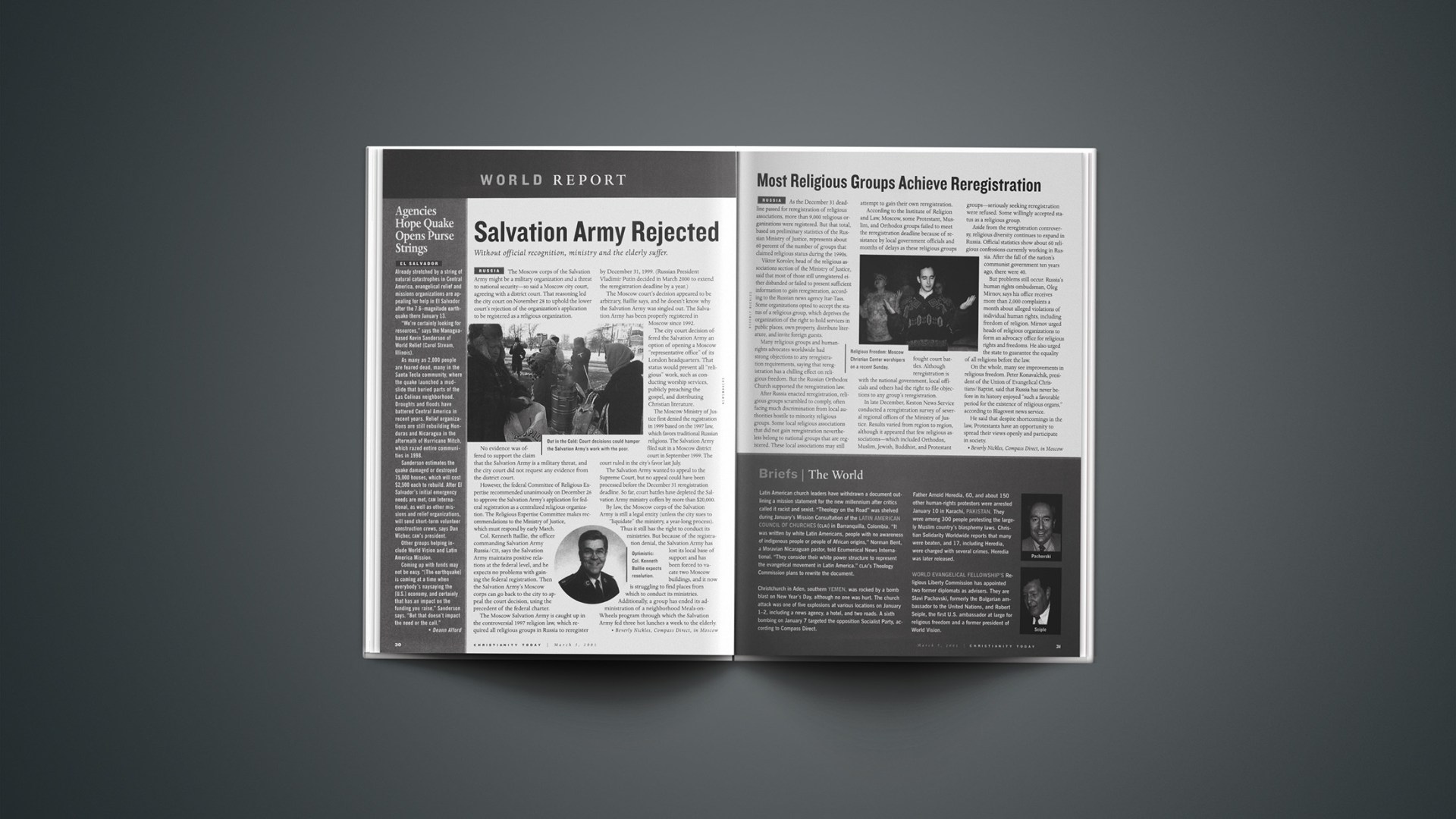
Salvation Army Rejected

Without official recognition, ministry and the elderly suffer.

The Moscow corps of the Salvation Army might be a military organization and a threat to national security—so said a Moscow city court, agreeing with a district court. That reasoning led the city court on November 28 to uphold the lower court’s rejection of the organization’s application to be registered as a religious organization.

No evidence was offered to support the claim that the Salvation Army is a military threat, and the city court did not request any evidence from the district court.

However, the federal Committee of Religious Expertise recommended unanimously on December 26 to approve the Salvation Army’s application for federal registration as a centralized religious organization. The Religious Expertise Committee makes recommendations to the Ministry of Justice, which must respond by early March.

Col. Kenneth Baillie, the officer commanding Salvation Army Russia/CIS, says the Salvation Army maintains positive relations at the federal level, and he expects no problems with gaining the federal registration. Then the Salvation Army’s Moscow corps can go back to the city to appeal the court decision, using the precedent of the federal charter.

The Moscow Salvation Army is caught up in the controversial 1997 religion law, which required all religious groups in Russia to reregister by December 31, 1999. (Russian President Vladimir Putin decided in March 2000 to extend the reregistration deadline by a year.)

The Moscow court decision appeared to be arbitrary, Baillie says, and he doesn’t know why the Salvation Army was singled out. The Salvation Army has been properly registered in Moscow since 1992.

The city court decision offered the Salvation Army an option of opening a Moscow “representative office” of its London headquarters. That status would prevent all “religious” work, such as conducting worship services, publicly preaching the gospel, and distributing Christian literature.

The Moscow Ministry of Justice first denied the registration in 1999 based on the 1997 law, which favors traditional Russian religions. The Salvation Army filed suit in a Moscow district court in September 1999. The court ruled in the city’s favor last July.

The Salvation Army wanted to appeal to the Supreme Court, but no appeal could have been processed before the December 31 reregistration deadline. So far, court battles have depleted the Salvation Army ministry coffers of more than $20,000.

By law, the Moscow corps of the Salvation Army is still a legal entity (unless the city sues to “liquidate” the ministry, a year-long process). Thus it still has the right to conduct its ministries. But because of the registration denial, the Salvation Army has lost its local base of support and has been forced to vacate two Moscow buildings, and it now is struggling to find places from which to conduct its ministries.

Additionally, a group has ended its administration of a neighborhood Meals-on-Wheels program through which the Salvation Army fed three hot lunches a week to the elderly.

Copyright © 2001 Compass Direct

Related Elsewhere

See Christianity Today‘s earlier coverage, “Salvation Army Closed in Moscow | Moscow court decision turns city into a ‘legal never-never land’ for Christian charity” (Jan. 11, 2001).

Stetson University’s history department has a fantastic Russia Religion News site that not only compiles, but translates news articles related to religion in Russia.

Visit the Salvation Army homepage, where contact information for the SA office in Moscow is available.

Previous Christianity Today stories about religious freedom in Russia include:

Will Putin Protect Religious Liberty? | Freedoms may be in danger in the new Russia. (July 26, 2000)

A Precarious Step Forward | Loosened rules in Russia may mean better times for religious freedom. (Feb. 3, 2000)

Russia’s minority churches welcome liberal ruling on religion law | 1997 ruling against ‘sects’ upheld, but religious groups claim victory. (Dec. 30, 1999)

Stepping Back from Freedom | The new law restricting religion is part of Russia’s struggle to redefine itself. (Nov. 17, 1997)

New Religion Law Fraught with Potential for Abuses | (Nov. 17, 1997)

Jehovah’s Witness Verdict Stalled | (April 26, 1999 )
Also in this issue

Pastors & Porn: Smut doesn't come in the same package anymore—but it's just as addictive.

Cover Story

Tangled in the Worst of the Web

Christine J. Gardner

Weather: Churches Battle Winter's Big Chill

Jim Jones

'Six Flags Over Israel'

Mark I. Pinsky

Checks and (out of) Balance

Fraud Trial: Ponzi-Scheme Trial Begins

Chuck Fager

Giving: Protestant Giving Rates Decline

Feds Limit Low-Power Radio Licenses

Corrie Cutrer

Sex Abuse: Witness Leaders Accused of Shielding Molesters

Corrie Cutrer

Sects: Watch Tower Undergoes Corporate Shakeup

Mark A. Kellner

Bahamas: 'Left in the Cracks'

Suzanne Lewis-Johnson in Nassau

Baptist Temple Loses Supreme Court Tax Appeal—and Building

Suzanne Lewis-Johnson

Peretti's Past Darkness

Jeremy Lott

El Salvador: Agencies Hope Quake Opens Purse Strings

Deann Alford

Most Religious Groups Achieve Reregistration

Beverly Nickles

Briefs: The World

Great Britain: Human Embryo Cloning Legalized

Cedric Pulford in London

India: Hindu Government Moves to Change Christian Divorce

Manpreet Singh in New Delhi

Afghanistan: Taliban Threatens Converts

Barbara G. Baker

India: Quake Rocks Hindu Hotbed

Infection in the Body

Resources for the Ensnared

Small Beneath the Firmament

Walter Wangerin Jr

God at Risk

Wendy Murray Zoba

Jesus Wept

The Chosen People Puzzle

Richard J. Mouw

The Homeless VIPs

DA Fletcher

Globalized Alumni

Andy Fletcher

Pushing Bush Right

Sheryl Henderson Blunt

Letters

Changing Hearts and Laws

A Christianity Today Editorial

Ma Bell, Madam

A Christianity Today Editorial

Quotations to Stir Mind and Heart

Ivan Illich

Calling Out the Name of Jesus

Jeff M. Sellers

Readers' Forum: The Silenced Word

Donald N. Bastian

Can God Reach the Mentally Disabled?

Lewis B. Smedes

Rx for Moral Fussbudgets

View issue

Our Latest

Who Writes History When There Is No Winner?

Lebanon’s civil war is a taboo subject. A group of Christians and Muslims is broaching it.

Review

Review: Angel Studios’ ‘David’

Peter T. Chattaway

Artistically, it’s ambitious. Narratively, it works. But it’s no “The Prince of Egypt.”

My Son’s Last Christmas at Home

Christmastime comes with its own losses and longings. God understands them.

Analysis

Bondi Beach Shooting Compels Christians to Stand with Jews

The Bulletin with Josh Stanton and Robert Stearns

Jewish-Christian friendships offer solace and solidarity after antisemitic violence.

The Russell Moore Show

David Platt on All You Want for Christmas

What if the most radical thing about Christmas isn’t that God came near—but that he came to serve?

Excerpt

The Story Behind Handel’s ‘Messiah’

The Bulletin with Charles King

Meet the unlikely characters who defined this musical classic.

News

The Christians Helping People Enslaved by Cybercrime Scam Centers

Erin Foley in Mae Sot, Thailand

After Myanmar’s military raided a compound, a network of ministries helps trafficking victims return home.

Dreaming Against the Machine

Technologies like AI privilege “growth” and “effectiveness” over imagination and inefficiency. God operates differently.

Apple PodcastsDown ArrowDown ArrowDown Arrowarrow_left_altLeft ArrowLeft ArrowRight ArrowRight ArrowRight Arrowarrow_up_altUp ArrowUp ArrowAvailable at Amazoncaret-downCloseCloseEmailEmailExpandExpandExternalExternalFacebookfacebook-squareGiftGiftGooglegoogleGoogle KeephamburgerInstagraminstagram-squareLinkLinklinkedin-squareListenListenListenChristianity TodayCT Creative Studio Logologo_orgMegaphoneMenuMenupausePinterestPlayPlayPocketPodcastRSSRSSSaveSaveSaveSearchSearchsearchSpotifyStitcherTelegramTable of ContentsTable of Contentstwitter-squareWhatsAppXYouTubeYouTube