The Wounded Spirit Frank Peretti
Word, 198 pages, $18.99
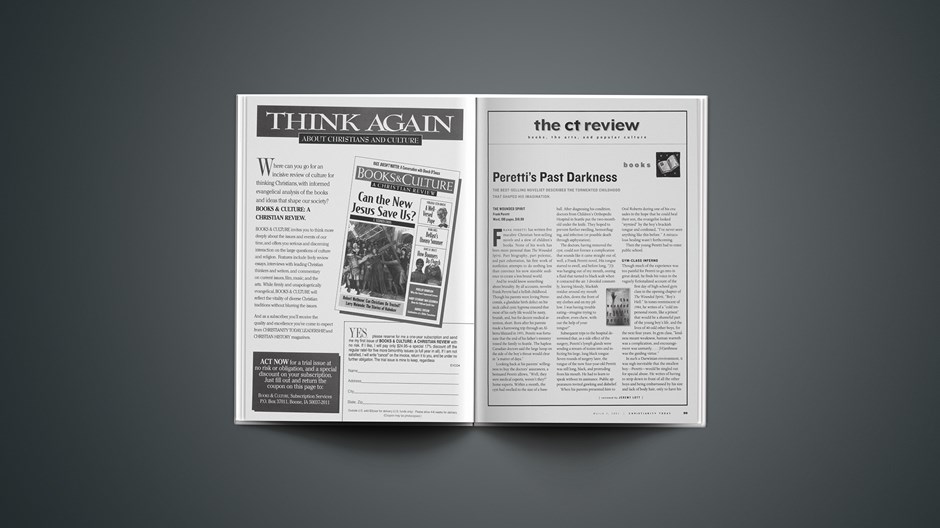
Frank Peretti has written five macabre Christian best-selling novels and a slew of children's books. None of his work has been more personal than The Wounded Spirit. Part biography, part polemic, and part exhortation, his first work of nonfiction attempts to do nothing less than convince his now sizeable audience to create a less brutal world.
And he would know something about brutality. By all accounts, novelist Frank Peretti had a hellish childhood. Though his parents were loving Pentecostals, a glandular birth defect on his neck called cystic hygroma ensured that most of his early life would be nasty, brutish, and, but for decent medical attention, short. Born after his parents made a harrowing trip through an Alberta blizzard in 1951, Peretti was fortunate that the end of his father's ministry tossed the family to Seattle. The hapless Canadian doctors said the large lump on the side of the boy's throat would clear in "a matter of days."
Looking back at his parents' willingness to buy the doctors' assurances, a bemused Peretti allows, "Well, they were medical experts, weren't they?" Some experts. Within a month, the cyst had swelled to the size of a baseball. After diagnosing his condition, doctors from Children's Orthopedic Hospital in Seattle put the two-month-old under the knife. They hoped to prevent further swelling, hemorrhaging, and infection (or possible death through asphyxiation).
The doctors, having removed the cyst, could not foresee a complication that sounds like it came straight out of, well, a Frank Peretti novel. His tongue started to swell, and before long, "[I]t was hanging out of my mouth, oozing a fluid that turned to black scab when it contacted the air. I drooled constantly, leaving bloody, blackish residue around my mouth and chin, down the front of my clothes and on my pillow. I was having trouble eating—imagine trying to swallow, even chew, without the help of your tongue!"
Subsequent trips to the hospital determined that, as a side effect of the surgery, Peretti's lymph glands were sending a stream of toxins into and infecting his large, long black tongue. Seven rounds of surgery later, the tongue of the now four-year-old Peretti was still long, black, and protruding from his mouth. He had to learn to speak without its assistance. Public appearances invited gawking and disbelief.
When his parents presented him to Oral Roberts during one of his crusades in the hope that he could heal their son, the evangelist looked "stymied" by the boy's brackish tongue and confessed, "I've never seen anything like this before." A miraculous healing wasn't forthcoming.
Then the young Peretti had to enter public school.
Gym-class inferno
Though much of the experience was too painful for Peretti to go into in great detail, he finds his voice in the vaguely fictionalized account of the first day of high-school gym class in the opening chapter of The Wounded Spirit, "Boy's Hell." In tones reminiscent of 1984, he writes of a "cold impersonal room, like a prison" that would be a shameful part of the young boy's life, and the lives of 40-odd other boys, for the next four years. In gym class, "kindness meant weakness, human warmth was a complication, and encouragement was unmanly. … [H]arshness was the guiding virtue."
In such a Darwinian environment, it was nigh inevitable that the smallest boy—Peretti—would be singled out for special abuse. He writes of having to strip down in front of all the other boys and being embarrassed by his size and lack of body hair, only to have his own uncertainties painfully reinforced by a pack of naked, jeering high-schoolers.
As anybody who has been in that position knows, once the torment starts, it's nearly unstoppable. The boy was attacked with wet towels, knocked down several times, and bounced against a locker. Not even the teacher's assistant would come to his aid. "Dear God, please get me out of here," young Peretti prayed frantically. "Please don't let them do this to me."
But no answer was forthcoming. "[E]very authority figure in his life said he had to be here," Peretti writes of himself. "He had to go to school, do his chores, finish the homework, keep his shoes tied, go to bed and get up at certain hours, eat his vegetables, and be here. End of discussion."
He wanted to lash out at his tormentors, to even the score. Both his size and his faith constrained him, but Peretti always wondered what would have happened without such constraints.
Preventing future Columbines?
The answer, he believes, came on April 20, 1999, when Eric Harris and Dylan Klebold walked into Columbine High School in Littleton, Colorado, and opened fire with their automatic weapons. They killed 13 before turning the guns on themselves.
Like Peretti, Harris and Klebold were outcasts picked on by classmates. They both looked and acted differently from those around them. Like Peretti, they developed strange obsessions; he with monsters, they with shock rock and Charles Darwin. He labels them and others like them "wounded spirits" and doesn't flinch from applying the label to himself. Yet he suffered through and went on to some semblance of normal life while they flamed out in a most spectacular fashion. Why? And why did "wounded spirits" of the past not resort to mass murder?
Article continues below
The short answer is that Peretti "knew a Savior who taught us to turn the other cheek and forgive" while Harris and Klebold presumably didn't. But he still needs to wrestle with the larger reality that something restrained past potential Harrises and Klebolds. To make sense of this restraint, he wrote the most awkward-fitting (and perhaps the best) chapter of the book, "The Playground Parable," but when all is said and done, Peretti proposes that schools ought to have a zero-tolerance teasing policy and restructure gym class to stress individual fitness instead of competition. This is not Peretti at his best.
Perhaps the problem is the nature of the book. Biography, preaching, and storytelling are mixed together at odd angles to create a less than satisfying whole. Several chapters attempt to show what high school is like for outsiders. Others attempt to give Aesop a run for his money. It has snippets of self-help talk mixed with biblical quotations and movie references sprinkled throughout. Peretti even dares to hope in the final chapter, "A Fresh Start," that "Maybe we're entering an era in which bullying and the intimidation of other people are at last consigned to their rightful place alongside racism, hatemongering," and several other Very Bad Things. It's such a beautiful dream that I'd hate to argue with it.
Here's a more interesting question Peretti could answer when he writes his formal autobiography: What positive role has suffering played in his life? While he speaks of suffering inhibiting him from making good choices, it is also possibly the greatest source of his success.
The mistreatment he suffered gave him a special interest in monsters, a longing for justice, and a special sensitivity to the problem of evil and its otherworldly manifestations. These are the same traits that make his novels bestsellers. That may be but a small comfort, given what he was put through, but it is a comfort nonetheless. Readers might benefit from seeing Peretti wrestle with the fact that his wounded spirit was uniquely able to bring reading pleasure to so many.
Jeremy Lott is a contributing editor to Books & Culture and the sole proprietor of DeviantReadings.com.
Once you get past the goofy Flash introduction of TheWoundedSpirit.com, there's plenty of worthwhile multimedia extras: an excerpt, a three-minute video summary narrated by Peretti, screen savers, and a lot more. The site also promises a workbook in the future. (The video ad for The Visitation is pretty cool, too.)
Christianity Today earlier reviewed Peretti's The Visitation, saying it was more successful as a novel than John Grisham's The Testament.
In a 1997 interview with World magazine, Peretti said he was tired of writing formulaic novels. "I guess I could just keep grinding out thrillers like a string of sausages," he told the magazine, "but after a while you just want to do more than the usual 'Christians minding their own business, then something bad happens, there's an investigation, then a turning point followed by a chase which builds to a climax-and right about here, somebody gets saved-and then the story resolves with some kind of moral and the whole cycle begins again in the next book' pattern. It's not a bad pattern; it works. But I don't want things to get too easy and repetitive."
The Dallas Morning News recently profiled Peretti and The Wounded Spirit.















 While we pray for peace, we need moral clarity about this war.
 As my doubts about his teachings grew, so did a secret fascination with Jesus.
 The plan would organize UMC churches in four global regions, with each given more leeway around same-sex marriage and other theological issues.






