
That painting I saw gives not the slightest hint that any of this is so. Behind Jesus, in the backdrop, is an idyllic (and lakeshore!) Jerusalem. Jesus’ face, in angled profile, is coolly serene, aloof almost. His eyes have a far away, dreamy look. His body, perched on a rock, is held with prim straightness. His hands rest on his lap like the front and back covers of a stiff-spined book laid open, face down.
The artist has managed somehow to make those hands look both boneless and rigid, soft as dough and brittle as porcelain. Could these hands cut dovetails and mortise joints, wield the saw and plane and hammer, touch lepers’ sores and blind men’s eyes, braid and lash a whip, spread wide to grasp nails? No, not these hands. These hands are good for petite point or finger-wagging but not much else. Behind Jesus’ head, encircling his sleek, smoothly combed hair, is a piercing-white light.
Jesus is perhaps contemplating. Or he is posing, in a stilted way, for a portrait, maybe this one. Or he is daydreaming. But one thing the portrait could never make you believe is that Jesus is weeping, or even capable of such a thing.
But Jesus wept. Maybe that frightens us, or threatens us, or embarrasses us. Before I preach, I try to work through my deeper emotions in solitude, in my study. If there is weeping to do, I do it there. That way, I reason, my preaching can be masterful, controlled, persuasive but not manipulative, and not ambushed or sabotaged by stray or unruly emotions. I am critical of the bad art and bad theology in that portrait of Jesus, but I carry it anyhow, a version of it, like an icon inside me: the serene and savvy man, facing danger, crisis, loss without even flinching. If my emotional range and display is an indication of the Jesus I follow, Jesus doesn’t weep. He’s too cool and too tough for that.
But Jesus wept. That one line, John 11:35, is the shortest verse in the Bible. Jesus weeps at the tomb of Lazarus, his friend, the one he loves. And, in truth, never has so much theology been so cleanly distilled as here. Never have such riches been rendered with such economy. The fullness of the Incarnation, Christ’s coming among us—to be with us, to be one with us—is gathered up and pressed into a single subject and verb.
The starkness of it contains a cosmic pageantry; the sparseness of it holds a theological galaxy. Here is love, mercy, passion, compassion, grief, and anger over our condition, our frailty, our vulnerability, chiseled down to two words: Jesus wept.
Skewed priorities
Jesus wept in a world whose economic priorities had become terribly skewed.John 11 begins with a description of Lazarus, the man who is sick and whom Jesus loves, and his two sisters, Martha and Mary. “This Mary,” John says, “was the same one who poured perfume on the Lord and wiped his feet with her hair” (v. 2), described fully in the next chapter. At a dinner that the resurrected Lazarus and his sisters give in Jesus’ honor, Mary “took about a pint of pure nard, an expensive perfume; she poured it on Jesus’ feet and wiped his feet with her hair. And the house was filled with the fragrance of the perfume” (12:3).
The story continues: “But one of his disciples, Judas Iscariot, who was later to betray him, objected, ‘Why wasn’t this perfume sold and the money given to the poor?'” Jesus tells Judas to leave Mary alone. “It was intended that she should save this perfume for the day of my burial,” Jesus says. “You will always have the poor among you, but you will not always have me” (12:4, 7-8).
John tells us bluntly that Judas doesn’t really care for the poor. He’s a thief, and as the treasurer for the disciples he pilfers the money bag. Later, we learn that Judas betrays Jesus for money.
This is the world Jesus weeps in. It’s a world where those who protest loudest about the poor, complain most bitterly that not enough is being done for the outcast and the underprivileged, often care nothing for them. They are often wealthy, and have cut a few corners, pilfered a few money bags, to get that way. It is a world in which such people are usually the first to point out the extravagance and wastefulness of others: if only the government, if only the church, if only those rich people who live over there, would do something, the poor would be helped.
It is a world swollen with indignation, but nearly empty of compassion. Jesus wept.
And he weeps in a world where others love to quote only half of his rebuttal to Judas: “You will always have the poor among you.” There you have it—Jesus said it, who are we to argue? Let’s just get on with life, liberty and the pursuit of happiness and trust that the “trickle-down effect” and some “invisible hand” will help the poor. We’re off the hook.
Jesus, though, had a second clause: “But you will not always have me.” The extravagance Jesus commends is not extravagance for its own sake or for our own sake. It is not self-indulgence. It is, rather, extravagance that is Christ-exalting. It is something poured out for him.
It is centered on his death. Jesus says that the perfume has been saved for the day of his burial. Mary didn’t know, but Jesus knew, the meaning of his death. It was a death for us. It was a death in which the only real hope, the only lasting hope, was secured and offered, free to all, needed by all, rich and poor alike. How terrible to give the poor bread but not the bread of life. How terrible to relieve only their poverty of means and not their poverty of spirit. How terrible to give them hope for this world but none for the next.
The poor will always be among us. That is not an excuse to forget the poor and instead pamper ourselves. But it’s not an excuse, either, to keep from pouring ourselves and our gifts out in remembrance and exaltation of the Crucified One. If he is lifted up, he will draw all people unto him.
We live in a world in which we use the poor to excuse our own lack of costly and lavish devotion to Jesus: I can’t serve a god who would let little children suffer in Sudan … I’m not going to any church where they’ll spend $30,000 on a sound system while slum-dwellers in SÃo Paulo don’t even have electricity or running water … And then we get in our expensive cars and drive to our homes with more room than we can use, and to buffet restaurants with more food than we can eat.
We use the fact that the poor will always be with us—that the problem of poverty is too vast, too complex, too deep-rooted to solve—to excuse our own apathy, inaction, and self-indulgence. Well, I don’t feel the least bit guilty buying this sport-utility vehicle because even if I gave the money to the poor, it’s just a drop in the ocean. They’ll always be with us. And anyway, if there were some natural disaster, I would be able to help people with this truck …
Meeting my needs
Jesus wept in a world where health and self-protection—salving and saving one’s own sweet flesh—mattered more than God’s glory.Mary and Martha want Jesus to come quick to Bethany: Lazarus, the one “he loves,” is sick (John 11:3). The disciples, on the other hand, are reluctant to go there: “Rabbi, a short while ago the Jews tried to stone you, and yet you are going back there?” (8) When Jesus does finally go to Bethany and finds Lazarus already dead and buried four days, Martha issues a stern rebuke to him: “If you had been here, my brother would not have died” (21), and even gentle Mary echoes this (v. 32).
Come, Jesus. Don’t go, Jesus. If you’d have come sooner, Jesus. These voices that beckon and warn and scold have one thing in common: Each is concerned with what’s best for me. For Mary and Martha, Jesus is useful the way a doctor or lawyer or janitor or bank teller is: He should be there when you need him in the way that you need him. For the disciples, Jesus is useful the way a good press agent is: He should keep you out of trouble.
The one thing nobody seems even remotely to consider is this: Maybe the comings and goings of Jesus have nothing to do with the well-being of Lazarus, his sisters, or the disciples. “This sickness,” Jesus says of Lazarus, “is for God’s glory, so that God’s son might be glorified through it” (4). “Did I not tell you,” Jesus says to Martha, “that if you believed you would see the glory of God?” (40)
Jesus weeps in a world where God’s glory is the least, the last, the most unlikely of our concerns—where the thought that God might be glorified in sickness, in suffering, in persecution, in dying, is absurd and offensive; where we expect that our interests and needs should dictate his schedule and itinerary—and shame on him if he’s late, and shame on him if he takes us into danger.
It’s a world whose popular theology is expressed in the comment that some who had come to mourn Lazarus made: “Could not he who opened the eyes of the blind man have kept this man from dying?” (v. 37). According to this theology, what’s-best-for-me is the highest court for judging God’s actions. Indeed, God’s glory can only be accounted for on the basis of what’s-best-for-me. His glory does not exist in its own right, as its own end. Either he serves me and mine, or what good is he?
An Inhospitable Place
Jesus wept in a world where political jeopardy—terrorism and tyranny, random violence and systematic brutality—intimidated his disciples from doing kingdom work.Again, the disciples don’t want Jesus to go to Bethany because of the danger to him and to them. (The one exception is Thomas. When he sees that Jesus can’t be talked out of going, he says to the rest of the disciples in verse 16, “Let us also go, that we may die with him.” So much for Doubting Thomas.)
Jesus says in response, “Are there not twelve hours of daylight? A man who walks by day will not stumble, for he sees by this world’s light. It is when he walks by night that he stumbles, for he has no light.” This echoes what Jesus had earlier told them: “As long as it is day, we must do the work of him who sent me. Night is coming, when no one can work. While I am in the world, I am the light of the world” (John 9:4).
Jesus redefines day and night, recasts light and darkness. Night, dark—that is whenever and wherever Jesus is absent. Day, light—that is wherever and whenever he is present. He is the light of the world, and in him, with him, we are sent to the dark places to let our light shine. The places and situations that, according to our definition, appear to be places of night and darkness—where they kill Christians or reject outright Christ’s righteousness—are the very places we need to go “while it is still day.”
Jesus takes our excuses for not going to such places—Lord, they hate you there; Lord, they’re burning churches in that country; Lord, they kill pastors in that part of the world; Lord, they are so debauched and depraved in that city—and turns those excuses on their heads: that’s all the more reason to go, he says. Go, while there is still some daylight. Go, before night falls. Go.
This world is a dangerous and inhospitable place for Jesus and those who follow him. It’s always been that way. The temptation before us more and more is to stock the larder, draw the shades, latch the windows, bolt the door, pull up the bedsheets. Keep safe, and let the world go to hell.
Confronting death
Jesus wept in a world where death was an enemy.Twice John tells us that Jesus, at the tomb, was “deeply moved” (33, 38). Once, John tells us, Jesus was “troubled.” Jesus wept in response to the sight of Mary weeping and the “Jews who had come along with her also weeping” (33). The original language that describes Jesus being deeply moved and troubled in spirit uses punchy, pungent words. The language mixes grief with anger with frustration with turmoil.
This is heart-rending, gut-wrenching emotion. When my middle daughter was 2 and my son 4, three older boys took a toy away from them in the park one day. My son ran away, crying. But my daughter, a feisty child, cried in another way: she, all two feet and 20 pounds of her, stood those boys down. She cried, but it was the crying of fierce defiance, the crying of anger at so gross an injustice.
The boys, all three of them, at first laughed. But then they grew afraid. They surrendered the toy and beat a quick retreat. That’s the emotion described here.
Jesus is about to stand death down. He weeps, even knowing full well that he is about to call Lazarus forth from the grave, present him alive. But the sight and sound of these mourners stirs his blood, wrenches his gut. Death is a gross injustice. Death is low-down enemy, a playground bully.
It should not have this kind of power, be able to plunder us this way and then taunt us. That is simply not right. It is not right that death should be able to convince us that there is something in creation that can separate us from the love of God that is in Christ—that can take even those who believe Jesus is the resurrection and the life and throttle the hope that is in them, make even the faithful think that his timing is tragically off.
A robin died while I was writing this. It hit, with a loud thump and crack, the window beside the desk where I sit. It startled me. I looked up and saw a smudge of feathers pressed onto the glass. I went outside and found the robin, lying twisted, its feathers splayed out, on the wood planks stacked beneath the window. A bright thick bead of blood, like a berry in its mouth, tipped its beak. I picked it up. Its warm body fluttered, twitched, then went limp. Its head bobbed loose from its body. The neck was cleanly broken.
I carried it across the lawn and fetched a shovel from behind the garden shed. It was a gray, cold day, drizzling. I dug a hole in the wet earth of my garden and then laid the bird at the bottom. I gave it a sharp hit with the shovel’s edge to make sure it was dead. And I covered it with earth.
Walking back, a huge sadness swept down on me. This is a world where robins die, and sparrows, and people: the ones we love, the ones Jesus loves. All of them. They fall to the ground, they are enfolded into the earth. And most times, Jesus doesn’t come to raise them up, not in our lifetime, not so that we see.
If you had have been here, my brother would not have died.
And where is Jesus—this one “who was to come into the world”? What does Jesus think? What does Jesus feel about a world like this?
Jesus wept.
Copyright © 2001 Christianity Today. Click for reprint information.
Related Elsewhere
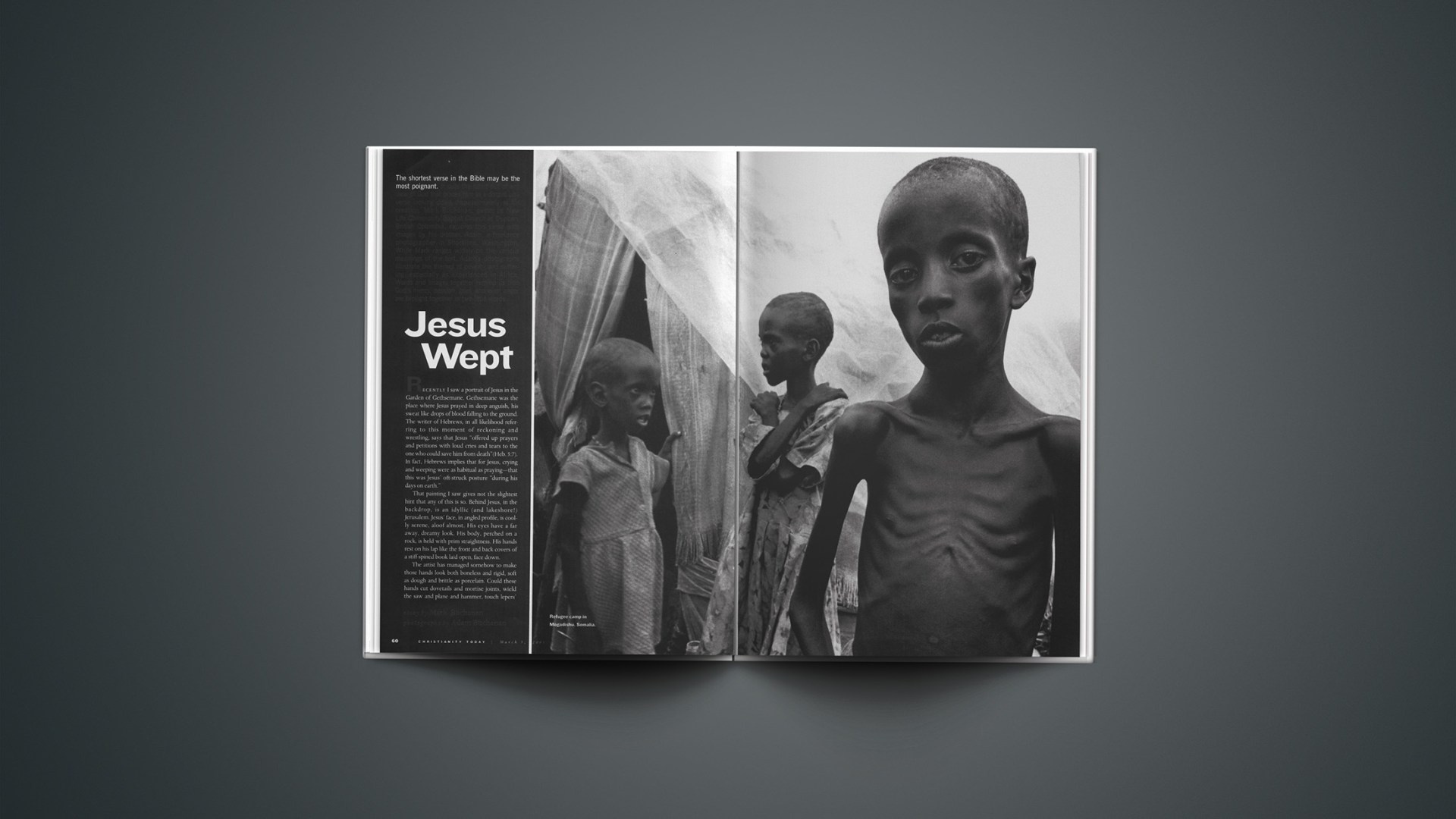
In the print issue of Christianity Today, this article was accompanied by photographs from Mark Buchanan’s brother, Adam, a freelance photographer in Shoreline, Washington. Adam’s photographs illustrated the themes of poverty and suffering, especially as experienced in Africa. To subscribe to our print magazine, click here.The Christian Classics Ethereal Library’s World Wide Study Bible offers historical references, commentary and comparative texts for John 11.
The Text This Week offers similar links, but also has contemporary references (such as modern sermons and journal articles), images of the raising of Lazarus, and other resources.
G. Walter Hansen’s “The Emotions of Jesus | And why we need to experience them” appeared in the February 3, 1997 issue of Christianity Today.