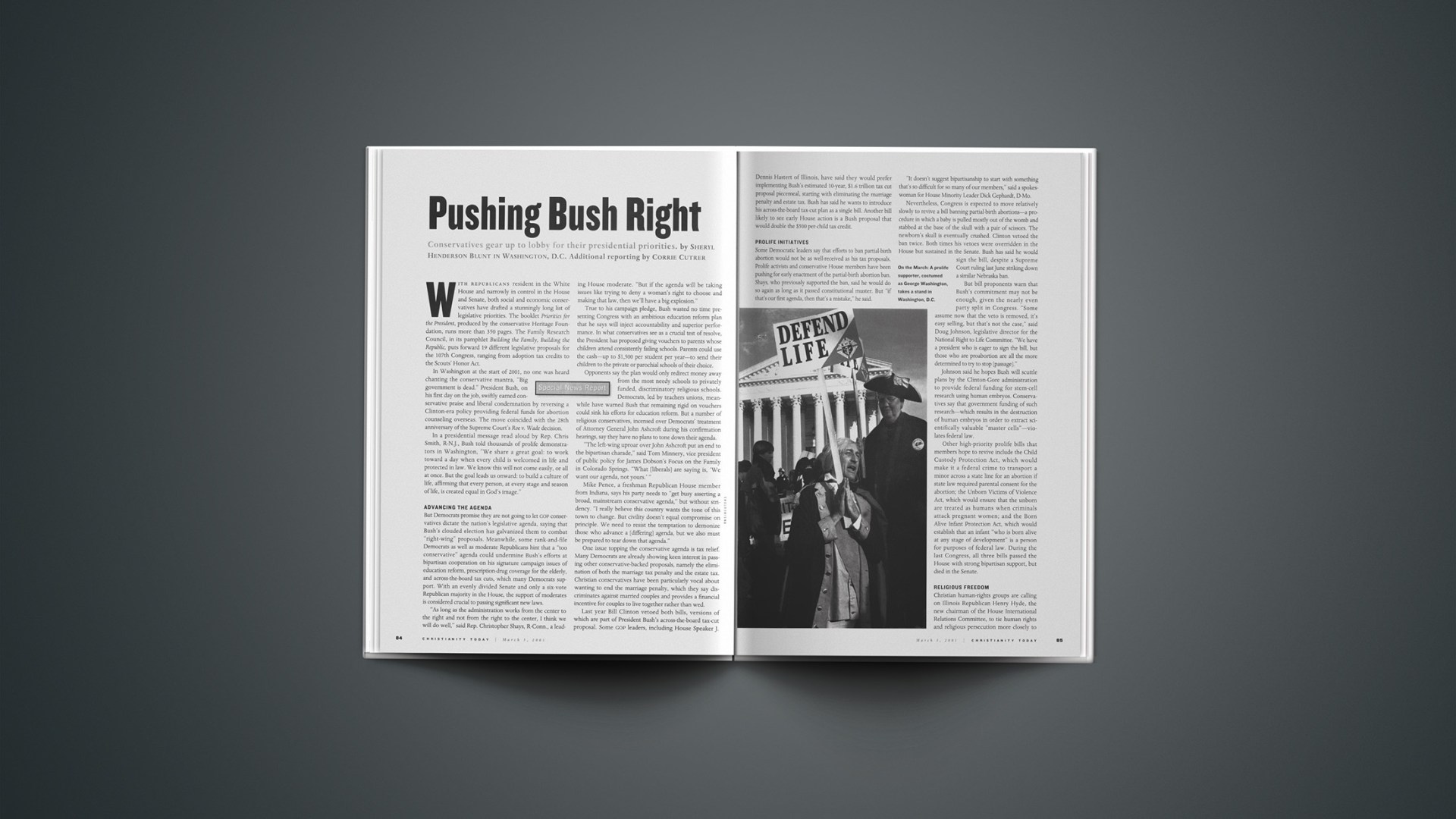

In Washington at the start of 2001, no one was heard chanting the conservative mantra, “Big government is dead.” President Bush, on his first day on the job, swiftly earned conservative praise and liberal condemnation by reversing a Clinton-era policy providing federal funds for abortion counseling overseas. The move coincided with the 28th anniversary of the Supreme Court’s Roe v. Wade decision.
In a presidential message read aloud by Rep. Chris Smith, R-N.J., Bush told thousands of prolife demonstrators in Washington, “We share a great goal: to work toward a day when every child is welcomed in life and protected in law. We know this will not come easily, or all at once. But the goal leads us onward: to build a culture of life, affirming that every person, at every stage and season of life, is created equal in God’s image.”
Advancing the agenda
But Democrats promise they are not going to let GOP conservatives dictate the nation’s legislative agenda, saying that Bush’s clouded election has galvanized them to combat “right-wing” proposals. Meanwhile, some rank-and-file Democrats as well as moderate Republicans hint that a “too conservative” agenda could undermine Bush’s efforts at bipartisan cooperation on his signature campaign issues of education reform, prescription-drug coverage for the elderly, and across-the-board tax cuts, which many Democrats support. With an evenly divided Senate and only a six-vote Republican majority in the House, the support of moderates is considered crucial to passing significant new laws.“As long as the administration works from the center to the right and not from the right to the center, I think we will do well,” said Rep. Christopher Shays, R-Conn., a leading House moderate. “But if the agenda will be taking issues like trying to deny a woman’s right to choose and making that law, then we’ll have a big explosion.”
True to his campaign pledge, Bush wasted no time presenting Congress with an ambitious education reform plan that he says will inject accountability and superior performance. In what conservatives see as a crucial test of resolve, the President has proposed giving vouchers to parents whose children attend consistently failing schools. Parents could use the cash—up to $1,500 per student per year—to send their children to the private or parochial schools of their choice.
Opponents say the plan would only redirect money away from the most needy schools to privately funded, discriminatory religious schools. Democrats, led by teachers unions, meanwhile have warned Bush that remaining rigid on vouchers could sink his efforts for education reform. But a number of religious conservatives, incensed over Democrats’ treatment of Attorney General John Ashcroft during his confirmation hearings, say they have no plans to tone down their agenda.
“The left-wing uproar over John Ashcroft put an end to the bipartisan charade,” said Tom Minnery, vice president of public policy for James Dobson’s Focus on the Family in Colorado Springs. “What [liberals] are saying is, ‘We want our agenda, not yours.’ “
Mike Pence, a freshman Republican House member from Indiana, says his party needs to “get busy asserting a broad, mainstream conservative agenda,” but without stridency. “I really believe this country wants the tone of this town to change. But civility doesn’t equal compromise on principle. We need to resist the temptation to demonize those who advance a [differing] agenda, but we also must be prepared to tear down that agenda.”
One issue topping the conservative agenda is tax relief. Many Democrats are already showing keen interest in passing other conservative-backed proposals, namely the elimination of both the marriage tax penalty and the estate tax. Christian conservatives have been particularly vocal about wanting to end the marriage penalty, which they say discriminates against married couples and provides a financial incentive for couples to live together rather than wed.
Last year Bill Clinton vetoed both bills, versions of which are part of President Bush’s across-the-board tax-cut proposal. Some GOP leaders, including House Speaker J. Dennis Hastert of Illinois, have said they would prefer implementing Bush’s estimated 10-year, $1.6 trillion tax cut proposal piecemeal, starting with eliminating the marriage penalty and estate tax. Bush has said he wants to introduce his across-the-board tax-cut plan as a single bill. Another bill likely to see early House action is a Bush proposal that would double the $500 per-child tax credit.
Prolife initiatives
Some Democratic leaders say that efforts to ban partial-birth abortion would not be as well-received as his tax proposals. Prolife activists and conservative House members have been pushing for early enactment of the partial-birth abortion ban. Shays, who previously supported the ban, said he would do so again as long as it passed constitutional muster. But “if that’s our first agenda, then that’s a mistake,” he said.“It doesn’t suggest bipartisanship to start with something that’s so difficult for so many of our members,” said a spokeswoman for House Minority Leader Dick Gephardt, D-Mo.
Nevertheless, Congress is expected to move relatively slowly to revive a bill banning partial-birth abortions—a procedure in which a baby is pulled mostly out of the womb and stabbed at the base of the skull with a pair of scissors. The newborn’s skull is eventually crushed. Clinton vetoed the ban twice. Both times his vetoes were overridden in the House but sustained in the Senate. Bush has said he would sign the bill, despite a Supreme Court ruling last June striking down a similar Nebraska ban.
But bill proponents warn that Bush’s commitment may not be enough, given the nearly even party split in Congress. “Some assume now that the veto is removed, it’s easy selling, but that’s not the case,” said Doug Johnson, legislative director for the National Right to Life Committee. “We have a president who is eager to sign the bill, but those who are proabortion are all the more determined to try to stop [passage].”
Johnson said he hopes Bush will scuttle plans by the Clinton-Gore administration to provide federal funding for stem-cell research using human embryos. Conservatives say that government funding of such research—which results in the destruction of human embryos in order to extract scientifically valuable “master cells”—violates federal law.
Other high-priority prolife bills that members hope to revive include the Child Custody Protection Act, which would make it a federal crime to transport a minor across a state line for an abortion if state law required parental consent for the abortion; the Unborn Victims of Violence Act, which would ensure that the unborn are treated as humans when criminals attack pregnant women; and the Born Alive Infant Protection Act, which would establish that an infant “who is born alive at any stage of development” is a person for purposes of federal law. During the last Congress, all three bills passed the House with strong bipartisan support, but died in the Senate.
Religious freedom
Christian human-rights groups are calling on Illinois Republican Henry Hyde, the new chairman of the House International Relations Committee, to tie human rights and religious persecution more closely to trade. In particular, they seek a harder administration stance against China and revival of a sanctions bill addressing human-rights violations by the Islamic government of Sudan against Christians and animists in the country’s war-torn south. In so doing they may be following in the steps of former Democratic President Jimmy Carter—also a professing evangelical—in tying human rights to foreign policy.Persecution of religious minorities and other human-rights issues have been priorities for Human Rights Subcommittee Chairman Smith. Gary Haugen, president of the International Justice Mission, says he wants Congress to follow through with its pledge of $95 million to help victims of sex trafficking worldwide. Haugen said he wants to see “whether or not the ‘compassionate conservatism’ that the Bush administration has promised to extend will reach around the world to those who are suffering under extreme hardship and deprivation.”
Faith-based initiatives
One of the key components of Bush’s “compassionate conservative” agenda is his proposal that the government and faith-based organizations work together to address social problems. Bush hailed the private religious groups in his inaugural address, saying that “some needs and hurts are so deep, they will only respond to a mentor’s touch or a pastor’s prayer. Church and charity, synagogue and mosque, lend our communities their humanity, and they will have an honored place in our plans and in our laws.”Joseph Loconte, William E. Simon Fellow for Religion and a Free Society at the Heritage Foundation, noted that the administration wasted no time in implementing its White House Office of Faith-based Action and Community Initiatives, which will be headed by John DiIulio, a Catholic who is a political scientist at the University of Pennsylvania.
Former Indianapolis Mayor Stephen Goldsmith, a Jew, will head up a related national advisory board.
“Bush wants to make the federal government more friendly to faith organizations, which means you have to try to change the culture—change the way [government] thinks about religion and clear away the statutes that undermine the work of religious groups,” Loconte said.
Detractors, including church-state separation groups, argue that such partnerships could result in religiously motivated, federally subsidized employment discrimination. But recognizing the success of many faith-based groups in combating illiteracy, teenage pregnancy, and alcohol and drug addiction, congressional Republicans have been working with Democrats on how to expand such programs within the law. Bush may have a powerful ally in former Democratic vice-presidential candidate Joseph Lieberman, who supported such initiatives as a senator.
Loconte says Bush has laid down an unexpected challenge. “This is a cultural moment right now, a tremendous opportunity for the church to rise to the occasion,” Loconte said. “The evangelical church is used to engaging in a confrontational way—on abortion, homosexuality, school prayer—challenging the status quo on social questions. But the public witness of the gospel, one could argue, is to focus not just on the prophetic role, but on the servant role. Now is a tremendous opportunity for the church to bear witness to the gospel through service. And it’s not clear that the church is ready. Nobody really knows what the church is going to do in response to this call.”
Working with African Americans
Bush also hopes to form a coalition with African Americans, whose history of addressing social problems through religious and political activism is considered crucial in promoting faith-based initiatives. At his first policy meeting, Bush talked with political liberals and conservatives from the faith community, including several prominent African-American church leaders, about how to bring about economic empowerment and moral renewal.But despite the handful of African-American leaders who have expressed interest in working with Bush, outrage over the contested presidential election and allegations of ballot irregularities in largely black Florida precincts have left many African Americans skeptical of efforts by Bush to reach out to blacks.
“I think many African Americans would say, ‘He’s the President of the United States, but he’s not our President,'” said Joseph Lyles, minister of Fort Foot Baptist Church in Fort Washington, Maryland, and president of the African-American Fellowship of the Southern Baptist Convention.
Kwesi Kamau, pastor of Bowers Memorial Church in Kansas City, Missouri, said that while many blacks have conservative family values and are prolife, Democrats prevailed among black voters because of their loyalty to African-American causes. Kamau added that religious conservatives, who are perceived as dominating the Republican Party, have a history with blacks “that’s been distasteful at best and very damaging at worst.”
For healing between the races to take place, he said, Bush and the GOP’s religious faithful will have to show a new sincerity in working with African Americans on issues that affect them. After all, said Kamau, “These are our brothers and sisters in Christ.”
Pence, an evangelical, said he doesn’t blame blacks for not warming up to Republicans. “There is evidence that members of my party need to do a better job of putting feet on their intentions” to work with African Americans, he said. “But Republicans will have to do more than just talk about it.”
Kamau said that while he believes Bush has “a vital role to play in healing the nation,” the church has an even greater responsibility.
Kamau said Christian lawmakers and religious leaders in both political parties would do well to remember that ultimately something more than politics is involved: “It’s not about being on the liberal side or the conservative side or the black side or the white side. It’s about being on God’s side.”
Copyright © 2001 Christianity Today. Click for reprint information.
Related Elsewhere
Christianity Today issued its own recommendations to Bush and the 107th Congress in a recent editorial, “Changing Hearts and Laws” (Mar. 1, 2001)Other Christianity Today stories on the president include:
The Bush Agenda | Will the White House be user-friendly for religious organizations? (Dec. 15, 2000)
Bush’s Call to Prayer | After Al Gore’s concession, evangelical leaders unify around faith-based initiatives, morality, and prayer as the incoming Bush administration gears up. (Dec. 14, 2000)
Anniversary of Church Shootings Serves as Reminder for Bush | Presidential candidate promises to battle religious bigotry in wake of Texas tragedy. (Sept. 15, 2000)
A Presidential Hopeful’s Progress | The spiritual journey of George W. Bush starts in hardscrabble west Texas. Will the White House be his next stop? (Sept. 5, 2000)
Bush and Gore Size Up Prolife Running Mates | Will abortion stances play an influential role in Vice Presidential selection? (July 17, 2000)
Might for Right? | As presidential primaries get under way, Christian conservatives aim to win. (Feb. 3, 2000)
God Bless America’s Candidates | What the religious and mainstream presses are saying about religion on the campaign trail and other issues. (Dec. 10, 1999)
Bush’s Faith-Based Plans | Bush argues that private religious organizations can partner successfully with government. (Oct. 25, 1999)