
But is this fear justified?
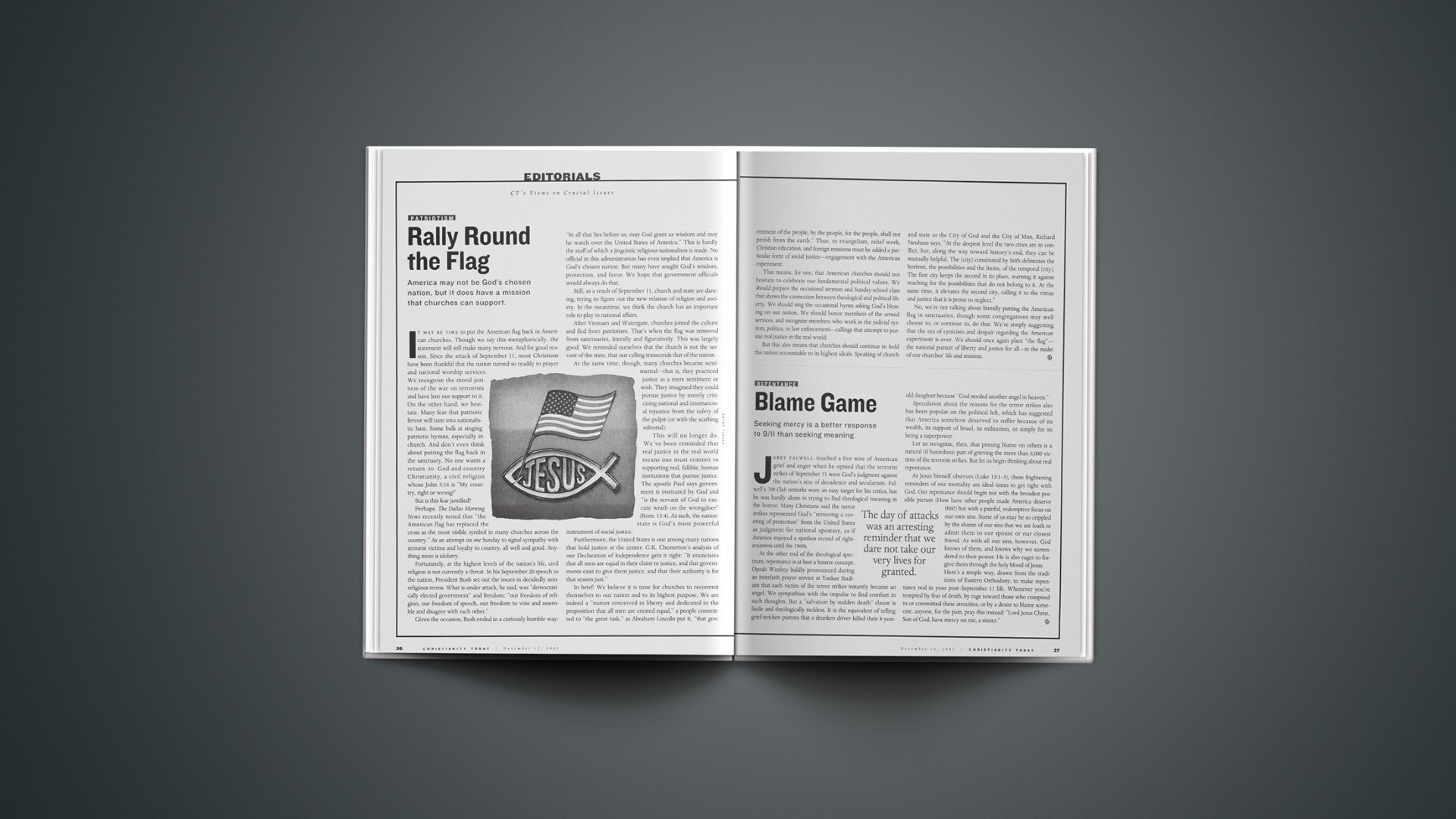
Perhaps. The Dallas Morning News recently noted that “the American flag has replaced the cross as the most visible symbol in many churches across the country.” As an attempt on one Sunday to signal sympathy with terrorist victims and loyalty to country, all well and good. Anything more is idolatry.
Fortunately, at the highest levels of the nation’s life, civil religion is not currently a threat. In his September 20 speech to the nation, President Bush set out the issues in decidedly nonreligious terms. What is under attack, he said, was “democratically elected government” and freedom: “our freedom of religion, our freedom of speech, our freedom to vote and assemble and disagree with each other.”
Given the occasion, Bush ended in a curiously humble way: “In all that lies before us, may God grant us wisdom and may he watch over the United States of America.” This is hardly the stuff of which a jingoistic religious nationalism is made. No official in this administration has even implied that America is God’s chosen nation. But many have sought God’s wisdom, protection, and favor. We hope that government officials would always do that.
Still, as a result of September 11, church and state are dancing, trying to figure out the new relation of religion and society. In the meantime, we think the church has an important role to play in national affairs.
After Vietnam and Watergate, churches joined the culture and fled from patriotism. That’s when the flag was removed from sanctuaries, literally and figuratively. This was largely good. We reminded ourselves that the church is not the servant of the state, that our calling transcends that of the nation.
At the same time, though, many churches became sentimental—that is, they practiced justice as a mere sentiment or wish. They imagined they could pursue justice by merely criticizing national and international injustice from the safety of the pulpit (or with the scathing editorial).
This will no longer do. We’ve been reminded that real justice in the real world means one must commit to supporting real, fallible, human institutions that pursue justice. The apostle Paul says government is instituted by God and “is the servant of God to execute wrath on the wrongdoer” (Rom. 13:4). As such, the nation-state is God’s most powerful instrument of social justice.
Furthermore, the United States is one among many nations that hold justice at the center. G.K. Chesterton’s analysis of our Declaration of Independence gets it right: “It enunciates that all men are equal in their claim to justice, and that governments exist to give them justice, and that their authority is for that reason just.”
In brief: We believe it is time for churches to recommit themselves to our nation and to its highest purpose. We are indeed a “nation conceived in liberty and dedicated to the proposition that all men are created equal,” a people committed to “the great task,” as Abraham Lincoln put it, “that government of the people, by the people, for the people, shall not perish from the earth.” Thus, to evangelism, relief work, Christian education, and foreign missions must be added a particular form of social justice—engagement with the American experiment.
That means, for one, that American churches should not hesitate to celebrate our fundamental political values. We should prepare the occasional sermon and Sunday-school class that shows the connection between theological and political liberty. We should sing the occasional hymn asking God’s blessing on our nation. We should honor members of the armed services, and recognize members who work in the judicial system, politics, or law enforcement—callings that attempt to pursue real justice in the real world.
But this also means that churches should continue to hold the nation accountable to its highest ideals. Speaking of church and state as the City of God and the City of Man, Richard Neuhaus says, “At the deepest level the two cities are in conflict, but, along the way toward history’s end, they can be mutually helpful. The [city] constituted by faith delineates the horizon, the possibilities and the limits, of the temporal [city]. The first city keeps the second in its place, warning it against reaching for the possibilities that do not belong to it. At the same time, it elevates the second city, calling it to the virtue and justice that it is prone to neglect.”
No, we’re not talking about literally putting the American flag in sanctuaries, though some congregations may well choose to, or continue to, do that. We’re simply suggesting that the era of cynicism and despair regarding the American experiment is over. We should once again plant “the flag”—the national pursuit of liberty and justice for all—in the midst of our churches’ life and mission.
Copyright © 2001 Christianity Today. Click for reprint information.
Related Elsewhere:
The official White House site has the full transcript to President Bush’s September 20 address.
Crosswalk.com’s “Some fear that the flag is upstaging the cross” looked at how Christians are responding to flags in worship after September 11.
A Christianity Today editorial from 1969 argued that “patriotism is not dead; our nation is not finished. Let us rally behind our flag; let us love our country with all its faults; let us work to improve it with all our strength.”
Christianity Today essays and analysis following September 11 include:
Wake-up Call | If September 11 was a divine warning, it’s God’s people who are being warned. (Nov. 5, 2001)
White-Powder Worries | The anthrax scare has put us on edge. How shall we deal with wartime fears? (Nov. 1, 2001)
Where Was God on 9/11? | Reflections from Ground Zero and beyond. (Oct.23, 2001)
Christian History Corner: Apocalypse Not | As speculations mount regarding the significance of recent events in God’s plan for the end of the world, voices from the past urge restraint. (Oct.12, 2001)
Judgment Day | God promised that calamity would follow disobedience. So why are we quick to dismiss it as a reason for the September 11 attacks? (Sept. 25, 2001)
Now What? | A Christian response to religious terrorism. (Sept. 21, 2001)
To Embrace the Enemy | Is reconciliation possible in the wake of such evil? (Sept. 21, 2001)
After the Grave in the Air | True reconciliation comes not by ignoring justice nor by putting justice first, but by unconditional embrace. (Sept. 21, 2001)
Was September 11 the Beginning of the End? | Observers say geography and gravity of attacks have led to little prophecy speculation. (Sept. 19, 2001)
Books & Culture Corner: The Imagination of Disaster | “We thought we were invulnerable.” Really? (Sept. 17, 2001)
Taking It Personally | What do we do with all this anger? (Sept. 14, 2001)
A Wake-Up Call to Become Global Christians | The deadly attacks on America will provoke many responses, but Christians are commanded to love our neighbors. (Sept. 12, 2001)
God’s Message in the Language of Events | In the face of evil, we must focus on keeping our hearts right. (Sept. 11, 2001)above all else.
Reflections on Suffering | Classic and contemporary quotations for dark times. (Sept. 13, 2001)
When Sin Reigns | An event like this shows us what humans are capable of becoming—both as children of darkness and of light. (Sept. 13, 2001)