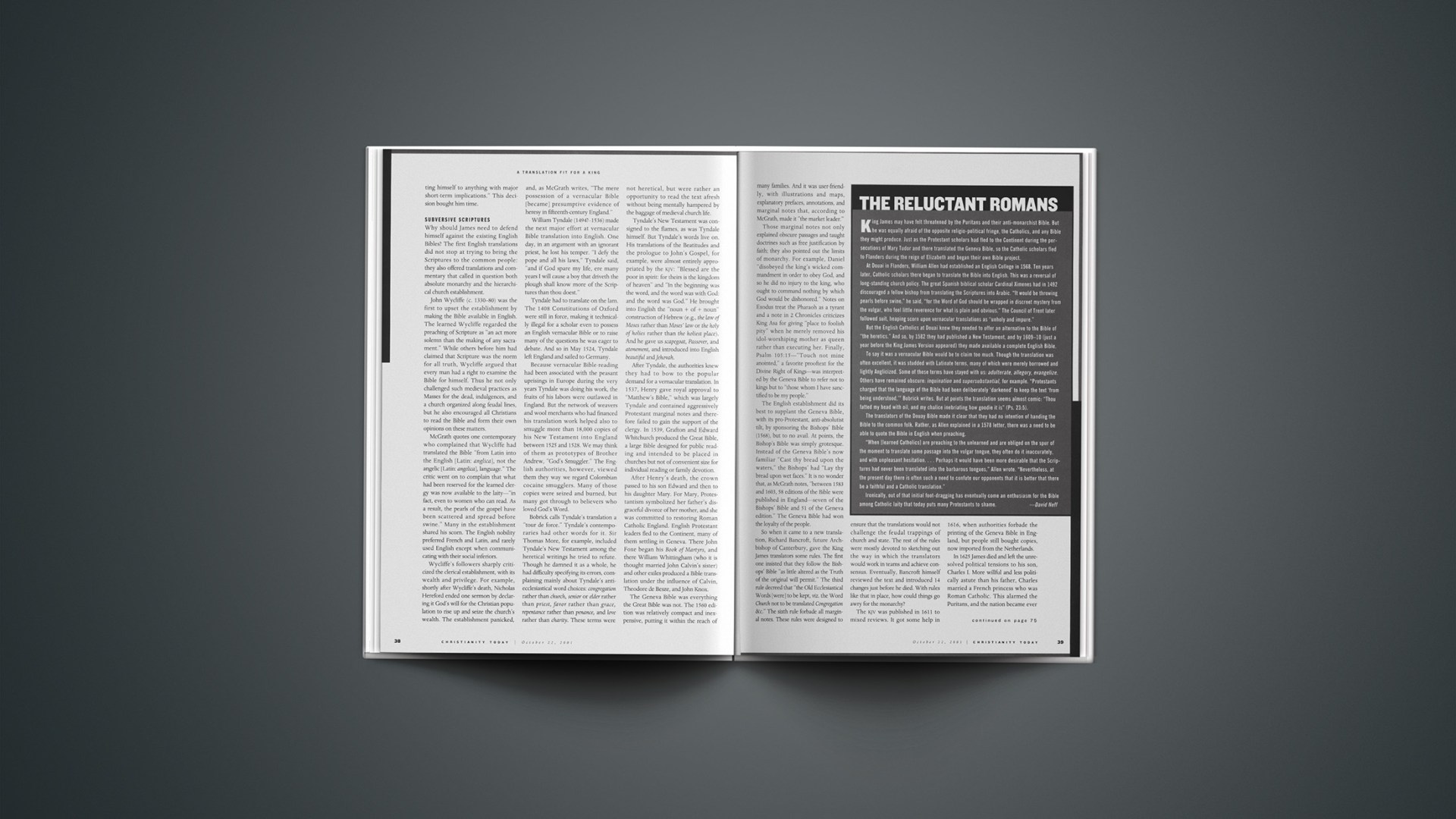

King James may have felt threatened by the Puritans and their anti-monarchist Bible. But he was equally afraid of the opposite religio-political fringe, the Catholics, and any Bible they might produce. Just as the Protestant scholars had fled to the Continent during the persecutions of Mary Tudor and there translated the Geneva Bible, so the Catholic scholars fled to Flanders during the reign of Elizabeth and began their own Bible project.
At Douai in Flanders, William Allen had established an English College in 1568. Ten years later, Catholic scholars there began to translate the Bible into English. This was a reversal of long-standing church policy. The great Spanish biblical scholar Cardinal Ximenes had in 1492 discouraged a fellow bishop from translating the Scriptures into Arabic. “It would be throwing pearls before swine,” he said, “for the Word of God should be wrapped in discreet mystery from the vulgar, who feel little reverence for what is plain and obvious.” The Council of Trent later followed suit, heaping scorn upon vernacular translations as “unholy and impure.”
But the English Catholics at Douai knew they needed to offer an alternative to the Bible of “the heretics.” And so, by 1582 they had published a New Testament, and by 1609-10 (just a year before the King James Version appeared) they made available a complete English Bible.
To say it was a vernacular Bible would be to claim too much. Though the translation was often excellent, it was studded with Latinate terms, many of which were merely borrowed and lightly Anglicized. Some of these terms have stayed with us: adulterate, allegory, evangelize. Others have remained obscure: inquination and supersubstantial, for example. “Protestants charged that the language of the Bible had been deliberately ‘darkened’ to keep the text ‘from being understood,'” Bobrick writes. But at points the translation seems almost comic: “Thou fatted my head with oil, and my chalice inebriating how goodie it is” (Ps. 23:5).
The translators of the Douay Bible made it clear that they had no intention of handing the Bible to the common folk. Rather, as Allen explained in a 1578 letter, there was a need to be able to quote the Bible in English when preaching.
“When [learned Catholics] are preaching to the unlearned and are obliged on the spur of the moment to translate some passage into the vulgar tongue, they often do it inaccurately, and with unpleasant hesitation. … Perhaps it would have been more desirable that the Scriptures had never been translated into the barbarous tongues,” Allen wrote. “Nevertheless, at the present day there is often such a need to confute our opponents that it is better that there be a faithful and a Catholic translation.”
Ironically, out of that initial foot-dragging has eventually come an enthusiasm for the Bible among Catholic laity that today puts many Protestants to shame.
Copyright © 2001 Christianity Today. Click for reprint information.
Related Elsewhere:
Also on our site:
A Translation Fit For a King | In the beginning, the King James Version was an attempt to thwart liberty. In the end, it promoted liberty. (Oct. 22, 2001)
We Really Do Need Another Bible Translation | As good as many modern versions are, they often do not allow us to hear what the Holy Spirit actually said. (Oct. 19, 2001)
The Catholic Encyclopedia has more on the Douai Bible.
For more information on the Geneva Bible, read “The Lost Translation” an article excerpted from American Vision’s Biblical Worldview.
ReligiousTolerance.com answers many questions on the Bible and compares Bible translations.
The American Bible Society has a wealth of information about the Bible and translation of the Bible.
Search or browse the King James Bible online. The Bible Gateway allows users to search and compare various translations.
Previous Christianity Today articles on Biblical translation include:
Old Wisdom for New Times | The International Bible Society is doing “spiritual archaeology” and retro-publishing to reach seekers. (April 23, 2001)
And the Word Came with Pictures | Visual Bible International (VBI), is producing a movie version of the Bible book for book, word for word. (March 1, 2001)
New Bible translations help to preserve world’s disappearing languages | The total number of languages in which the Bible is available in part or in its entirety now stands at 2233. (Feb. 28, 2000)
The Battle for the Inclusive Bible | Conflicts over “gender-neutral” versions are not really about translation issues. (Nov. 15, 1999)
What Bible Version Did Jesus Read? | What does the knowledge that Jesus used different versions of Scripture mean for us today? (April 26, 1999)
Do Inclusive-Language Bibles Distort Scripture? | He Said, They Said ( October 27, 1997)
On the Shoulders of King James | Barclay M. Newman has kept before him a question posed by the translators of the 1611 King James Version: “What can be more [important] than to deliver God’s book unto God’s people in a tongue which they understand?” (Oct. 27, 1997)
Confessions of a Bible Translator | As a stylist on a new translation of the Bible, Daniel worries over the effectiveness of the language into which the text is translated. (Oct. 27, 1997)
The Great Translation Debate | The divide over gender-inclusive Bibles hides what unites us. (Oct. 27, 1997)
Bible Translators Deny Gender Agenda | Focus on the Family yanks children’s Bible; NIV translator loses seminary job. (July 14, 1997)
Hands Off My NIV! | Bible society cancels plans for ‘gender-accurate’ Bible after public outcry. (June 16, 1997)