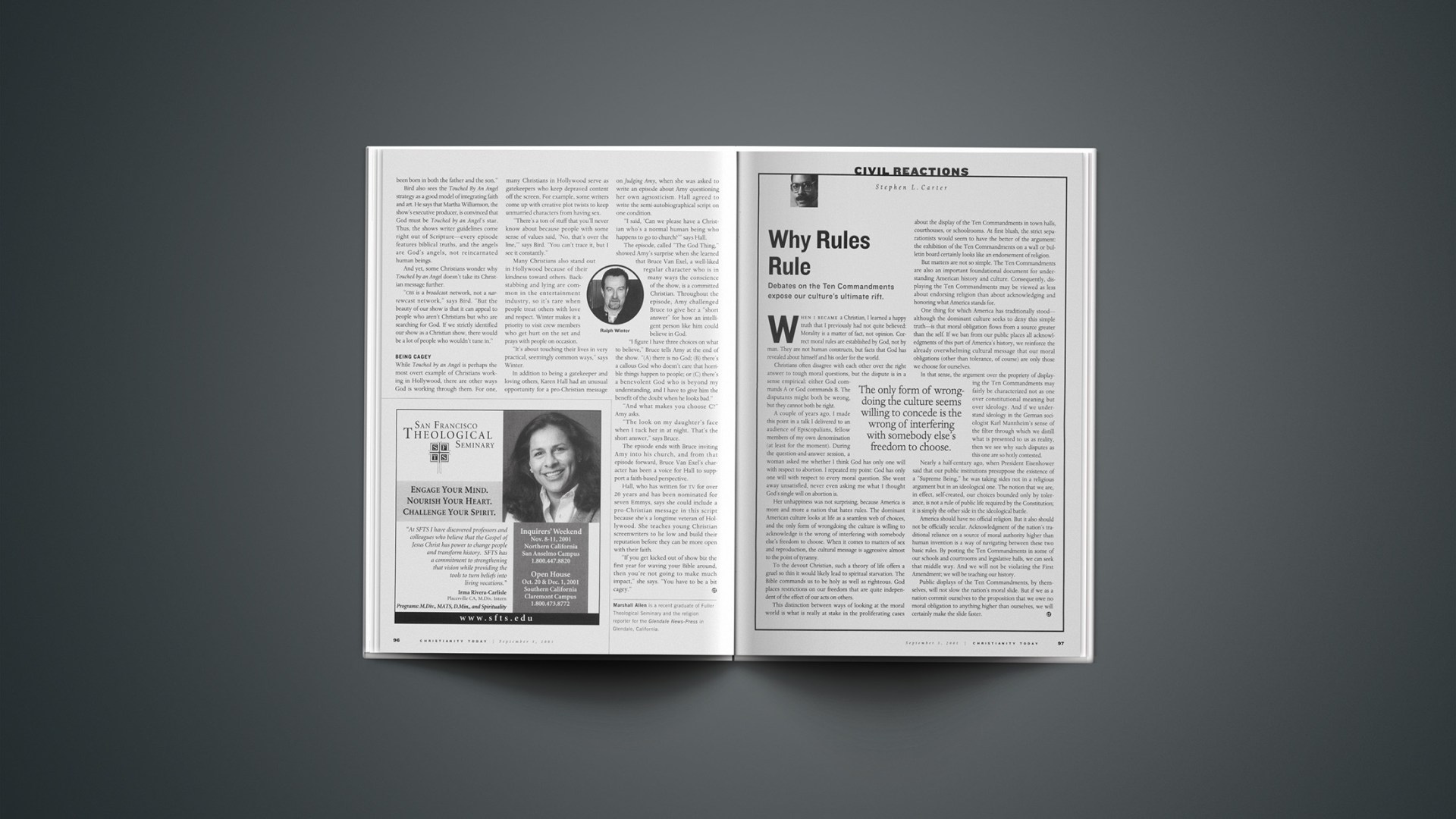

Christians often disagree with each other over the right answer to tough moral questions, but the dispute is in a sense empirical: either God commands A or God commands B. The disputants might both be wrong, but they cannot both be right.
A couple of years ago, I made this point in a talk I delivered to an audience of Episcopalians, fellow members of my own denomination (at least for the moment). During the question-and-answer session, a woman asked me whether I think God has only one will with respect to abortion. I repeated my point: God has only one will with respect to every moral question. She went away unsatisfied, never even asking me what I thought God’s single will on abortion is.
Her unhappiness was not surprising, because America is more and more a nation that hates rules. The dominant American culture looks at life as a seamless web of choices, and the only form of wrongdoing the culture is willing to acknowledge is the wrong of interfering with somebody else’s freedom to choose. When it comes to matters of sex and reproduction, the cultural message is aggressive almost to the point of tyranny.
To the devout Christian, such a theory of life offers a gruel so thin it would likely lead to spiritual starvation. The Bible commands us to be holy as well as righteous. God places restrictions on our freedom that are quite independent of the effect of our acts on others.
This distinction between ways of looking at the moral world is what is really at stake in the proliferating cases about the display of the Ten Commandments in town halls, courthouses, or schoolrooms. At first blush, the strict separationists would seem to have the better of the argument: the exhibition of the Ten Commandments on a wall or bulletin board certainly looks like an endorsement of religion.
But matters are not so simple. The Ten Commandments are also an important foundational document for understanding American history and culture. Consequently, displaying the Ten Commandments may be viewed as less about endorsing religion than about acknowledging and honoring what America stands for.
One thing for which America has traditionally stood—although the dominant culture seeks to deny this simple truth—is that moral obligation flows from a source greater than the self. If we ban from our public places all acknowledgments of this part of America’s history, we reinforce the already overwhelming cultural message that our moral obligations (other than tolerance, of course) are only those we choose for ourselves.
In that sense, the argument over the propriety of displaying the Ten Commandments may fairly be characterized not as one over constitutional meaning but over ideology. And if we understand ideology in the German sociologist Karl Mannheim’s sense of the filter through which we distill what is presented to us as reality, then we see why such disputes as this one are so hotly contested.
Nearly a half-century ago, when President Eisenhower said that our public institutions presuppose the existence of a “Supreme Being,” he was taking sides not in a religious argument but in an ideological one. The notion that we are, in effect, self-created, our choices bounded only by tolerance, is not a rule of public life required by the Constitution; it is simply the other side in the ideological battle.
America should have no official religion. But it also should not be officially secular. Acknowledgment of the nation’s traditional reliance on a source of moral authority higher than human invention is a way of navigating between these two basic rules. By posting the Ten Commandments in some of our schools and courtrooms and legislative halls, we can seek that middle way. And we will not be violating the First Amendment; we will be teaching our history.
Public displays of the Ten Commandments, by themselves, will not slow the nation’s moral slide. But if we as a nation commit ourselves to the proposition that we owe no moral obligation to anything higher than ourselves, we will certainly make the slide faster.
Copyright © 2001 Christianity Today. Click for reprint information.
Related Elsewhere
Recent media coverage of Ten Commandments displays includes:Poll Shows ‘Ten Commandments Judge’ Has Wide Support—Religion News Service (Aug. 28, 2001)
King display blocked from Ala. court — Associated Press (Aug. 29, 2001)
Judge unveils Bible-based monument — Chicago Tribune (Aug. 16, 2001)
Ten Commandments in Alabama Judicial Building Reviving Debate — FOXNews (Aug. 15, 2001)
Religious monument will stand, mayor vows — National Post (May 30, 2001)
High Court Lets Ruling On Church, State Stand — The Washington Post (May 30, 2001)
Michigan Proposal allows Commandments in public schools — The Detroit News (May 28, 2001)
For additional coverage of Ten Commandments debates, see The Freedom Forum.
In 1997, CT‘s sister publication Christian Reader published an interview with Judge Roy Moore entitled Are the Ten Commandments Unconstitutional?
Christianity Today‘s previous coverage of Ten Commandments controversies includes:
Ten Commandments Case Turned Down | Denial means Indiana town’s Decalogue display is unconstitutional. (June 13, 2001)
Schools OK Decalogue Book Covers | Chicago school district has approved a plan for an independent religious group to distribute covers off-campus (Nov. 2, 2000)
Hang Ten? | Thou shalt avoid Ten Commandments tokenism. (Mar. 3, 2000)
Ten Commandments Judge Cleared | Roy Moore’s integrity confirmed regarding legal fund. (Oct. 25, 1999)
House Upholds Display of Ten Commandments | Spurred by recent fatal shootings in public schools, the House of Representatives voted to permit the display of the Ten Commandments. (April 9, 1999)
Ten Commandments Judge Looking for Federal Fight | Does courtroom display defy separation of church and state? (Dec. 12, 1997)
Earlier Christianity Today columns by Stephen L. Carter include:
We Interrupt This Childhood | Parents who raise their children to do right face a barrage of resistance. (July 11, 2001)
And the Word Turned Secular | Christians should count the cost of the state’s affirmation. (May 29, 2001)
Vouching for Parents | Vouchers are not an attack on public schools but a vote of trust in families. (Apr. 2, 2001)
The Courage to Lose | In elections, and in life, there is something more important than winning. (Feb. 6, 2001)