


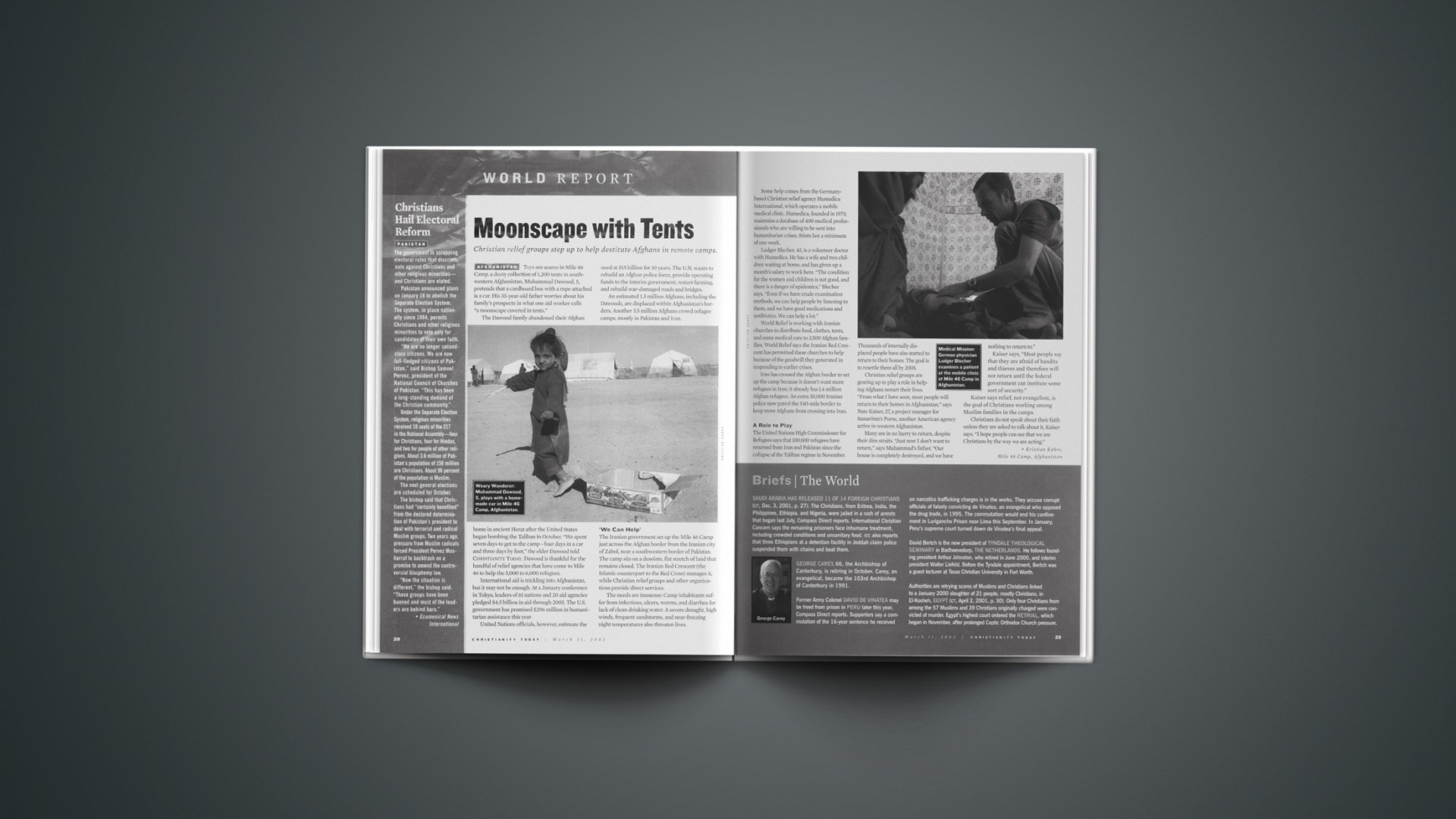

Toys are scarce in Mile 46 Camp, a dusty collection of 1,200 tents in southwestern Afghanistan. Muhammad Dawood, 5, pretends that a cardboard box with a rope attached is a car. His 35-year-old father worries about his family’s prospects in what one aid worker calls “a moonscape covered in tents.”
The Dawood family abandoned their Afghan home in ancient Herat after the United States began bombing the Taliban in October. “We spent seven days to get to the camp—four days in a car and three days by foot,” the elder Dawood told Christianity Today. Dawood is thankful for the handful of relief agencies that have come to Mile 46 to help the 5,000 to 6,000 refugees.
International aid is trickling into Afghanistan, but it may not be enough. At a January conference in Tokyo, leaders of 61 nations and 20 aid agencies pledged $4.5 billion in aid through 2005. The U.S. government has promised $296 million in humanitarian assistance this year.
United Nations officials, however, estimate the need at $15 billion for 10 years. The U.N. wants to rebuild an Afghan police force, provide operating funds to the interim government, restart farming, and rebuild war-damaged roads and bridges.
An estimated 1.3 million Afghans, including the Dawoods, are displaced within Afghanistan’s borders. Another 3.5 million Afghans crowd refugee camps, mostly in Pakistan and Iran.
‘We Can Help’
The Iranian government set up the Mile 46 Camp just across the Afghan border from the Iranian city of Zabol, near a southwestern border of Pakistan. The camp sits on a desolate, flat stretch of land that remains closed. The Iranian Red Crescent (the Islamic counterpart to the Red Cross) manages it, while Christian relief groups and other organizations provide direct services.
The needs are immense: Camp inhabitants suffer from infections, ulcers, worms, and diarrhea for lack of clean drinking water. A severe drought, high winds, frequent sandstorms, and near-freezing night temperatures also threaten lives.
Some help comes from the Germany-based Christian relief agency Humedica International, which operates a mobile medical clinic. Humedica, founded in 1979, maintains a database of 400 medical professionals who are willing to be sent into humanitarian crises. Stints last a minimum of one week.
Ludger Blecher, 45, is a volunteer doctor with Humedica. He has a wife and two children waiting at home, and has given up a month’s salary to work here. “The condition for the women and children is not good, and there is a danger of epidemics,” Blecher says. “Even if we have crude examination methods, we can help people by listening to them, and we have good medications and antibiotics. We can help a lot.”
World Relief is working with Iranian churches to distribute food, clothes, tents, and some medical care to 3,500 Afghan families. World Relief says the Iranian Red Crescent has permitted these churches to help because of the goodwill they generated in responding to earlier crises.
Iran has crossed the Afghan border to set up the camp because it doesn’t want more refugees in Iran; it already has 1.4 million Afghan refugees. An extra 30,000 Iranian police now patrol the 540-mile border to keep more Afghans from crossing into Iran.
A Role to Play
The United Nations High Commissioner for Refugees says that 100,000 refugees have returned from Iran and Pakistan since the collapse of the Taliban regime in November. Thousands of internally displaced people have also started to return to their homes. The goal is to resettle them all by 2005.
Christian relief groups are gearing up to play a role in helping Afghans restart their lives. “From what I have seen, most people will return to their homes in Afghanistan,” says Nate Kaiser, 27, a project manager for Samaritan’s Purse, another American agency active in western Afghanistan.
Many are in no hurry to return, despite their dire straits. “Just now I don’t want to return,” says Muhammad’s father. “Our house is completely destroyed, and we have nothing to return to.”
Kaiser says, “Most people say that they are afraid of bandits and thieves and therefore will not return until the federal government can institute some sort of security.”
Kaiser says relief, not evangelism, is the goal of Christians working among Muslim families in the camps.
Christians do not speak about their faith unless they are asked to talk about it, Kaiser says. “I hope people can see that we are Christians by the way we are acting.”
Copyright © 2002 Christianity Today. Click for reprint information.
Related Elsewhere
For more on the political and humanitarian situation in Afghanistan, see Yahoo! full coverage and World Refugee.com.
Special Report: Afghanistan features ongoing PBS’ Online NewsHour coverage of the situation in Afghanistan.
Afghanistan Humanitarian Update includes a look at the refugee situation at a glance, statistics, maps, and analysis. From the UN High Commissioner on Refugees.
Previous Christianity Today articles on the work of aid groups in Afghanistan include:
Aid Workers Urge Foreign Political Intervention in AfghanistanEthnic tensions and frequent violence threaten stabilization in the country. (November 26, 2001)
Agencies Scramble to HelpInternational relief organizations quickly work to aid Afghanistan refugees. (November 14, 2001)