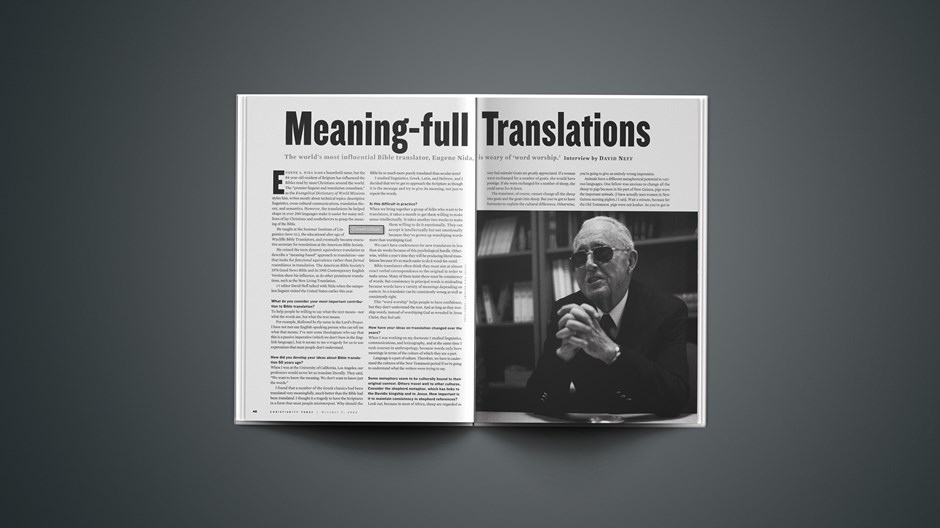
Eugene A. Nida is not a household name, but the 84-year-old resident of Belgium has influenced the Bibles read by most Christians around the world. The "premier linguist and translation consultant," as the Evangelical Dictionary of World Missions styles him, writes mostly about technical topics: descriptive linguistics, cross-cultural communications, translation theory, and semantics. However, the translations he helped shape in over 200 languages make it easier for many millions of lay Christians and nonbelievers to grasp the meaning of the Bible.
He taught at the Summer Institute of Linguistics (now SIL), the educational alter ego of Wycliffe Bible Translators, and eventually became executive secretary for translations at the American Bible Society.
He coined the term dynamic equivalence translation to describe a "meaning-based" approach to translation—one that looks for functional equivalence rather than formal resemblance in translation. The American Bible Society's 1976 Good News Bible and its 1995 Contemporary English Version show his influence, as do other prominent translations, such as the New Living Translation.
CT editor David Neff talked with Nida when the outspoken linguist visited the United States earlier this year.
What do you consider your most important contribution to Bible translation?
To help people be willing to say what the text means—not what the words are, but what the text means.
For example, Hallowed be thy name in the Lord's Prayer. I have not met one English-speaking person who can tell me what that means. I've met some theologians who say that this is a passive imperative (which we don't have in the English language), but it seems to me a tragedy for us to use expressions that most people don't understand.
How did you develop your ideas about Bible translation 50 years ago?
When I was at the University of California, Los Angeles, our professors would never let us translate literally. They said, "We want to know the meaning. We don't want to know just the words."
I found that a number of the Greek classics had been translated very meaningfully, much better than the Bible had been translated. I thought it a tragedy to have the Scriptures in a form that most people misinterpret. Why should the Bible be so much more poorly translated than secular texts?
I studied linguistics, Greek, Latin, and Hebrew, and I decided that we've got to approach the Scripture as though it is the message and try to give its meaning, not just to repeat the words.
When we bring together a group of folks who want to be translators, it takes a month to get them willing to make sense intellectually. It takes another two weeks to make them willing to do it emotionally. They can accept it intellectually but not emotionally because they've grown up worshiping words more than worshiping God.
We can't have conferences for new translators in less than six weeks because of this psychological hurdle. Otherwise, within a year's time they will be producing literal translations because it's so much easier to do it word-for-word.
Bible translators often think they must aim at almost exact verbal correspondence to the original in order to make sense. Many of them insist there must be consistency of words. But consistency in principal words is misleading because words have a variety of meanings depending on context. So a translator can be consistently wrong as well as consistently right.
This "word worship" helps people to have confidence, but they don't understand the text. And as long as they worship words, instead of worshiping God as revealed in Jesus Christ, they feel safe.
How have your ideas on translation changed over the years?
When I was working on my doctorate I studied linguistics, communications, and lexicography, and at the same time I took courses in anthropology, because words only have meanings in terms of the culture of which they are a part.
Language is a part of culture. Therefore, we have to understand the cultures of the New Testament period if we're going to understand what the writers were trying to say.
Some metaphors seem to be culturally bound to their original context. Others travel well to other cultures. Consider the shepherd metaphor, which has links to the Davidic kingship and to Jesus. How important is it to maintain consistency in shepherd references?
Look out, because in most of Africa, sheep are regarded as very bad animals! Goats are greatly appreciated. If a woman were exchanged for a number of goats, she would have prestige. If she were exchanged for a number of sheep, she could never live it down.
The translator, of course, cannot change all the sheep into goats and the goats into sheep. But you've got to have footnotes to explain the cultural difference. Otherwise, you're going to give an entirely wrong impression.
Animals have a different metaphorical potential in various languages. One fellow was anxious to change all the sheep to pigs because in his part of New Guinea, pigs were the important animals. (I have actually seen women in New Guinea nursing piglets.) I said, Wait a minute, because for the Old Testament, pigs were not kosher. So you've got to have a footnote explaining the cultural differences. These people are smart enough to recognize the difference.
Article continues below
You respect the intelligence of the reader even in nonliterate societies.
They're not stupid. Most primitive people know different cultures do things in different ways from the way they do it. They are much more adaptable than the translators. They don't worship their own particular culture as much as the missionaries worship their own English interpretation of Greek and Hebrew culture.
In fact, the smartest committee I ever worked with were five Bushmen in the Kalahari Desert. Linguistically, they have a highly complicated language with tonal differences. And culturally they were extremely sophisticated. Never met with five better men in my life than in the Kalahari Desert.
We have an interesting way of testing translations. We always get somebody who's a very good reader—a local person, never a missionary—to read the translation to a group of people. We watch their eyes and especially around the mouth. If the people begin to open their mouths, you know they're understanding. If they sit there with the mouth closed, you know they don't understand.
What units of written texts carry the most meaning?
The phrase. In all communication, the context (not the individual words) has to be focused on. In semiotics and information theory, it is the context that has the most possibilities for indicating the meaning of the core element. So we try to have people understand that they've got to build context into expressions in order for key words to make sense.
Do you sometimes add context?
Of course. You may have a word like logos, which has over 70 meanings. How do you know what meaning out of 70? It's by the context. Therefore you've got to build meaning into your translation of the word logos by indicating a meaning.
How do you react to complaints about the way gender has been handled in meaning-based translations?
Face the fact that ancient Israel was a male-dominated culture. You had to have ten men to form a synagogue. Sixty women couldn't be a synagogue without ten men.
In many instances, though, it is good to talk about people and leave it ambiguous. There is nothing sacred about specifying always men, men, men.
Article continues below
What are the limits in our translating gender references for the modern American church? Should we say brothers and sisters everywhere Paul writes adelphoi?
We're stuck with English, and we have to make a decision if we're going to be inclusive. It seems to me that the words in those contexts are referring to people in general. It's not referring just to men, although we have to admit that in many instances they were men who were involved in the discussions. But the implications of such passages are for people in general.
Translators who have been influenced by your work tend to shy away from using the Jews, particularly in the Passion narratives. They substitute Jewish leaders and other phrases. Is that legitimate?
The problem Jesus had was not with the Jews in general—the problem was in the Jewish leadership. I think that's perfectly legitimate because in the Gospels, when it says the Jews, it is not talking about Jews in general. It is usually talking about the Pharisees, but in some instances the Sadducees.
Some American translations have suppressed biblical poetry, even in the Psalms. How should poetry and other rhetorical elements be handled?
I was very surprised that in the Living Bible there were a number of passages that were really quite lyrical, but it was all printed as prose because the translator felt that most Americans didn't believe anything that was in poetic lines. He was probably right, because most people don't believe that poetry really has any particular truth.
Bible translators are not producing poetry in the traditional European sense. Western poetic style can work for some of the Psalms, though not for all of the Psalms. But if somebody has the skill, the creativity, and the ability to render the Psalms poetically, they should be encouraged.
We had a Zulu poet who came to us and said, the Psalms are real nice, but they're not written right. Zulu poetry has a very complicated 12-syllable line structure. It's a chant structure. He reorganized the material, and now it's meaningful for Zulus. And it has the flow of what the Psalms would have had, because they were normally chanted.
One critic recently complained about meaning-based translation, saying that it required the translator to do exegesis first.
Frankly, we like to have exegesis first and last. If the translator doesn't know what he's talking about, why should he be translating?
How familiar with biblical languages should preachers be?
They should be familiar with the Bible, not necessarily with biblical languages.
I was in Japan trying to push a translation committee there to speed up their work. I took one of the important passages of the New Testament—"The righteousness of God is revealed from faith to faith"—and I tried to explain all the problems involved in that very succinct statement. When I got through, they said, "If we made the Bible that clear, what would the preachers have to do?"
Article continues below
I said, "They could preach." Preaching is not exegeting the Greek or Hebrew text. Preaching is applying that message to life. The New Testament is a terribly practical book, and it has a lot of lessons for everyday living.
We translators want to give them a basis for exegeting it right. We always have footnotes because in some passages we don't know what was really meant. There may be two or even three interpretations.
In the case of "The righteousness of God is revealed from faith to faith," is this God's own personal righteousness? Or is it the way in which God makes us righteous through our faith in Jesus Christ? These are very important differences, and they ought to be footnoted, ideally in the order in which the truth was recognized by the major part of Christendom.
Should I look for a different kind of translation to read aloud in church from one that I might study at my desk?
There are three kinds of translations: first, a liturgical translation; second, a common-language translation that almost everybody can read and understand; third, translations for particular constituencies—children, for example. All major languages need these three types of translation.
If you're going to have the Scriptures presented orally from the pulpit, you're not going to have a lot of footnotes. Hopefully your preacher will take time to explain some of the problems. But a Bible for public reading should not only be accurate in meaning but should have a good flow of language so that you don't have a lot of unnecessary breaks in the line.
What would you tell young people who think that Bible translation might be their calling?
Well, SIL [www.sil.org] has a good program, but young people really ought to get a good foundation in Greek and Hebrew and in cultural anthropology. Then they can pick up what is related to translation. More of the problems involve cultural anthropology than they do problems of theology.
What are the biggest challenges that the whole field of Bible translation faces? Is it just the sheer number of languages?
I think it would be a string of Mongolian languages that goes all the way from Mongolia to Turkey. A number of these languages have nothing of the Scriptures. The cultures are mostly Muslim.
Article continues below
It would be very important also in some of the more well-known Muslim areas to produce translations that are more relevant and on a better level of Arabic. So many of the translations reflect a very traditional form of the language.
What is the impact of multiple translations?
It makes people begin to think. As long as all people had the King James Version, they didn't think. It's terribly important to have different translations to get a good argument started.
When I was a small boy, my most important theological learning was the result of a preacher who used the 13th chapter of Revelation to prove that Mussolini was the Antichrist. One week later, another man used the same passage to prove that Mussolini wasn't the Antichrist. So I asked my father, What's wrong?
He said, Son, it's much more important to know how to doubt than it is how to believe.
An awful lot of Christians don't think. Preachers just want them to say Amen.
Has the plethora of translations saturated the market for Bibles? What further is needed?
What is really needed is for people to take the message seriously and share it with other people, focused primarily on what this message has meant to me. So many Christians love to argue about the Bible rather than take it seriously as a message that is important for their own lives. In many of the churches in Africa, Asia, and elsewhere, people take the Bible's message far more seriously than they do here in America, where the Bible is so ordinary.

















 While we pray for peace, we need moral clarity about this war.
 We’ve got little information on Jesus’ appearance and personality. But that’s the way God designed it.españolFrançais
 How groups like Hillsong learned to let go of the literal in favor of creative collaboration.españolPortuguês






