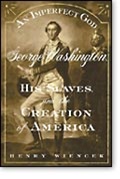
Henry Wiencek
Farrar, Straus and Giroux,
404 pp.; $26
Like many before him, Henry Wiencek finds George Washington "elusive" and "contradictory." Elusive partly because he was embarrassed about his lack of formal education, contradictory because he wrung his hands over slavery but remained a slaveholder throughout his life. But near the end, Washington demanded that all his unpaid servants be freed upon his death. "Washington filled almost three pages with explicit instructions for the manner in which his slaves should be freed," writes Wiencek, who won the National Book Critics Award in 1999. "He specified that the [slave] children should be educated and trained so that they could support themselves as free people."
It's unfortunate that Washington waited until the last moment to turn this good deed; had he done otherwise—had he found a way to liberate the slaves earlier—that precedent, like the other important precedents he set, might have accelerated general emancipation, or it might have caused South Carolina to leave the Union before it could haul the rest of the country into a devastating war. But might-have-beens, however interesting, don't add up to much, and one must at least give points to Washington for being unique among his peers: "No other Founding Father…set his slaves free, and certainly none of them contemplated educating slaves as Washington did."
In a sense, it's peculiar that Washington would have any concern about his slaves' future. If he felt badly for plucking his slaves' teeth to be implanted in his own jaw, he never said so in writing. If he regretted sending recalcitrant slaves to an almost certain harsh death in the West Indies (a threat he kept up till 1793), such scruples were not public knowledge. If before donning "his Olympian raiments as Revolutionary commander" he cringed at the thought of "ordering breeding wenches from his slave trader," that emotion hasn't been preserved in the record.
But the burden of An Imperfect God—a burden Wiencek bears skillfully if sometimes ponderously—is that Washington's "inner man" experienced conflict for years: he hated slavery and he needed slaves. Thus Wiencek's text orbits around Washington's "decades-long moral struggle with slavery." There is much here on "the psychology of mastery," "psychological dislocation," and "psychological cruelties."
As it happens, the evidence for the internal struggle Wiencek believes Washington navigated is persuasive, even if, on the whole, meager in volume. Wiencek fills in the narrative with standard reflections on the first president—he "towered over most men by about a foot"; his marriage for status and money was "a match made in Virginia"—and with travel writing: "A school-bus disgorged a gaggle of middle-school children as I arrived at Mount Vernon's main gate." And so on.
Perhaps it's too much to wish that Washington could have found a way, while living, to liberate his slaves. Virginia's "governing economic principle" was that "[s]laves equal land, and land equals wealth." Washington, being a gentleman in hock to his ears but a gentleman nevertheless, needed land—the more the better. And as Citicorp and WalMart would be reassured to learn, there was nothing shameful in colonial Virginia about massive debt so long as one could keep up appearances. After the Revolution, Virginia owned half of America's debt to Britain. "Virginia planters built up debts they could not repay because they expected, by right, to live well." The global economy of the day made Turkish carpet, Moroccan leather, and Venetian blinds important possessions. And underwriting the nonsense, so to speak, were slaves with names like Adam, Jack, William, and Frank.
Another Mount Vernon slave, Anne, was a girl who "probably" frolicked with Washington's stepchildren. She was also the stepchildren's aunt. "Anne was the daughter of Martha [Washington's] father and a woman whose name is not known, of mixed white, Native American, and African blood."
We read here that racial mixing was "extremely distasteful" to Virginia's elite; but it was also ubiquitous, and it wasn't the riffraff who owned the slaves. Thus Wiencek, citing the work of another researcher, tells us that Washington "came of age, and learned to be a master, on a racial borderland where definitions and boundaries of race were dangerously fluid." Southerners protected themselves from this "danger" by intentionally failing to notice it. ("Any lady is ready to tell you who is the father of all the mulatto children in everybody's household but her own," wrote the brilliant diarist Mary Chesnut.) And, like Washington, they often hoarded light pigmentation indoors, while the dark-skinned stayed in the fields. A European visitor to Washington's estate in the 1790s noted that one of Washington's house slaves had hair and skin "so like our own that had I not been told, I should never had suspected his ancestry."
All this is quite wicked, and there's much to regret about it. Washington put it this way: "I can clearly foresee that nothing but the rooting out of slavery can perpetuate the existence of our union." Jefferson said something similar. The difference is that Washington acted, albeit quite late in the proverbial game.
Article continues below
Preston Jones, a contributing editor to Books & Culture, teaches at John Brown University.
Books & Culture Corner appears every Monday. Earlier editions of Books & Culture Corner and Book of the Week include:
I Shop, Therefore I Am | Critics of "consumer culture" are all wet, Virginia Postrel says. The riot of choices available to us resonates with our deepest aesthetic instincts (Oct. 20, 2003)
Back to the Future | A sprawling new novel by the author of Snowcrash and Cryptonomicon goes to the 17th century to investigate the birth of the modern world. (You won't be surprised to learn that the Puritans are among the Bad Guys.) (Oct. 13, 2003)
Terrorists on Trial | How the nation responded to an earlier attack. (Sept. 29, 2003)
The Contemplative Christian | Eugene Peterson calls believers to a life lived with "wholeness, honesty, without contrivance"-against the grain of much that's currently driving the church in America. (Sept. 29, 2003)
Recalling California | Want to understand what's going on in the Golden State? Toss your newsmagazines and pick up Joan Didion's new book (Sept. 22, 2003)
The Ph.D. Octopus, 100 Years On | How Christians can make a difference in the upside-down world of graduate school (Sept. 15, 2003)
A New View of Worldview | Some critics want to retire the concept. Not so fast, says David Naugle (Aug. 18, 2003)
'A Golden Age' of Religious Tolerance? | The Ornament of the World analyzes how the intellectual elites of medieval Spain eschewed fundamentalism and showed surprising sensitivity in reconciling competing truths. (Aug. 11, 2003)
Article continues below
Looking for the 'I' | What happens to the self when the brain is injured or malformed? (Aug. 4, 2003)
The Terror of the Therapeutic | Margaret Atwood's new novel considers the price we may pay for looking to technology to remedy our ills, personal and social. (July 28, 2003)












 While we pray for peace, we need moral clarity about this war.
 But let’s not mistake it for calling.
 Amid the continued declines, Southern Baptists are celebrating back-to-back years of growth in worship attendance and baptism.





