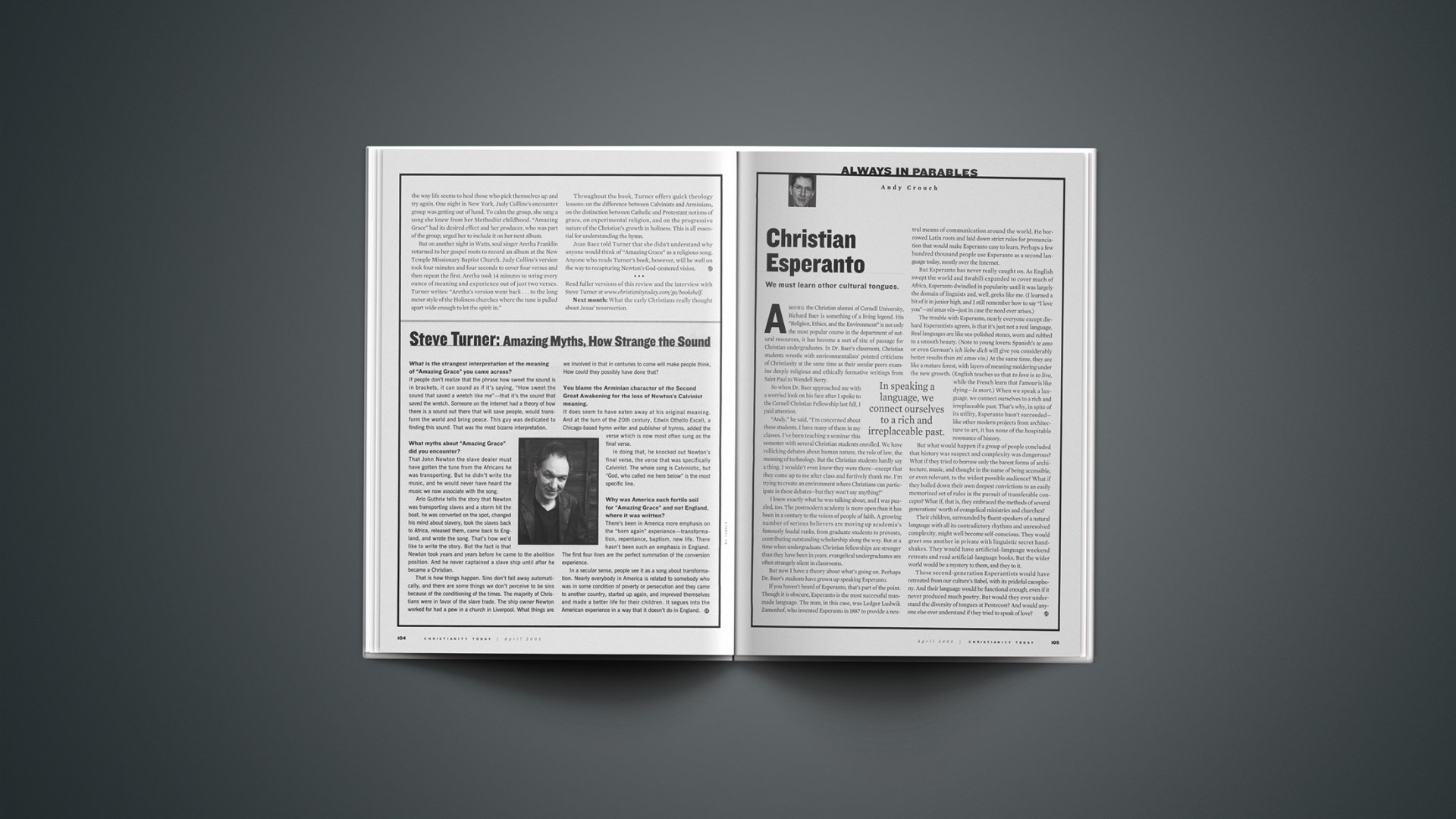

Among the Christian alumni of Cornell University, Richard Baer is something of a living legend. His “Religion, Ethics, and the Environment” is not only the most popular course in the department of natural resources, it has become a sort of rite of passage for Christian undergraduates. In Dr. Baer’s classroom, Christian students wrestle with environmentalists’ pointed criticisms of Christianity at the same time as their secular peers examine deeply religious and ethically formative writings from Saint Paul to Wendell Berry.
So when Dr. Baer approached me with a worried look on his face after I spoke to the Cornell Christian Fellowship last fall, I paid attention.
“Andy,” he said, “I’m concerned about these students. I have many of them in my classes. I’ve been teaching a seminar this semester with several Christian students enrolled. We have rollicking debates about human nature, the role of law, the meaning of technology. But the Christian students hardly say a thing. I wouldn’t even know they were there—except that they come up to me after class and furtively thank me. I’m trying to create an environment where Christians can participate in these debates—but they won’t say anything!”
I knew exactly what he was talking about, and I was puzzled, too. The postmodern academy is more open than it has been in a century to the voices of people of faith. A growing number of serious believers are moving up academia’s famously feudal ranks, from graduate students to provosts, contributing outstanding scholarship along the way. But at a time when undergraduate Christian fellowships are stronger than they have been in years, evangelical undergraduates are often strangely silent in classrooms.
But now I have a theory about what’s going on. Perhaps Dr. Baer’s students have grown up speaking Esperanto.
If you haven’t heard of Esperanto, that’s part of the point. Though it is obscure, Esperanto is the most successful man-made language. The man, in this case, was Ledger Ludwik Zamenhof, who invented Esperanto in 1887 to provide a neutral means of communication around the world. He borrowed Latin roots and laid down strict rules for pronunciation that would make Esperanto easy to learn. Perhaps a few hundred thousand people use Esperanto as a second language today, mostly over the Internet.
But Esperanto has never really caught on. As English swept the world and Swahili expanded to cover much of Africa, Esperanto dwindled in popularity until it was largely the domain of linguists and, well, geeks like me. (I learned a bit of it in junior high, and I still remember how to say “I love you”—mi amas vin—just in case the need ever arises.)
The trouble with Esperanto, nearly everyone except die-hard Esperantists agrees, is that it’s just not a real language. Real languages are like sea-polished stones, worn and rubbed to a smooth beauty. (Note to young lovers: Spanish’s te amo or even German’s ich liebe dich will give you considerably better results than mi amas vin.) At the same time, they are like a mature forest, with layers of meaning moldering under the new growth. (English teaches us that to love is to live, while the French learn that l’amour is like dying—la mort.) When we speak a language, we connect ourselves to a rich and irreplaceable past. That’s why, in spite of its utility, Esperanto hasn’t succeeded—like other modern projects from architecture to art, it has none of the hospitable resonance of history.
But what would happen if a group of people concluded that history was suspect and complexity was dangerous? What if they tried to borrow only the barest forms of architecture, music, and thought in the name of being accessible, or even relevant, to the widest possible audience? What if they boiled down their own deepest convictions to an easily memorized set of rules in the pursuit of transferable concepts? What if, that is, they embraced the methods of several generations’ worth of evangelical ministries and churches?
Their children, surrounded by fluent speakers of a natural language with all its contradictory rhythms and unresolved complexity, might well become self-conscious. They would greet one another in private with linguistic secret handshakes. They would have artificial-language weekend retreats and read artificial-language books. But the wider world would be a mystery to them, and they to it.
These second-generation Esperantists would have retreated from our culture’s Babel, with its prideful cacophony. And their language would be functional enough, even if it never produced much poetry. But would they ever understand the diversity of tongues at Pentecost? And would anyone else ever understand if they tried to speak of love?
Copyright © 2003 Christianity Today. Click for reprint information.
Related Elsewhere
Crouch is editor-in-chief of re:generation quarterly.
Many of Crouch’s other writings are available at his and his wife’s website.
Earlier Andy Crouch columns for Christianity Today include:
We’re Rich | But why is it so hard to admit? (Feb. 20, 2003)
Blinded by Pop Praise | To see God “high and lifted up,” just open your eyes. (Dec. 17, 2002)
The Future Is P.O.D. | Multicultural voices have an edge in reaching a rapidly changing America. (October 12, 2002)
Rekindling Old Fires | We can resist technology’s chilling effects on how we spend time together. (August 2, 2002)
Interstate Nation | The national highway system is a lesson in how to transform a nation. (June 21, 2002)
Amplified Versions | Worship wars come down to music and a power plug. (April 17, 2002)
Thou Shalt Be Cool | This enduring American slang leaves plenty out in the cold. (March 18, 2002)
Borrowing Against Time | We live in a fallen world. We will die. We need to face that. (Jan. 17, 2002)
Grounded | Our technologies give us an illusion of omnipresence—most of the time. (Nov. 15, 2001)
Zarathustra Shrugged | What apologetics should look like in a skeptical age. (Sept. 5, 2001)
Consuming Passions | One man’s “testimony” from the First Great Mammon Awakening. (July 10, 2001)