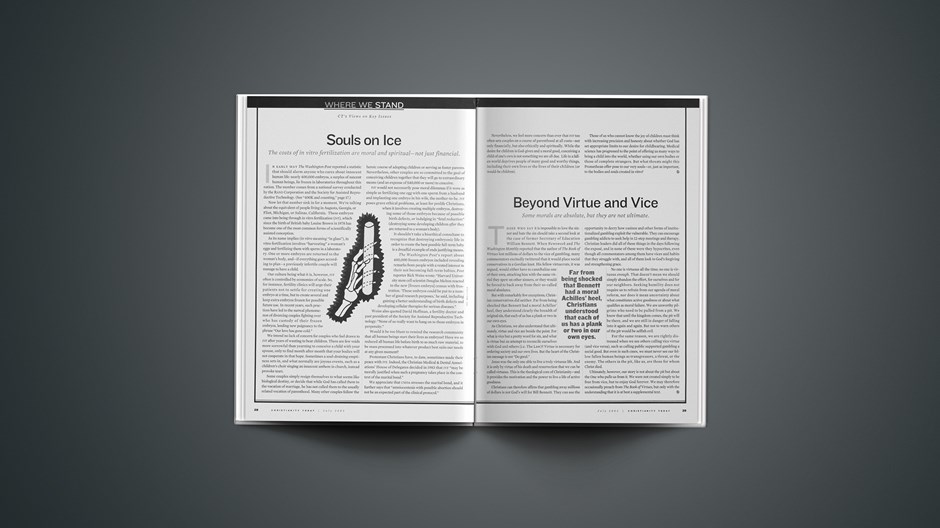
In early May The Washington Post reported a statistic that should alarm anyone who cares about innocent human life: nearly 400,000 embryos, a surplus of nascent human beings, lie frozen in laboratories throughout this nation. The number comes from a national survey conducted by the RAND Corporation and the Society for Assisted Reproductive Technology.
Now let that number sink in for a moment. We're talking about the equivalent of people living in Augusta, Georgia, or Flint, Michigan, or Salinas, California. These embryos came into being through in vitro fertilization (IVF), which since the birth of British baby Louise Brown in 1978 has become one of the most common forms of scientifically assisted conception.
As its name implies (in vitro meaning "in glass"), in vitro fertilization involves "harvesting" a woman's eggs and fertilizing them with sperm in a laboratory. One or more embryos are returned to the woman's body, and—if everything goes according to plan—a previously infertile couple will manage to have a child.
Our culture being what it is, however, IVF often is controlled by economies of scale. So, for instance, fertility clinics will urge their patients not to settle for creating one embryo at a time, but to create several and keep extra embryos frozen for possible future use. In recent years, such practices have led to the surreal phenomenon of divorcing couples fighting over who has custody of their frozen embryos, lending new poignancy to the phrase "Our love has gone cold."
We intend no lack of concern for couples who feel drawn to IVF after years of wanting to bear children. There are few voids more sorrowful than yearning to conceive a child with your spouse, only to find month after month that your bodies will not cooperate in that hope. Sometimes a soul-draining emptiness sets in, and what normally are joyous events, such as a children's choir singing an innocent anthem in church, instead provoke tears.
Some couples simply resign themselves to what seems like biological destiny, or decide that while God has called them to the vocation of marriage, he has not called them to the usually related vocation of parenthood. Many other couples follow the heroic course of adopting children or serving as foster parents. Nevertheless, other couples are so committed to the goal of conceiving children together that they will go to extraordinary means (and an expense of $40,000 or more) to conceive.
IVF would not necessarily pose moral dilemmas if it were as simple as fertilizing one egg with one sperm from a husband and implanting one embryo in his wife, the mother-to-be. IVF poses grave ethical problems, at least for prolife Christians, when it involves creating multiple embryos, destroying some of those embryos because of possible birth defects, or indulging in "fetal reduction" (destroying some developing children after they are returned to a woman's body).
It shouldn't take a bioethical consultant to recognize that destroying embryonic life in order to create the best possible full-term baby is a dreadful example of ends justifying means.
The Washington Post's report about 400,000 frozen embryos included revealing remarks from people with a vested interest in their not becoming full-term babies. Post reporter Rick Weiss wrote: "Harvard University stem cell scientist Douglas Melton reacted to the new [frozen embryo] census with frustration. 'These embryos could be put to a number of good research purposes,' he said, including gaining a better understanding of birth defects and developing cellular therapies for serious diseases."
Weiss also quoted David Hoffman, a fertility doctor and past president of the Society for Assisted Reproductive Technology: "None of us really want to hang on to those embryos in perpetuity."
Would it be too blunt to remind the research community that all human beings start their lives as embryos? Have we so reduced all human life before birth to so much raw material, to be mass processed into whatever product best suits our needs at any given moment?
Protestant Christians have, to date, sometimes made their peace with IVF. Indeed, the Christian Medical & Dental Associations' House of Delegates decided in 1983 that IVF "may be morally justified when such a pregnancy takes place in the context of the marital bond."
We appreciate that CMDA stresses the marital bond, and it further says that "amniocentesis with possible abortion should not be an expected part of the clinical protocol."
Nevertheless, we feel more concern than ever that IVF too often sets couples on a course of parenthood at all costs—not only financially, but also ethically and spiritually. While the desire for children is God-given and a moral good, conceiving a child of one's own is not something we are all due. Life in a fallen world deprives people of many good and worthy things, including their own lives or the lives of their children (or would-be children).
Those of us who cannot know the joy of children must think with increasing precision and honesty about whether God has set appropriate limits to our desire for childbearing. Medical science has progressed to the point of offering us many ways to bring a child into the world, whether using our own bodies or those of complete strangers. But what threats might this Promethean offer pose to our very souls—or, just as important, to the bodies and souls created in vitro?
Christianity Today's Life Ethics archive and the Science Pages of our sister publication Books & Culture have more perspective on bioethics. For current news on Fertility and Pregnancy, see Yahoo full coverage.
CT's earlier coverage of frozen embryos and fertility treatments includes:
Biotech Babies | How far should Christian couples go in the quest for a child of their own? (Dec. 7, 1988)
No Room in the Womb? | Couples with high-risk pregnancies face the 'selective reduction' dilemma (Dec. 6, 1999)
















 While we pray for peace, we need moral clarity about this war.
 We’ve got little information on Jesus’ appearance and personality. But that’s the way God designed it.españolFrançais
 How groups like Hillsong learned to let go of the literal in favor of creative collaboration.españolPortuguês






