Rock journalist and poet Steve Turner has made a long career of writing about the history of pop music. Book-length treatments have focused on Marvin Gaye, the Beatles, Cliff Richard, U2, and Van Morrison. Most recently he turned his attention to the history of "Amazing Grace."
As a rock journalist, what musician has been your favorite subject?
I enjoyed writing about the Beatles because I'd grown up with them. It was great to be able indulge myself and listen to all the songs. My book A Hard Day's Write told the story behind every Beatles song, and there were a lot of anecdotes about how they came to be written.
How did writing that book inform what you did in Amazing Grace?
I've been particularly interested in backgrounds of things. I've gone to places where particular songs or books were written, like going on the fairy tale route in Germany and looking for where the Grimm's fairy tales were collected, or going to Switzerland and finding where Heidi was written, and also going to David Bowie's Berlin and Dylan's Woodstock. And then I wrote Hungry for Heaven, which was about rock music and religion.
How does your book on "Amazing Grace" relate to Hungry for Heaven?
Well it helped when talking about the background to Judy Collins's recording of "Amazing Grace." The fact that religion was considered okay for rock music around that time—late '60s, early '70s—meant "Amazing Grace" seemed a natural song to record at the time. But it wouldn't have done five or six years before that.
My background in music also meant I'd start out at an advantage because I knew who the artists were and, if they were still living, I knew who to contact in order to talk to them.
You've got a wonderful discography at the back of the book. What is your favorite recording of "Amazing Grace"?
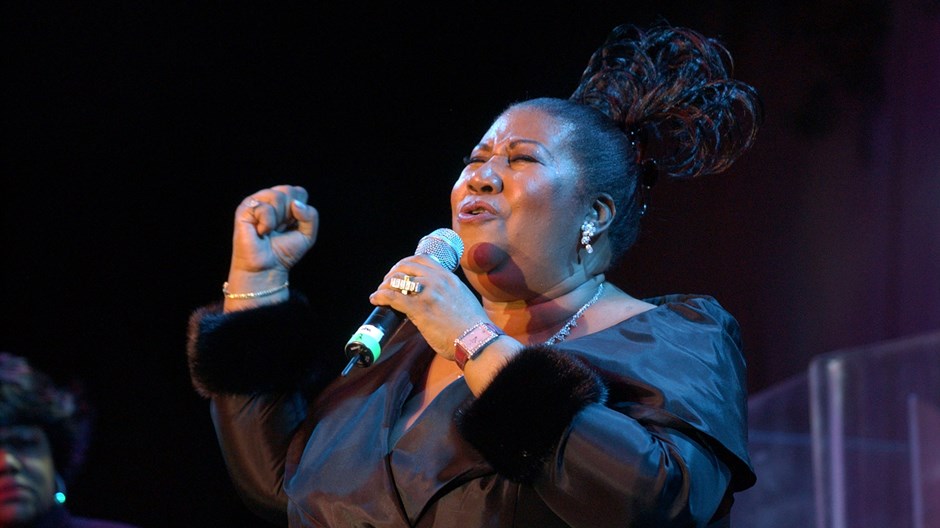
I actually like the Rod Stewart version, a bluesy version with a slide guitar. There aren't very many blues-tinged versions of "Amazing Grace." I also think Aretha Franklin's version is outstanding. It's a very long version in the tradition of Mahalia Jackson where every syllable is invested with a tremendous amount of emotion.
I enjoyed the way you unpacked the difference between Judy Collins's secularized folk approach and Aretha Franklin's gospel approach.
Well, Judy's version is very clean, very white, if you like. It doesn't have any musical instruments in the background and is not impassioned enough. But Aretha's version is full of tremendous passion and lots of ad libs. They're from two different schools.
What is the strangest interpretation of the meaning of "Amazing Grace" you came across?
If people don't realize that the phrase how sweet thesound is in brackets, it can sound as if it's saying, "How sweet the sound that saved a wretch like me"—that it's the sound that saved the wretch. Someone on the Internet had a theory of how there is a sound out there that will save people, would transform the world and bring peace. And this guy was dedicated to finding this sound. That was probably the most bizarre interpretation I've heard.
I once heard Arlo Guthrie at Chicago's Ravinia Festival say that "Amazing Grace" was about second chances and trying harder. How do artists like him turn a song about grace into a self-help ballad?
Well, I've heard Arlo say things like that. He gives an example of the sort of determination you need to give up smoking. I think that is one interpretation of grace that's popular today. It has to do with determination and overcoming obstacles. The Judy Collins version came around the time the New Ages therapies and encounter groups were coming into fashion. Post-1970, after the Judy Collins version, this belief that "Amazing Grace" is about doing it for yourself became quite popular. In fact, John Newton meant the exact opposite, that he'd reached the end of his tether, that he tried every means of reforming his own life. And it was only when he exhausted that absolutely that he realized God's grace. It's a complete opposite meaning to the one that people like Arlo Guthrie are putting out.
You tell about talking to Bono about "Amazing Grace." Did you talk to other artists about the song ?
Well if the artists were around, I'd talk to them. I talked to Pete Seeger, I talked to Joan Baez, I talked to Doc Watson, I talked to guys from the Dixie Hummingbirds and the Blind Boys of Alabama. If they were alive, I'd try to get hold of them. Aretha, for whatever reason, is not very available, even to do concerts. I would have liked to have talked to her.
As you talked to these artists, did you discuss the contrast between the way they perceived the song and what the song meant originally?
Yes, when I talked to Judy Collins. And Joan Baez surprised me by saying that she didn't think of it as a religious song. She thought of it like "Swing Low, Sweet Chariot," a song that had origins in the church but had long since left that behind and could almost be regarded as a secular song. She seemed almost surprised that I would think of it as a religious song. The '60s, which was the time when a lot of people were abandoning the church, was the time that "Amazing Grace" really started to become a popular song outside of the church. It seemed strange to me that in the midst of the counterculture, you had people standing up singing this song by a Calvinist minister from England.
Article continues below
I was also surprised that Doc Watson, who is a blind, white folk/blues singer, sang "Amazing Grace" not because he was trying to dig up new traditional material as a lot of the urban folkies of the '60s were, but because it was something he really believed. He is a Christian, and he talked very passionately about how he believes every word of the song.
Beside the stylistic differences, what's the difference between gospel artists and folk or pop artists who have approached this song?
At the time that Tin Pan Alley was churning out formulaic pop songs, folk artists wanted to get back to something that was more real. This search for authentic American songs is illustrated by the Lomaxes, father and son, going around America with a tape recorder and recording folk songs from unlikely people. The suburban folkies of the '50s and '60s looked to the Lomax catalog to find genuine, non-Tin Pan Alley songs. So I think a lot of the motivation for folkies was that this was real music that meant a lot to mountain people and sharecroppers.
Black church people invest the song with a lot of personal meaning, and they'll talk about how grace has worked in their lives. In addition, the struggles that black people have come through related very much to the words of the song, that they have felt wretched, they've felt that they've been rescued, both individually and as a people.
And quite a lot of them are aware that it had a connection to slavery. They knew that Newton was involved in slave trade and that he'd also effectively been a slave when he was on Plantain Island in Sierra Leone. He'd been enslaved and he had enslaved people.
Article continues below
There's a lot of mythology about that. I heard one singer introduce the song by talking about the fact that the tune is pentatonic and can therefore be played on the black notes of the piano. And then he said that so much African music is pentatonic and he just knew that John Newton heard this tune floating up from the hold of the ship.
I've heard that Newton the slave dealer must have gotten the music from the Africans that he was transporting. But you have to point out that he didn't actually write the music, and he would never have heard the music we now associate with the song.
What mythology did you yourself hold that you discovered was wrong when you did your research?
I think I just knew the basic skeleton of this story. I knew he was a slave trader, I knew that he had been in a storm, and I knew he'd written a song. I didn't really know the sequence in which that happened.
Arlo Guthrie tells the story on stage that Newton was transporting slaves and the storm hit the boat, he was converted on the spot, changed his mind about slavery, took the slaves back to Africa, released them, came back to England, and wrote the song. That would be nice. That would be the way we'd like to write the story. But the fact is that he took years and years before he came to the abolition position. And he never captained a slave ship until after he became a Christian. All his life as a slave captain was actually post-conversion.
That is how things happen. Sins don't fall away automatically, and there are some things we don't perceive to be sins because of the conditioning of the time, which is what he came to see later on. The majority of Christians were in favor of the slave trade. The ship owner that he worked for had a pew in the church in Liverpool. It was not uncommon at all for prominent Anglicans to also be involved in the slave trade. And it made me wonder, what things are we involved in that we think are fine but in centuries to come people will think, How could they possibly have done that?
You seem to either credit or blame the Arminian character of the Second Great Awakening for the progressive loss of Newton's meaning. Did I read you right?
Yes. It does seem to have eaten away at his original meaning. I was interested to note that this guy called Edwin Othello Excell, a Chicago-based hymn writer and publisher of hymns, was the one that added the verse which is most often sung as the final verse now ["When we've been there ten thousand years … "]. In doing that he knocked out Newton's final verse, the verse that, if anything, was specifically Calvinist.
Article continues below
It had the line, "God, who called me here below."
That's right. When you see the whole song, you would see it as Calvinistic from verse one to verse six, but that was the most specific line. And it's interesting that Excell changed it at the turn of the 20th century.
Why do you think America seemed to be such fertile soil for "Amazing Grace" and not England, its homeland?
It seemed to ring a lot of bells with the American experience. In the Christian sense, there's been in America more emphasis on the "born again" experience—transformation, repentance, baptism, new life—the experiential side of it. There hasn't been such an emphasis in England. And so the first four lines are the perfect summation of the conversion experience: "Amazing Grace (how sweet the sound) / that saved a wretch like me. / I once was lost, but now I'm found, / was blind but now I see." That's the best four-line stanza to sum up the personal experience of conversion.
In the secular sense, people would see it as a song about transformation. And that's quite important to the whole American experience. Nearly everybody's related to somebody who was in some condition of poverty or persecution and they left, came to another country, started up again, and tried to improve themselves and make a better life for their kids. It segues into the American experience in a way that it doesn't in England.
And it's being passed on from generation to generation. It's like an inheritance in many American families.
Curiously, I had to learn the song from the folkies. In my particular church, the hymnal used a wretched tune, so we never sang those wonderful words.
In England it wasn't in a lot of hymnals. It wasn't even in the Episcopal hymnbook in America until the early '80s. It's ironic that Judy Collins is really responsible for putting it into a lot of British hymnbooks for the first time.
Amazing Grace: The Story of America's Most Beloved Song by Steve Turner is this month's selection for the Christianity Today Editor's Bookshelf. Elsewhere on our site, you can:
David Neff was editor in chief of Christianity Today, where he worked from 1985 until his retirement in 2013. He is also the former editor in chief of Christian History magazine, and continues to explore the intersection of history and current events in his bimonthly column, "Past Imperfect." His earlier column, "Editor's Bookshelf," ran from 2002 to 2004 and paired Neff's reviews of thought-provoking books and interviews with the authors.















 While we pray for peace, we need moral clarity about this war.
 We’ve got little information on Jesus’ appearance and personality. But that’s the way God designed it.españolFrançais
 The plan would organize UMC churches in four global regions, with each given more leeway around same-sex marriage and other theological issues.





