
EDITOR’S BOOKSHELF REVIEW
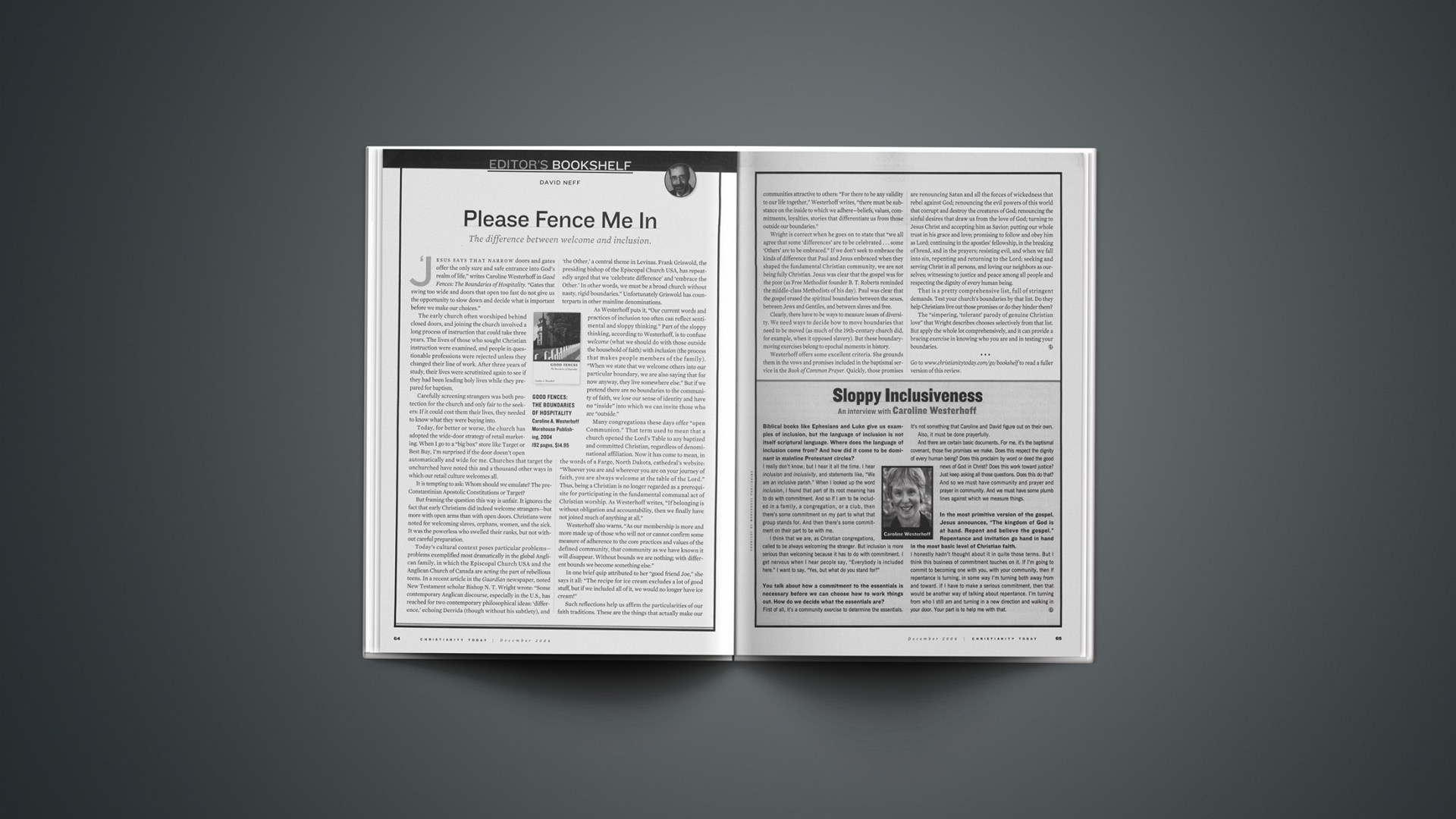
“Jesus says that narrow doors and gates offer the only sure and safe entrance into God’s realm of life,” writes Caroline Westerhoff in Good Fences: The Boundaries of Hospitality. “Gates that swing too wide and doors that open too fast do not give us the opportunity to slow down and decide what is important before we make our choices.” Indeed, the only time the Bible tells us to “fling wide the gates” is so that the “King of Glory can come in.”
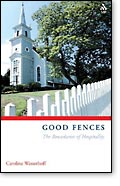 Good Fences: The Boundaries of Hospitality by Caroline A. Westerhoff Morehouse Publishing, 2004 192 pages, $14.95 |
The Early Church often worshiped behind closed doors, and joining the church involved a long process of instruction that could take three years. The lives of those who sought Christian instruction were examined, and people in questionable professions were rejected unless they changed their line of work. After three years of study, their lives were scrutinized again to see if they had been leading holy lives while they prepared for baptism.
Such a “narrow gate” philosophy was appropriate in a hostile culture where cycles of persecution came and went and being a Christian meant taking your life in your hands. Carefully screening strangers was both protection for the church and was only fair to the seekers: If it could cost them their lives, they needed to know what they were buying into.
Today, for better or worse, the church has adopted the wide-door strategy of retail marketing. When I go to a “big box” store like Target or Best Buy, I’m surprised if the door doesn’t open automatically and wide for me. Churches that target the unchurched have noted this and a thousand other ways in which our retail culture welcomes all.
It is tempting to ask: Who should we emulate? The pre-Constantinian Apostolic Constitutions or Target?
But framing the question this way is unfair. It ignores the fact that the early Christians did indeed welcome strangers—but more with open arms than with open doors. Christians were noted for welcoming slaves, orphans, women, and the sick. It was the powerless who swelled their ranks, but not without careful preparation.
Today’s cultural context poses particular problems—problems exemplified most dramatically in the global Anglican family, in which the Episcopal Church USA and the Anglican Church of Canada are acting the part of rebellious teens. In a recent article in the Guardian newspaper, noted New Testament scholar Bishop N. T. Wright complained about the extreme openness of the leadership in the Episcopal Church. He wrote: “Some contemporary Anglican discourse, especially in the US, has reached for two contemporary philosophical ideas: ‘difference’, echoing Derrida (though without his subtlety), and ‘the Other’, a central theme in Levinas. Frank Griswold, the presiding bishop of the Episcopal Church (US), has repeatedly urged that we ‘celebrate difference’ and ’embrace the Other’. In other words, we must be a broad church without nasty, rigid boundaries.” Unfortunately Griswold has counterparts in other mainline denominations.
“Nasty, rigid boundaries” are important and useful. As Westerhoff puts it, boundaries create our identity. But unfortunately, “our current words and practices of inclusion too often can reflect sentimental and sloppy thinking.” (As Wright said, Derrida without the subtlety.)
Part of the sloppy thinking, according to Westerhoff, is to confuse welcome (what we should do with those outside the household of faith) with inclusion (the process that makes people members of the family). “When we state that we welcome others into our particular boundary, we are also saying that for now anyway, they live somewhere else.” But if we pretend there are no boundaries to the community of faith, we lose our sense of identity and have no “inside” into which we can invite those who are “outside.”
A friend recently e-mailed me a news item about a church in Florida that advertises something called “open baptism,” which comes with “no strings attached.” The church website also says, “Lack of ‘belief’ is not an obstacle to belonging or to participating at St. Christopher’s by-the-Sea.” Well, gosh, if you have to put belief in quotation marks, that is, if you don’t even want to affirm the basic idea that churches are defined in part by the beliefs their members share, it isn’t really clear what anyone is really joining. As Westerhoff writes, “If belonging is without obligation and accountability, then we finally have not joined much of anything at all.”
St. Christopher’s and other congregations also offer “open communion.” That term used to mean that a church opened the Lord’s Table to any baptized and committed Christian, regardless of denominational affiliation. Now it has come to mean, in the words of a Fargo, North Dakota, cathedral’s website: “Whoever you are and wherever you are on your journey of faith, you are always welcome at the table of the Lord.” Thus, being a Christian, is no longer regarded as a prerequisite for participating in the fundamental communal act of Christian worship.
This is the confusion of welcome and inclusion that Westerhoff warns against when she writes, “If anyone and everyone are too easily included, we are saying in effect that anything goes. We are disclaiming our boundaries. And as our membership is more and more made up of those who will not or cannot confirm some measure of adherence to the core practices and values of the defined community, that community as we have known it will disappear. Without bounds we are nothing; with different bounds we become something else.”
In one brief quip attributed to her “good friend Joe,” she says it all: “The recipe for ice cream excludes a lot of good stuff, but if we included all of it, we would no longer have ice cream!’ “
Such reflections help us affirm the importance of the particularities of our faith traditions: the things that we can and should rejoice in. These are the things that actually make our communities attractive to others: “For there to be any validity to our life together,” writes Westerhof, “there must be substance on the inside to which we adhere—beliefs, values, commitments, loyalties, stories that differentiate us from those outside our boundaries. And ironically, it is this differentiating stuff that will attract those we can then welcome to our community, welcome to come inside so perhaps they can later be included.”
Bishop Wright is correct when he goes on to state that “we all agree that some ‘differences’ are to be celebrated … some ‘Others’ are to be embraced.” If we don’t seek to embrace the kinds of difference that Paul and Jesus embraced when they shaped the fundamental Christian community, we are not being fully Christian. Jesus was very clear that the gospel was for the poor (as Free Methodist founder B. T. Roberts reminded the middle-class Wesleyans of his day). Paul was very clear that the gospel erased the spiritual boundaries between the sexes, between Jews and Gentiles, and between slaves and free. These social and religious markers were no longer significant. All had an equal share in the salvation that flowed from the sacrifice of Jesus and all had equal access to God’s grace.
The bonus to this multifaceted church is the depth of insight and compassion that comes from hearing the voices of others whose lives, experiences, and opportunities are different from ours. And that in turn helps us do a better job of loving our neighbors as ourselves. But, as Wright notes, “to celebrate all differences … is to collapse into soggy … niceness, a simpering, ‘tolerant’ parody of genuine Christian love.”
More seriously, he cites Yale theologian Miroslav Volf’s warning that “random ’embracing’ risks colluding with behaviour which should instead be questioned.” And, we should add, it also risks being infected with bad thinking and false philosophies. It is that “random embracing” that resulted in the Episcopal Church’s Office of Women’s Ministries promoting a “Women’s Eucharist” that included an offering of “raisin cakes” to the “Queen of Heaven.” Christians who know their Bibles will recognize that as an act of idolatry condemned by Hosea and Jeremiah. But Christians who do not know their own tradition and do not know the Scriptures will commit idolatry in the name of inclusiveness.
Clearly, there have to be ways to measure issues of diversity. We need ways to decide how to move boundaries that need to be moved (as much of the 19th-century church did, for example, when it opposed the slavery, or as the 16th-century reformers did when they challenged the notions of church derived from the institutions of empire). But these boundary-moving exercises should not be the church’s constant mode of functioning. They belong to epochal moments in history.
Westerhoff offers some excellent criteria. She grounds them in the vows and promises included in the baptismal service in the Book of Common Prayer. Quickly, those promises are renouncing Satan and all the forces of wickedness that rebel against God; renouncing the evil powers of this world that corrupt and destroy the creatures of God; renouncing the sinful desires that draw us from the love of God; turning to Jesus Christ and accepting him as Savior; putting our whole trust in his grace and love; promising to follow and obey him as Lord; continuing in the apostles’ fellowship, in the breaking of bread, and in the prayers; resisting evil, and when we fall into sin, repenting and returning to the Lord; seeking and serving Christ in all persons, and loving our neighbors as ourselves; witnessing to justice and peace among all people and respecting the dignity of every human being.
That is a pretty comprehensive list of what the Christian life is about. It is full of stringent demands. Test your church’s boundaries by that list. Do they help Christians live out those promises or do they hinder them?
The “simpering, ‘tolerant’ parody of genuine Christian love” that Bishop Wright describes chooses very selectively from that list. But apply the whole lot comprehensively, and it can provide a bracing exercise in knowing who you are and in testing your boundaries.
Related Elsewhere:
Good Fences: The Boundaries of Hospitality is this month’s selection of Editor’s Bookshelf. Elsewhere on our site, you can:
Read an interview with Caroline Westerhoff, author of Good Fences.
By the book online from Christianbook.com and other book retailers.
More information is available from the publisher.
Earlier Editor’s Bookshelf columns include:
Freeing God’s Children
Building Alliances to Save Lives | Why evangelicals’ partnership with others to fight persecution worked—and where the coalition is heading. (Sept. 22, 2004)
Operation Human Rights | How evangelicals got outside their comfort zone to help the oppressed overseas. And interview with Allen D. Hertzke. (Sept. 22, 2004)
Evangelicals’ Conflicting Interests in Fighting Persecution | It took more than a concern for human rights to motivate churches’ and ministries’ powerful grassroots. An excerpt from Freeing God’s Children. (Sept. 22, 2004)
Da Vinci Code Rebuttals
Da Vinci Dissenters | Four books try to break, crack, or decode the deception. (June 15, 2004)
Speaking in Code | A roundup of the many anti-Da Vinci Code books from Christian publishers. (June 15, 2004)
Parody: Da Vinci Rejects | What other publishers could have done to respond to Dan Brown’s bestseller. (June 15, 2004)
Does Christianity Teach Male Headship?
Creating Husbands and Fathers | The discussion of gender roles moves beyond ‘proof-text poker.’ (July 19, 2004)
Raising Up Fathers | An interview with Maggie Gallagher
One Faith: The Evangelical Consensus
Discovering Unity | Two theologians are bullish on evangelical futures. (Jan. 20, 2004)
Mission-Driven Faith | An interview with Thomas Oden and J.I. Packer (Jan. 20, 2004)
A Season in Bethlehem
Thugs in Jesus’ Hometown | A Season in Bethlehem shows how the city lost its historic harmony. (Nov. 17, 2003)
The Erosion Continues | Joshua Hammer talks about the implications of Christians’ Holy Land exodus. (Nov. 17, 2003)
The Creed
Ground Rules | The Creed defines the game of faith without exhausting its excitement. (Oct. 22, 2003)
‘We Live What We Believe’ | Luke Timothy Johnson talks about the importance of the creed—even for non-creedal Christians. (Oct. 22, 2003)
Excerpt: The Countercultural Creed | What are Christians really doing when they stand up and say “I believe”? (Oct. 22, 2003)
In the Shadow of the Temple: Jewish Influences on Early Christianity
The Church’s Hidden Jewishness | Hebrew thinking in a Greek world. (Sept. 15, 2003)
‘Normalizing’ Jewish Believers | How should Christianity’s Jewish heritage change how Gentiles relate to their faith? An interview with Oskar Skarsaune (Sept. 15, 2003)
Sing Me to Heaven and My God And I
Thanks for the Memoirs | Two authors write about pain and God’s elusive presence. (Aug. 19, 2003)
Choosing a Partner, Not a Future | Margaret Kim Peterson, author of Sing Me to Heaven, discusses her marriage to a man dying of AIDS and the theological lessons she learned. (Aug. 19, 2003)
Excerpt: A Green and Dying Tree | I saw the fruit of healing prayer even as AIDS was taking my husband’s life. From Sing Me to Heaven. (Aug. 19, 2003)
Excerpt: The Unintentional Ethicist | How three assumptions about God can shape the moral choices we are called to make. From My God and I. (Aug. 19, 2003)
For the Glory of God: How Monotheism Led to Reformations, Science, Witch-Hunts, and the End of Slavery
Getting Western Civ Right | Christian theology is the catalyst, not the brake, for progress in Western history. (July 18, 2003)
Progress Through Theology | An interview with Rodney Stark, author of For the Glory of God: How Monotheism Led to Reformations, Science, Witch-hunts, and the End of Slavery. (July 18, 2003)
The Truth About the Catholic Church and Slavery | The problem wasn’t that the leadership was silent. It was that almost nobody listened. (July 18, 2003)
Political Visions & Illusions: A Survey & Christian Critique of Contemporary Ideologies
American (and Un-American) Idols | Sacrificing community at the altar of freedom. (June 16, 2003)
Avoiding Rights Talk | An interview with David Koyzis, author of Political Visions & Illusions. (June 16, 2003)
Being the Body
Connecting Colson’s Dots | Being the Body ties together Charles Colson’s varied strands of advocacy. (May 19, 2003)
Survival Through Community | An interview with Charles Colson, author of Being the Body. (May 19, 2003)
The Resurrection of the Son of God
Life After Life After Death | The Resurrection of the Son of God is a “ground-clearing exercise” of historiographical obstacles. (April 17, 2003)
You Can’t Keep a Justified Man Down | An interview with N. T. Wright, author of The Resurrection of the Son of God. (April 17, 2003)
Grace: The Story of America’s Most Beloved Song
Converting ‘Amazing Grace’ | The story behind America’s most beloved song shows the God-centered vision with which it was written. (March 31, 2003)
Amazing Myths, How Strange the Sound | An interview with Steve Turner, the author of Amazing Grace: The Story of America’s Most Beloved Song. (March 31, 2003)
Blessed Are the Cynical: How Original Sin Can Make America A Better Place
Paradox Lost | Blessed Are the Cynical shows what happened to sin. (Feb. 17, 2003)
Getting Cynical About Ourselves | An interview with Mark Ellingsen, the author of Blessed Are the Cynical. (Feb. 17, 2003)
Christianity Today recently published a story on another human rights issue, sex trafficking.
More Christianity Today articles are available on persection, social justice, and missions & ministry.
Copyright © 2004 Christianity Today. Click for reprint information.