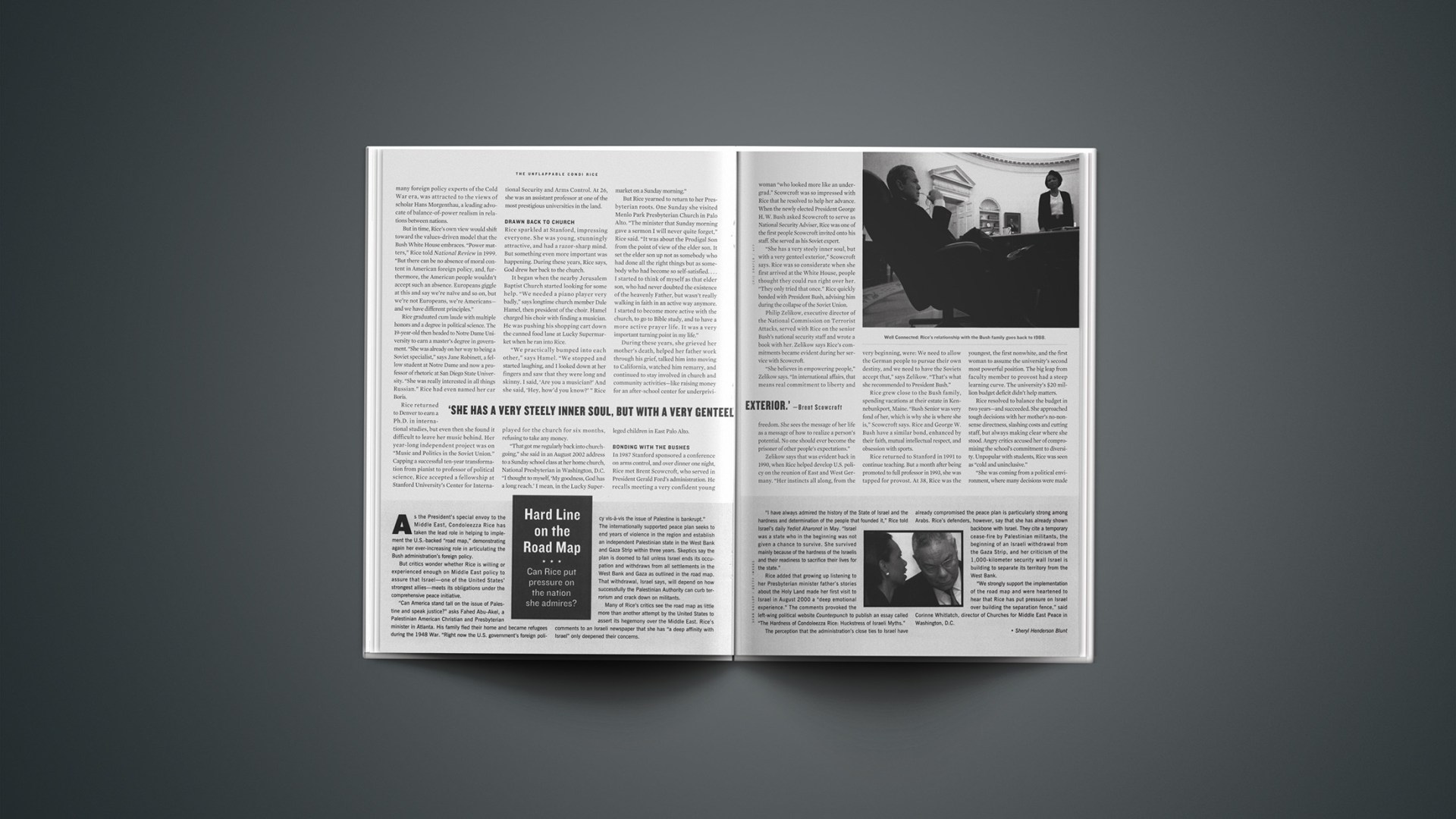

As the President’s special envoy to the Middle East, Condoleezza Rice has taken the lead role in helping to implement the U.S.-backed “road map,” demonstrating again her ever-increasing role in articulating the Bush administration’s foreign policy.
But critics wonder whether Rice is willing or experienced enough on Middle East policy to assure that Israel—one of the United States’ strongest allies—meets its obligations under the comprehensive peace initiative.
“Can America stand tall on the issue of Palestine and speak justice?” asks Fahed Abu-Akel, a Palestinian American Christian and Presbyterian minister in Atlanta. His family fled their home and became refugees during the 1948 War. “Right now the U.S. government’s foreign policy vis-à-vis the issue of Palestine is bankrupt.” The internationally supported peace plan seeks to end years of violence in the region and establish an independent Palestinian state in the West Bank and Gaza Strip within three years. Skeptics say the plan is doomed to fail unless Israel ends its occupation and withdraws from all settlements in the West Bank and Gaza as outlined in the road map. That withdrawal, Israel says, will depend on how successfully the Palestinian Authority can curb terrorism and crack down on militants.
Many of Rice’s critics see the road map as little more than another attempt by the United States to assert its hegemony over the Middle East. Rice’s comments to an Israeli newspaper that she has “a deep affinity with Israel” only deepened their concerns.
“I have always admired the history of the State of Israel and the hardness and determination of the people that founded it,” Rice told Israel’s daily Yediot Aharonot in May. “Israel was a state who in the beginning was not given a chance to survive. She survived mainly because of the hardness of the Israelis and their readiness to sacrifice their lives for the state.”
Rice added that growing up listening to her Presbyterian minister father’s stories about the Holy Land made her first visit to Israel in August 2000 a “deep emotional experience.” The comments provoked the left-wing political website Counterpunch to publish an essay called “The Hardness of Condoleezza Rice: Huckstress of Israeli Myths.”
The perception that the administration’s close ties to Israel have already compromised the peace plan is particularly strong among Arabs. Rice’s defenders, however, say that she has already shown backbone with Israel. They cite a temporary cease-fire by Palestinian militants, the beginning of an Israeli withdrawal from the Gaza Strip, and her criticism of the 1,000-kilometer security wall Israel is building to separate its territory from the West Bank.
“We strongly support the implementation of the road map and were heartened to hear that Rice has put pressure on Israel over building the separation fence,” said Corinne Whitlatch, director of Churches for Middle East Peace in Washington, D.C.
• Sheryl Henderson Blunt
Copyright © 2003 Christianity Today. Click for reprint information.
Related Elsewhere
Also appearing on our site today:
The Unflappable Condi Rice | Why the world’s most powerful woman asks God for help.
‘The Privilege of Struggle’ | How Rice understands suffering and prayer.
Christianity Today sister publication Christian Reader profiled Rice last fall:
Condoleezza Rice’s Secret Weapon | How our National Security Adviser finds the strength to defend the free world. (September/October 2002)
Bios on Condi Rice are available at the Hoover Institute at Stanford University, The White House, and The State Department.
More related coverage includes:
Walking in faith—The Washington Times (August 27, 2002)
Condoleezza Rice: A Talk with the National Security Adviser—NPR (March 1, 2002)
Profile: Condoleezza Rice—BBC (September 25, 2001)
The quiet power of Condi Rice—Newsweek
Previous Christianity Today articles on the conflict in the Holy Land include:
Palestinian Christians, Strangers in a Familiar Land | They’ve called the Holy Land home for centuries, but they’ve never actually governed themselves. (August 8, 2003)
Roadblocks and Voting Blocs | Today’s evangelicals are committed to peace—not just security—for Israel. (August 1, 2003)
‘U.S. Credibility Hangs on Whether It Can Do Justice for the Palestinians’ | A Palestinian Christian and former PCUSA moderator talks about his faith and critiques Bush’s road map to peace in the Middle East. (August 1, 2003)
Opinion Roundup: The Evangelical View of Israel? | Evangelicals are more diverse on the Israeli-Palestinian conflict than we are led to believe. (June 11, 2003)
A Middle Way in the Middle East | A third theological path through the Israeli-Palestinian thicket. (April 11, 2003)
How Evangelicals Became Israel’s Best Friend | In the last 50 years, Israel has needed all the friends it can get, and evangelicals have been loyal and productive supporters. (October 5, 1998)
Activists well acquainted with terror | “Jerusalem Women Speak” tour gains relevance for audience members struggling with new fears. (September 27, 2001)
Palestine’s Christians Persist Despite Pressures | With escalating violence in Israel, ministries face a “sad and scary” situation. (September 19, 2001)
Strengthen Christian Presence In The Holy Land, Carey Pleads | Middle-East leaders asked to help tone down violence that has killed 650 in 10 months. (August 2, 2001)
Violence Puts Archaeologists Between Rocks, Hard Places | About half of the planned excavations in the Holy Land this summer have been canceled. (June 27, 2001)
Greek Orthodox Priest Falls Victim to Middle East Conflict | Monks worry they may appear as threats to each warring side. (June 21, 2001)
Pilgrimages Drop and Workers Lose Jobs as Middle East Violence Continues | Silence fills places normally crowded with pilgrims, reports British group. (April 11, 2001)
Holy Land Roadblocks | Christian pilgrims learn about Palestinians’ everyday indignities. (Apr. 9, 2001)
Christian Zionists Rally for Jewish State | More than 600 Christians from around the world flock to Jerusalem to show solidarity with Israel as peace process collapses. (Apr. 9, 2001)
Between a Rock and a Holy Site | Muslims have stepped up their efforts to take control of places revered by Jews and Christians. (Feb. 13, 2001)
The Peace Regress | What’s behind the current outbreak of hostilities in the Holy Land? (Jan. 11, 2001)
Conflict in the Holy Land | A timeline of trials for the most contested piece of real estate in the world. (Jan. 11, 2001)
Between the Temple Mount and a Hard Place | Palestinian Christians want both peace in their villages and justice for their Muslim brothers. (Dec. 5, 2000)
Christmas Plans for Bethlehem Scrapped | Escalating violence cancels millennial celebration in town of Christ’s birth. (Dec. 1, 2000)
Latin Patriarch tells Israel to Surrender Lands to Palestinians | Catholic leader says Israel will never have peace unless it “converts all of its neighbors to friends.” (Nov. 1, 2000)
Israelis and Palestinians Pay Tribute to Pope’s Pilgrimage to Holy Land | Though some at grassroots remain unappeased, leaders of both groups are full of praise. (March 29, 2000)
West Bank Squeezed by Warring Majorities (Nov. 16, 1998)
Jerusalem as Jesus Views It (Oct. 5, 1998)
Temple Mount on Shaky Ground? | (April 6, 1998)