Nashville's cowboy church has no organ, no bulletin, no altar, and no stained-glass windows. Worshipers wear their Stetson hats indoors, and ushers pass their hats to collect the offering. As country music pours from speakers on the stage, a three-year-old boy sits on his father's lap, kicking his booted feet in time with the melody. Men and women in jeans and sweatshirts sit in pews, listening to Harry Yates preach a simple message on repentance and the forgiveness of God.
The church's worship services at the Texas Troubadour Theater, near Opryland, feature a ten-piece country and western band. Joanne Cash Yates, one of Johnny Cash's five siblings, headlines the musical portion of the service. Harry and Joanne Yates founded the church 12 years ago. Dreaming of a church that appealed both to the unchurched and to musicians, the couple held their first services in a rented bar. From its beginnings of six people, the church now attracts six hundred.
"I've always been a cowboy at heart," says Yates, who grew up on a ranch in west Texas. "I didn't fit in with the three-piece suit and tie bunch—and I met a lot of people who wouldn't go to church for that reason. We created an atmosphere that was appealing to those folks, so they'd listen to the Word of God."
Websites indicate that in recent years at least 100 cowboy churches have sprung up on farms and ranches in 38 other states and in Mexico and Canada. The typical cowboy church attracts people from neighboring towns who are unchurched or have wandered away from ordinary worship services. Members like the come-as-you-are atmosphere and a sense of acceptance that they sometimes have not felt in conventional churches.
These worshipers are not necessarily cowboys, but they enjoy western culture. They want to fit in even if they are wearing coveralls and muddy boots. They want to listen to country and gospel music instead of hymns. They want to hear sermons that relate to their culture—to trail rides, grazing herds, breaking horses, or (for farmers) prayers for rain and good crops. Many of these believers are baptized in horse troughs or ponds.
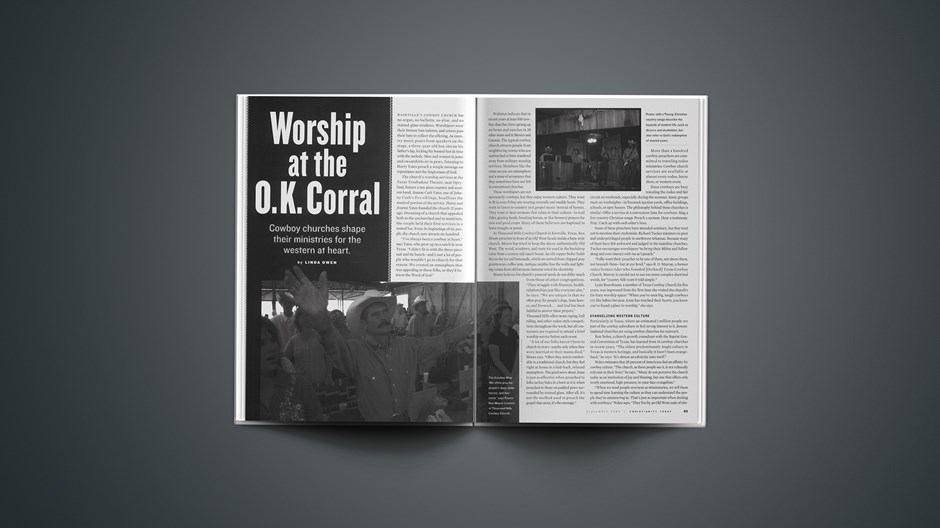
At Thousand Hills Cowboy Church in Kerrville, Texas, Ron Moore preaches in front of an Old West facade inside a barn-style church. Moore has tried to keep the decor authentically Old West. The wood, windows, and rusty tin used in the backdrop came from a century-old ranch house. An old copper boiler holds the ice for tea and lemonade, which are served from chipped gray graniteware coffee pots. Antique saddles line the walls and lighting comes from old kerosene lanterns wired for electricity.
Moore believes his church's pastoral needs do not differ much from those of other congregations. "They struggle with finances, health, relationships just like everyone else," he says. "We are unique in that we often pray for people's dogs, lame horses, and livestock … and God has been faithful to answer these prayers."
Thousand Hills offers team roping, bull riding, and other rodeo-style competitions throughout the week, but all contestants are required to attend a brief worship service before each event.
"A lot of our folks haven't been to church in years—maybe only when they were married or their mama died," Moore says. "Often they aren't comfortable in a traditional church, but they feel right at home in a laid-back, relaxed atmosphere. The good news about Jesus is just as effective when preached to folks on hay bales in a barn as it is when preached to those on padded pews surrounded by stained glass. After all, it's not the method used to preach the gospel that saves; it's the message."
More than a hundred cowboy preachers are committed to traveling rodeo ministries. Cowboy church services are available at almost every rodeo, horse show, or western event.
Since cowboys are busy traveling the rodeo and fair circuit on weekends, especially during the summer, many groups meet on weeknights—in livestock auction yards, office buildings, schools, or opry houses. The philosophy behind these churches is similar: Offer a service at a convenient time for cowboys. Sing a few country Christian songs. Preach a sermon. Hear a testimony. Pray. Catch up with each other's lives.
Some of these preachers have attended seminary, but they tend not to mention their credentials. Richard Tucker ministers to poor and underprivileged people in northwest Arkansas. Because many of them have felt awkward and judged in the mainline churches, Tucker encourages worshipers "to bring their Bibles and follow along and even interact with me as I preach."
"Folks want their preacher to be one of them, not above them, not beneath them—but at eye level," says R. O. Murray, a former rodeo bronco rider who founded [Orchard] Texas Cowboy Church. Murray is careful not to use too many complex doctrinal words, for "country folk want it told simply."
Lynn Rosenbaum, a member of Texas Cowboy Church for five years, was impressed from the first time she visited the church's tin-barn worship space: "When you've seen big, tough cowboys cry like babies because Jesus has touched their hearts, you know you've found a place to worship," she says.
Article continues below
Evangelizing Western Culture
Particularly in Texas, where an estimated 1 million people are part of the cowboy subculture or feel strong interest in it, denominational churches are using cowboy churches for outreach.
Ron Nolen, a church growth consultant with the Baptist General Convention of Texas, has learned from 16 cowboy churches in recent years. "The oldest predominantly Anglo culture in Texas is western heritage, and basically it hasn't been evangelized," he says. "It's almost an ethnicity unto itself."
Nolen estimates that 20 percent of Americans feel an affinity for cowboy culture. "The church, as these people see it, is not culturally relevant to their lives," he says. "Many do not perceive the church today as an institution of joy and blessing, but one that offers only overly emotional, high-pressure, in-your-face evangelism."
"When we send people overseas as missionaries, we tell them to spend time learning the culture so they can understand the people they're ministering to. That's just as important when dealing with cowboys," Nolen says. "They live by an Old West code of simplicity and John Wayne ethics—being kind to women and children, loyal and patriotic citizens, and overall good people. When these people come to these cowboy churches, many of them hear the gospel for the first time. Once they do, they easily adapt to Christian living."
In Tomball, Texas, Shawn O'Hearn holds services in a 16,000-square-foot barn. In the beginning they worshiped every other Sunday morning in an 18-stall horse barn. Today people from around the world visit "the barn of the Lord." They sit on Mexican blankets draped over bales of hay as children run to the front and dance on a dirt floor. With hundreds attending services and watching on television, the church plans to move to an indoor 3,000-seat rodeo arena.
Cross-Country Ministries
On the rodeo circuit, chef Linda Weise and her husband, Ted, feed up to 300 people from a 30-foot mobile kitchen they pull behind their Freightliner truck. "Cowboy churches provide good pastoral care," Ted Weise says. "A cowboy preacher on the road is more of an evangelist than a pastor, but the work that Linda and I do is a little of both. We see the same cowboys and cowgirls and their families throughout the year, so we do counseling, weddings, funerals—and are there to encourage them and provide them spiritual guidance."
Article continues below
In California's Salinas Valley, the two churches in Al and Bonnie Stoeberl's Christian Country Helps Ministries meet monthly. Because the Stoeberls' churches designate their outreach to farmers, ranchers, those who train or show horses, and rodeo professionals, they selected worship sites on the Salinas Rodeo Grounds and the Salinas Valley Fairgrounds.
With Christian Country Music becoming a mushrooming genre in the music industry, cowboy congregations are visited regularly by Christian recording artists, who sing for up to an hour before the sermon. R. O. Murray says attendance in his and other churches fluctuates, but "admittedly the larger attendance is on those Sundays when Christian country recording artists are offering the message in song."
Singer Candice Myers describes the music as traditional country. "The lyrics are about people who work hard to put food on the table, who wear faded jeans, and who have given up beer joints and barroom brawls," she says. "They lift up a godly kind of life—love that is pure, marriages that are successful, and families that are staying together."
Like other C&W, Christian country songs describe the hazards of modern life (divorce, alcoholism, domestic violence), but they also refer to the God who redeems wasted years. "The music must have subtle overtones that the non-Christian listener will embrace before he has the chance to identify it with religion," Myers says.
Myers gives her testimony nationwide at cowboy churches and at rodeos wherever her husband, world champion steer wrestler Rope Myers, competes. Myers says that cowboy churches vary—some are charismatic, some are conservative. "The one thing they all have in common is a heart for the lost," she says. "Cowboy church is about winning souls."
Linda Owen is a freelance writer and former pastor in San Antonio, Texas.
















 While we pray for peace, we need moral clarity about this war.
 We’ve got little information on Jesus’ appearance and personality. But that’s the way God designed it.españolFrançais
 Beyoncé’s right. Whether listening to Cowboy Carter or reading theology, diversity is a good thing.






